
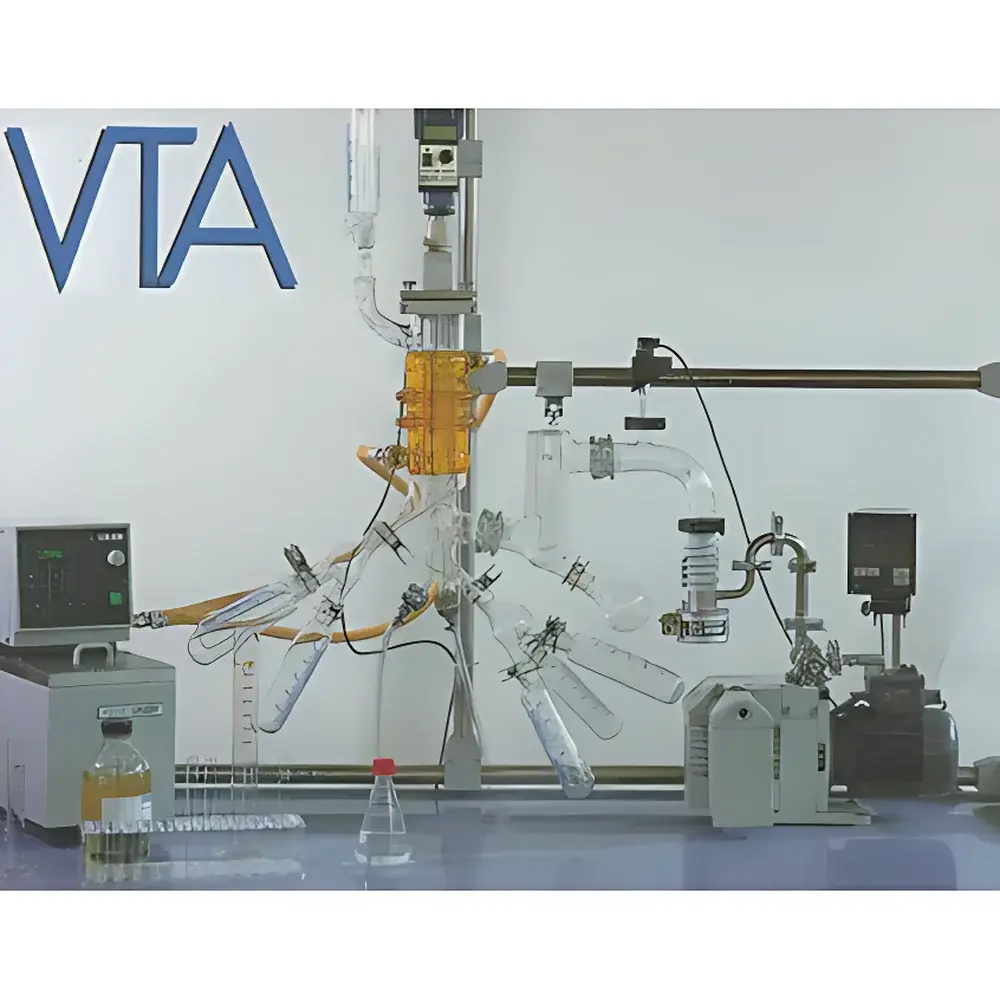
VTA VKL70 Short-Path Molecular Distillation System
| Origin | Germany |
|---|---|
| Manufacturer Type | Authorized Distributor |
| Origin Category | Imported |
| Model | VKL70 |
| Pricing | Upon Request |
Overview
The VTA VKL70 Short-Path Molecular Distillation System is a precision-engineered, bench-scale molecular distillation apparatus designed for high-vacuum, low-temperature separation of thermally labile compounds. Operating on the principle of molecular distillation—where separation occurs under ultra-high vacuum (< 1 × 10⁻³ mbar) and short path lengths to minimize residence time and thermal degradation—the VKL70 enables efficient fractionation of heat-sensitive materials including pharmaceutical actives, natural extracts, polymer precursors, and high-value petrochemical intermediates. Unlike conventional fractional distillation, molecular distillation relies on differences in mean free path rather than relative volatility, making it uniquely suited for substances with high boiling points, low vapor pressure, or pronounced thermal instability. The system integrates a WRS-type self-cleaning roller刮膜 (wiped-film) evaporator with an internal condenser, ensuring uniform film formation, rapid heat transfer, and minimal back-mixing. All major process components—including feed vessel, evaporator body, condenser coil, cold trap, and collection flasks—are constructed from borosilicate glass 3.3 (Duran®), providing exceptional chemical resistance, thermal shock tolerance, and optical clarity for real-time process observation.
Key Features
- Ultra-high vacuum capability: Achieves stable operating pressures down to < 0.001 mbar using a dual-stage vacuum system comprising a rotary vane pump (2.5 m³/h) and an oil diffusion pump
- WRS roller-type wiped-film evaporator: Stainless steel 1.4571 rotor with three PTFE-reinforced glass fiber rollers (25% reinforcement); speed continuously adjustable from 60–500 rpm with digital readout
- Evaporation surface area: 0.05 m²; internal condenser surface area: 0.065 m²; maximum process temperature: 300 °C with ±0.01 °C stability via digital oil bath circulator
- Material compatibility: Evaporator and condenser fabricated from Duran® glass; scraper basket and drive shaft from corrosion-resistant SS 1.4571; sealing elements made of FKM (Viton®) for broad chemical resistance
- Modular, pre-assembled architecture: Fully integrated and factory-tested at VTA’s Deggendorf facility (Germany); disassembled only for safe transport with standardized ISO/KF ground-glass joints (NS 29/32, KS 50)
- Dedicated cooling infrastructure: Integrated liquid nitrogen or dry ice cold trap (2.5 dm² surface area); water-cooled internal condenser; auxiliary cooling ports for external chiller integration
Sample Compatibility & Compliance
The VKL70 accommodates feedstocks with viscosities up to approximately 1,000 mPa·s at processing temperature, supporting applications across fine chemicals, nutraceuticals, and specialty petroleum fractions. Its design conforms to fundamental requirements of Good Laboratory Practice (GLP) and supports traceable operation under regulated environments. While not certified as GMP-compliant out-of-the-box, the system’s construction—using USP Class VI–qualified elastomers (FKM), non-leaching glass surfaces, and documented assembly protocols—facilitates qualification for pharmaceutical development workflows. Vacuum instrumentation includes a digital capacitance manometer covering 0.001–1000 mbar, enabling precise pressure control aligned with ASTM D2892 and ISO 9199 methodologies for vacuum distillation validation. All electrical components meet CE marking requirements per EN 61000-6-3 and EN 61000-6-4 for electromagnetic compatibility.
Software & Data Management
The VKL70 operates as a hardware-integrated platform without proprietary software dependency. Temperature, rotational speed, and vacuum level are monitored and controlled via independent analog/digital interfaces: a PID-controlled oil circulator (25–300 °C), a frequency-inverter-driven motor controller with tachometric feedback, and a calibrated vacuum gauge with RS-232 output option. For laboratories requiring audit-ready records, optional data acquisition modules can log timestamped parameters compliant with FDA 21 CFR Part 11 when paired with validated third-party SCADA or LIMS systems. Process documentation—including calibration certificates for temperature sensors and vacuum transducers—is provided with each unit, supporting IQ/OQ protocol execution.
Applications
- Purification of omega-3 fatty acid concentrates (EPA/DHA) from fish oil hydrolysates
- Deacidification and deodorization of vegetable sterols and squalene
- Isolation of monoglycerides and diglycerides from glycerolysis reactions
- Recovery of catalyst residues and unreacted monomers from polycondensation byproducts
- Separation of light-end hydrocarbons and sulfur-containing compounds in synthetic lubricant base stocks
- Lab-scale feasibility studies for continuous molecular distillation scale-up (e.g., pilot-to-production transition)
FAQ
What is the maximum allowable feed viscosity for stable film formation?
The WRS roller system maintains consistent thin-film dynamics for feeds up to ~1,000 mPa·s at operational temperature. Higher viscosities may require pre-heating or solvent dilution to ensure uniform distribution across the evaporator surface.
Can the system be operated under inert gas blanketing?
Yes—optional gas inlet ports (NW16) are available for nitrogen or argon purging during loading and venting cycles, minimizing oxidative degradation of oxygen-sensitive fractions.
Is remote monitoring supported?
Analog signal outputs (0–10 V or 4–20 mA) are available for vacuum, temperature, and rotation speed; digital RS-232 interface enables integration with programmable logic controllers or custom LabVIEW-based dashboards.
What maintenance intervals are recommended for the vacuum system?
Rotary vane pump oil should be replaced every 500 operating hours; diffusion pump oil requires replacement after 2,000 hours or upon visible discoloration. Cold trap cleaning is advised before each new batch when handling condensable volatiles.
Are custom geometries or material substitutions available?
VTA offers engineering consultation for application-specific adaptations—including Hastelloy C-276 evaporator linings, quartz condenser coils, or modified feed nozzles—subject to technical review and lead-time assessment.
Related Products






