
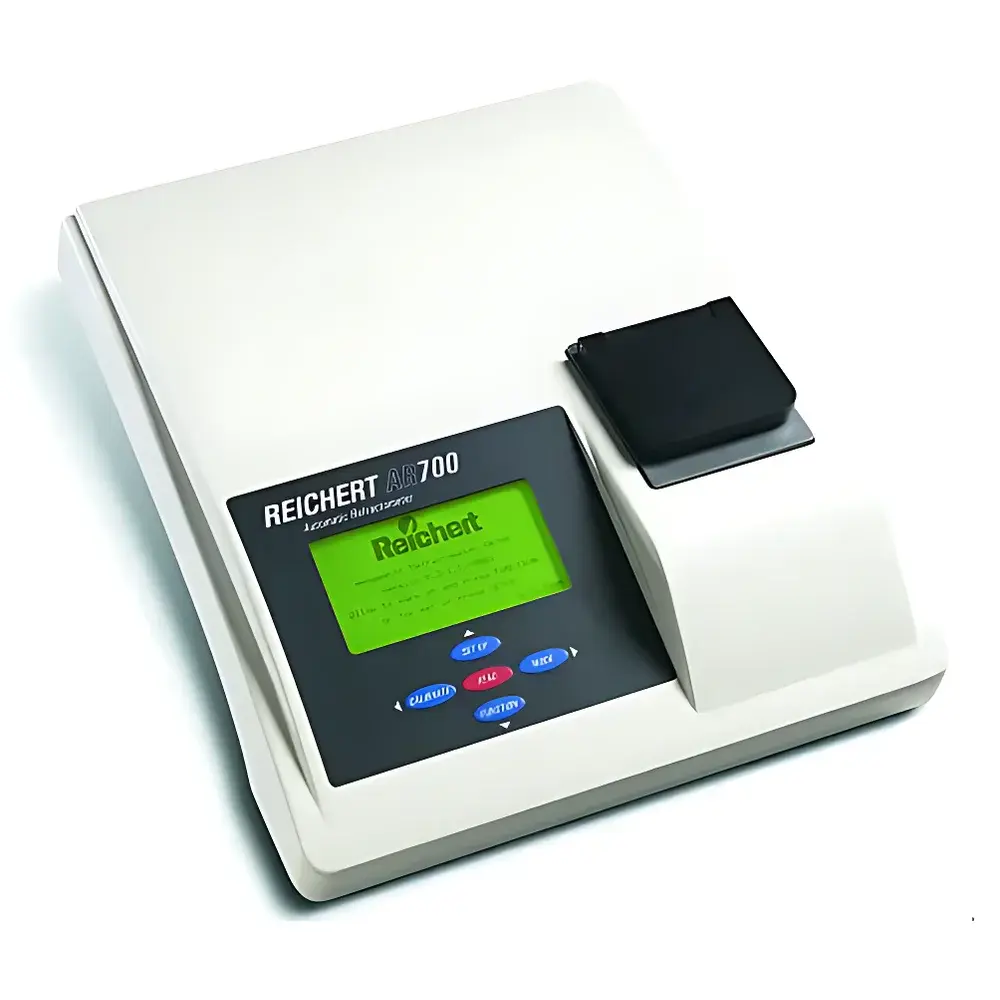
Reichert AR700 Automated Refractometer
| Brand | Reichert |
|---|---|
| Origin | USA |
| Model | AR700 |
| Instrument Type | Benchtop Refractometer |
| Temperature Control | Peltier-based, 10–100 °C |
| Display | LCD (11 × 6 cm) |
| Refractive Index Range | 1.33290–1.60000 RI |
| Refractive Index Resolution | 0.00001 RI |
| Brix Range | 0.00–95.00% |
| Brix Resolution | 0.01% |
| Light Source | High-intensity LED, 589 nm |
| Prism Material | Sapphire |
| Sample Chamber | Sealed Teflon-lined 416 stainless steel cell |
| Temperature Accuracy | ±0.01 °C |
| Calibration Support | NIST-traceable standard oils |
| Data Logging | Built-in calibration history storage (≥14 user programs), password-protected settings, factory reset preservation |
Overview
The Reichert AR700 Automated Refractometer is a high-precision benchtop instrument engineered for reliable, traceable refractive index (RI) and Brix measurements across research laboratories, quality control environments, and regulated manufacturing facilities. It operates on the principle of total internal reflection at the prism–sample interface, where incident light at the sodium D-line wavelength (589 nm) undergoes critical angle shift proportional to the sample’s refractive index. This optical measurement is intrinsically linked to solute concentration, molecular density, and compositional homogeneity—making the AR700 particularly valuable for quantitative analysis in chemistry, food science, pharmaceuticals, and industrial fluids. Unlike manual or analog refractometers, the AR700 integrates real-time Peltier temperature control, sapphire prism optics, and automated equilibrium detection to eliminate operator-dependent variability and external water bath dependencies. Its design conforms to fundamental metrological requirements for ISO/IEC 17025-compliant testing laboratories and supports alignment with USP , ASTM D1218, and AOAC 932.12 methodologies where refractometry serves as a primary or orthogonal assay.
Key Features
- Sapphire prism assembly—mechanically robust, chemically inert, and resistant to abrasion and thermal shock, ensuring long-term optical stability and calibration integrity.
- Integrated Peltier thermoelectric module with active temperature regulation from 10 °C to 100 °C at ±0.01 °C accuracy; eliminates reliance on external water baths and reduces method setup time by >70%.
- Automatic sample equilibrium detection—monitors thermal and optical stabilization before initiating measurement, preventing premature readings and enhancing inter-run reproducibility.
- High-brightness, narrow-band 589 nm LED illumination source with >50,000-hour lifetime—provides consistent spectral output without warm-up drift or filament degradation.
- Sealed sample chamber constructed from 416 stainless steel with Teflon® lining—enables safe handling of aggressive solvents, viscous polymers, and particulate-laden suspensions without cross-contamination or residue buildup.
- Onboard data management with password-protected access, up to 14 customizable measurement protocols, and permanent storage of calibration history—including date/time stamps, standard IDs, and deviation logs.
Sample Compatibility & Compliance
The AR700 accommodates transparent, translucent, and opaque liquid samples—including emulsions, slurries, and highly colored solutions—without requiring dilution or filtration. Its wide RI range (1.33290–1.60000) covers aqueous systems, organic solvents, polymer melts, glycol-based antifreezes, and high-concentration sugar syrups. The instrument supports compliance with multiple regulatory frameworks: its audit-trail-capable calibration logging satisfies FDA 21 CFR Part 11 requirements when used with validated software configurations; its traceable calibration using NIST-certified reference oils aligns with ISO 17025 clause 6.6; and its temperature-controlled measurement protocol meets GLP/GMP expectations for method validation in pharmaceutical excipient testing and clinical serum protein quantification. Routine verification can be performed using certified refractive index standards across the operational range, with documented pass/fail criteria per internal SOPs.
Software & Data Management
The AR700 firmware includes embedded calibration history tracking, user-defined program recall, and factory setting preservation—ensuring method consistency across shifts and operators. All calibration events are timestamped and associated with operator ID (via password entry), standard lot number, and measured deviation from certified value. Data export is supported via RS-232 or USB-to-serial interface for integration into LIMS or ELN platforms. While the base unit does not include PC software, it is compatible with third-party laboratory informatics systems that accept ASCII-formatted serial output. For regulated environments, optional IQ/OQ documentation packages are available from Reichert Technical Services to support installation and operational qualification under GxP guidelines.
Applications
- Chemical & Petrochemical: Monitoring solvent purity, polymerization degree in resins, glycol concentration in heat transfer fluids, freeze point depression in deicing formulations, and hydrocarbon blend ratios in refinery streams.
- Food & Beverage: Quantifying soluble solids (°Brix) in fruit juices, dairy concentrates, and fermentation broths; assessing maturity indices in horticultural produce; verifying additive concentrations (e.g., sweeteners, preservatives) in ready-to-drink beverages.
- Pharmaceutical & Clinical: Determining protein concentration in serum/plasma samples; validating isotonicity of parenteral solutions; detecting adulteration in excipients; supporting stability-indicating assays for liquid dosage forms.
- Industrial Fluids: Measuring coolant concentration in metalworking fluids, brake fluid hygroscopicity, hydraulic oil degradation, and fire suppression foam dilution ratios.
FAQ
Does the AR700 require external water circulation for temperature control?
No—the instrument uses an integrated Peltier thermoelectric module and requires no external chiller, water bath, or plumbing.
Can the AR700 measure turbid or viscous samples?
Yes—it accepts opaque, semi-opaque, and highly viscous liquids due to its high-intensity 589 nm LED and optimized prism-sample coupling geometry.
Is NIST-traceable calibration material included with the instrument?
A set of certified refractive index standards is available as an optional accessory; Reichert provides full traceability documentation upon request.
What is the minimum sample volume required?
Approximately 0.5 mL is sufficient to cover the sapphire prism surface; the sealed chamber minimizes evaporation during extended measurements.
How frequently should calibration verification be performed?
Per ISO/IEC 17025 and internal quality procedures, daily verification with a mid-range standard is recommended prior to sample analysis; full multi-point calibration is advised weekly or after maintenance.




