
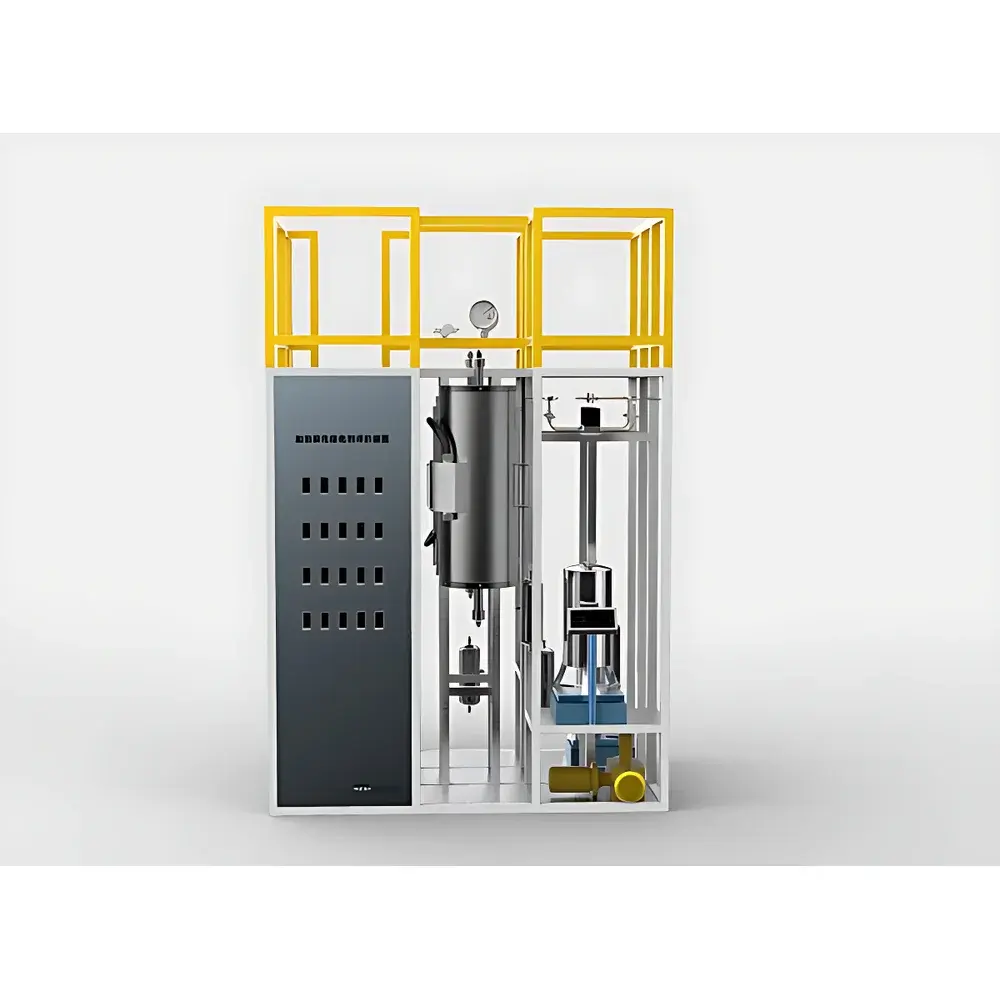
Henven HJQL Hydrocracking Catalyst Evaluation System
| Brand | Henven |
|---|---|
| Origin | Beijing, China |
| Manufacturer | Henven (Producer) |
| Model | HJQL |
| Flow Rate | ~400 L/h |
| Operating Pressure | 5.0 MPa |
| Pressure Drop | ≤0.3 MPa |
| Signal Input/Output | 0–5 V |
| Catalyst Loading Volume | 100 mL |
| Maximum Design Temperature | 500 °C |
| Dimensions | 420 × 800 × 1800 mm (W × D × H) |
Overview
The Henven HJQL Hydrocracking Catalyst Evaluation System is a dual-reactor, high-pressure fixed-bed catalytic testing platform engineered for rigorous laboratory-scale assessment of hydrocracking catalysts under industrially representative conditions. It implements a coupled reaction architecture—comprising an upstream hydrogenation (Reactor A) and downstream cracking (Reactor B) zone—to simulate the sequential physicochemical transformations occurring in commercial hydrocracking units. The system operates on the principle of continuous-flow heterogeneous catalysis, where gaseous feedstocks (e.g., H₂, N₂, H₂S, light hydrocarbons) and liquid feeds (e.g., vacuum gas oil, model compounds) are precisely metered, preheated, mixed, and introduced into temperature- and pressure-controlled catalytic beds. Reaction effluents are cooled, phase-separated, and analyzed offline or interfaced with online GC/TCD/FID systems. Designed to ASTM D6566, ISO 10723, and relevant sections of API RP 941, the HJQL supports kinetic modeling, deactivation studies, and lifetime prediction under isothermal or programmed-temperature operation up to 500 °C and 5.0 MPa.
Key Features
- Dual independent fixed-bed reactors (A: hydrogenation; B: cracking) with individually programmable temperature zones (±1 °C stability) and pressure regulation via back-pressure controllers
- Integrated embedded HMI touchscreen interface running real-time SCADA-grade configuration software for synchronized control of flow, pressure, temperature, and data logging
- Stainless-steel 316L reactor tubes with flanged connections, rated for 5.0 MPa maximum operating pressure and 550 °C short-term exposure
- Precision mass flow controllers (MFCs) for H₂, N₂, and inert gases; calibrated liquid feed pumps supporting viscosities up to 20 cP at flow rates from 0.1 to 400 L/h
- Full-spectrum analog I/O (0–5 V) compatible with third-party DAQ systems and PLC integration for automated shutdown logic per ISA-84/IEC 61511 safety protocols
- Modular design enabling rapid catalyst loading/unloading (100 mL per bed), thermocouple insertion ports, and optional quench sections for transient kinetic analysis
Sample Compatibility & Compliance
The HJQL accommodates solid granular, extrudate, or pelletized catalysts (diameter 1–3 mm; length ≤10 mm) and supports co-feeding of multi-phase streams—including sulfur-containing model compounds (e.g., dibenzothiophene), nitrogen bases (e.g., quinoline), and aromatic-rich fractions. All wetted parts comply with ASME BPVC Section VIII Div. 1 for pressure equipment certification. The system meets GLP documentation requirements per OECD 117 and supports audit-ready electronic records when paired with validated data acquisition software. Pressure relief devices conform to PED 2014/68/EU, and electrical components carry CE marking per EN 61000-6-2/6-4 EMI standards.
Software & Data Management
The embedded controller provides real-time trending of 32+ process variables (e.g., bed temperatures, differential pressures, inlet/outlet flows, loop pressures) with configurable alarm thresholds and event-triggered data snapshots. Historical data exports to CSV or Excel-compatible formats with UTC timestamps and operator ID tagging. Optional software modules support automated test sequencing (e.g., sulfiding ramp, activity mapping, thermal aging cycles) and export of structured datasets compliant with ASTM E2500-17 for model training. Full 21 CFR Part 11 compliance—including electronic signatures, audit trails, and role-based access control—is available through validated third-party SCADA extensions.
Applications
- Activity benchmarking of NiMo/Al₂O₃, CoMo/Al₂O₃, and noble-metal bifunctional catalysts under varying H₂ partial pressures and space velocities
- Stability evaluation via 1000+ hour on-stream tests with periodic sampling for coke deposition (TGA), metal leaching (ICP-MS), and acidity loss (NH₃-TPD)
- Process parameter optimization for feedstock flexibility studies—e.g., blending shale-derived syncrude with conventional VGO
- Development of accelerated deactivation protocols aligned with UOP/Shell industrial correlation methods
- Support for catalyst regeneration cycle validation and post-mortem characterization workflows
FAQ
What catalyst forms are supported in the HJQL reactor beds?
Granular, extruded, or spherical catalysts with particle sizes between 1–3 mm and aspect ratios ≤5 are compatible. Custom reactor liners accommodate non-standard geometries upon request.
Can the system be integrated with online gas chromatography?
Yes—the effluent stream includes standardized 1/4″ Swagelok fittings and pressure-regulated sample loops compatible with Agilent, Shimadzu, and Thermo Fisher GC autosamplers.
Is remote monitoring supported?
The embedded controller features Ethernet TCP/IP connectivity and Modbus RTU/ASCII support for integration into existing lab-wide supervisory networks.
What safety certifications does the HJQL hold?
It carries CE marking for electromagnetic compatibility and mechanical safety, complies with PED 2014/68/EU for pressure equipment, and incorporates dual redundant pressure relief paths per ISO 4126-1.
Does Henven provide method development support?
Yes—application engineers offer protocol development assistance, including test matrix design, calibration traceability documentation, and reporting templates aligned with ASTM and ISO reporting conventions.
Related Products



