
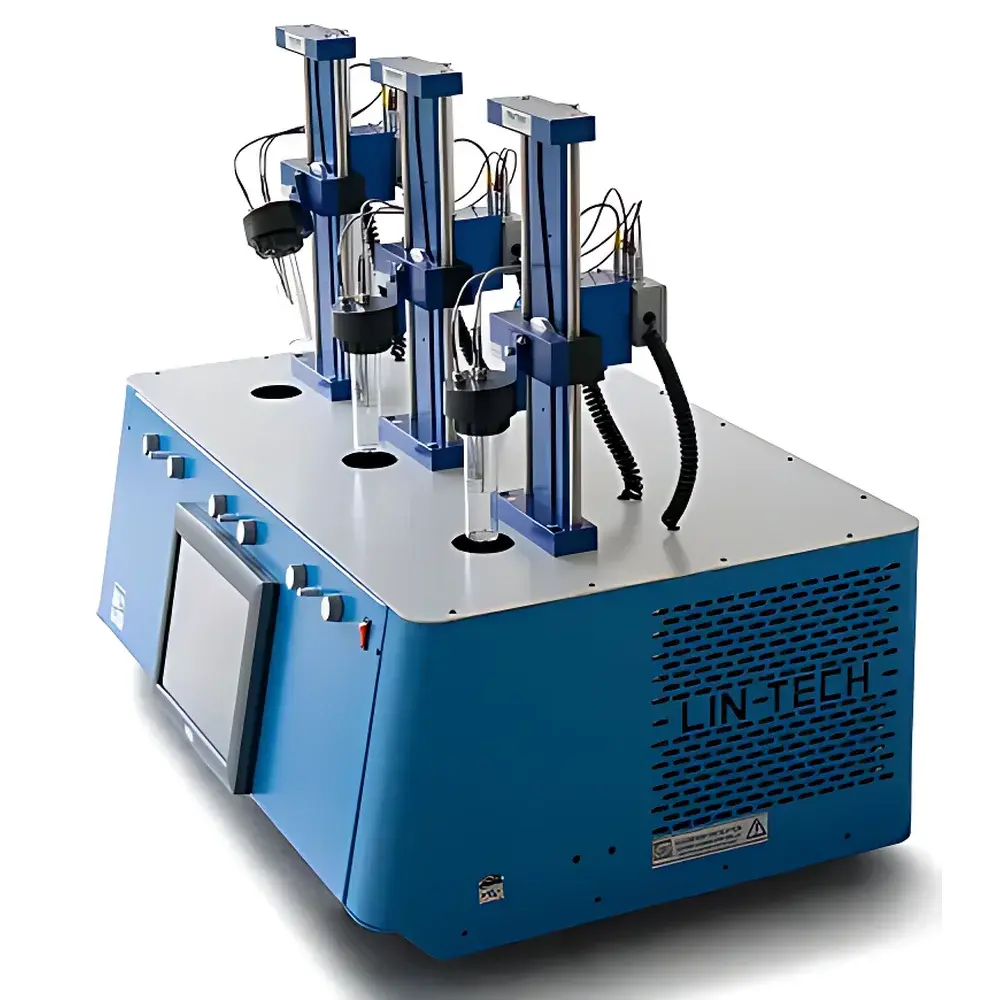
Linetroic NewLab 300/2 Automatic Cloud and Pour Point Tester (Model 200 CFPP)
| Brand | Linetroic |
|---|---|
| Origin | Switzerland |
| Model | 200 CFPP |
| Compliance | ASTM D97, D5950, D5853 |
| Temperature Range | +80 °C to –90 °C |
| Temperature Resolution | 0.06 °C |
| Temperature Accuracy | ±0.1 °C |
| Cooling System | Single-stage or dual-stage compressor (–40 °C or –85 °C base cooling) |
| Sensor Type | PT100 Class A platinum resistance thermometers |
| Sample Capacity | Standardized test jar per ASTM/IP/ISO specifications |
Overview
The Linetroic NewLab 300/2 Automatic Cloud and Pour Point Tester (Model 200 CFPP) is a fully automated, benchtop instrument engineered for precise determination of cloud point (CP), cold filter plugging point (CFPP), and pour point (PP) in petroleum-based liquids and biofuels. It operates on standardized thermodynamic principles defined in ASTM D2500 (cloud point), ASTM D6371 (CFPP), and ASTM D97 (pour point), employing controlled stepwise cooling combined with real-time optical and thermal detection of phase transition behavior. The system integrates a high-stability dual-stage refrigeration unit, precision PT100 Class A temperature sensing, and programmable mechanical actuation to automate sample tube manipulation—eliminating operator-dependent variability while ensuring strict adherence to regulatory testing protocols used in refinery QC, fuel specification verification, and international trade compliance.
Key Features
- Automated multi-point cloud, CFPP, and pour point analysis in a single run—no manual intervention required after sample loading.
- Dual-stage compressor cooling system capable of reaching –85 °C, enabling reliable measurement of low-temperature performance for arctic-grade diesel, aviation turbine fuels (Jet A-1), and biodiesel blends (B5–B100).
- Two independent PT100 Class A sensors: one immersed at the bottom of the test jar for bulk temperature monitoring, another positioned at the liquid surface for detecting wax crystal formation onset (cloud point) and flow cessation (pour point).
- Programmable mechanical arm that lifts and tilts the sample tube at user-defined temperature intervals (e.g., every 1 °C or 3 °C), replicating the manual tilt-and-observe procedure per ASTM D97 with sub-second repeatability.
- Refrigeration safety architecture includes dual pressure controllers (for single- and dual-stage configurations), thermal cut-off valves for jacketed cooling zones, and internal compressor overload protection—fully compliant with IEC 61010-1 electrical safety requirements.
- Optimized test jar design: silver-plated base with anti-scratch polymer film, calibrated volume marking, and precision-fit glass tube clamping mechanism ensuring consistent thermal contact and mechanical alignment across thousands of cycles.
Sample Compatibility & Compliance
The Model 200 CFPP accepts a broad spectrum of hydrocarbon-based samples including crude oil fractions, distillate fuels (diesel, kerosene), residual fuels (FO, HFO), lubricating oils, engine oils, biofuels (FAME, HVO), and fuel additives. All test procedures conform to globally recognized standards: ASTM D97 (pour point), ASTM D2500/D5773 (cloud point), ASTM D6371 (CFPP), ISO 3016, ISO 3015, IP 15, IP 441, and EN 116. Instrument validation documentation supports GLP and GMP environments; audit trails, electronic signatures, and data integrity controls align with FDA 21 CFR Part 11 requirements when integrated with optional LIMS-compatible software modules.
Software & Data Management
The embedded control interface provides intuitive method setup, real-time temperature profiling, and automatic endpoint detection based on thermal hysteresis and probe response kinetics. Test reports include raw temperature vs. time curves, annotated transition points, pass/fail flags against specification limits (e.g., EN 590), and exportable CSV/PDF files. Optional PC-based software enables remote monitoring, multi-instrument fleet management, statistical process control (SPC) charting, and integration with enterprise quality systems via OPC UA or RESTful API. All data entries are timestamped, user-attributed, and stored with immutable audit logs—meeting traceability requirements for ISO/IEC 17025 accredited laboratories.
Applications
This instrument serves critical roles across upstream, midstream, and downstream petroleum operations: verifying cold-weather operability of diesel formulations prior to seasonal distribution; validating compliance of marine fuels with IMO 2020 sulfur and low-temperature specifications; supporting R&D of low-carbon fuel alternatives under ASTM D7467 and EN 15940; and enabling rapid QC screening in refinery blending units. It is routinely deployed in third-party certification labs serving API, SAE, and CEN standardization bodies, as well as national metrology institutes conducting interlaboratory comparison studies.
FAQ
What standards does the Model 200 CFPP support for cold filter plugging point (CFPP) testing?
ASTM D6371, ISO 3015, and EN 116 are natively supported through pre-configured test methods with validated cooling ramp profiles and filtration timing logic.
Can the instrument measure both cloud point and pour point in one sequence?
Yes—the system executes sequential CP → CFPP → PP determinations using a single sample aliquot, minimizing material consumption and cross-contamination risk.
Is external calibration required for temperature sensors?
PT100 Class A probes are factory-calibrated and traceable to NIST standards; optional annual recalibration services include certificate issuance with uncertainty budgets.
How is sample viscosity managed during low-temperature testing?
The mechanical tilt mechanism is torque-compensated to accommodate increasing resistance from wax network formation—ensuring consistent angular displacement regardless of apparent viscosity up to 100,000 cSt.
Does the system support unattended overnight operation?
Yes—full automation, thermal fault logging, and emergency shutdown protocols enable safe 24/7 batch processing with up to 12 samples per carousel configuration.







