
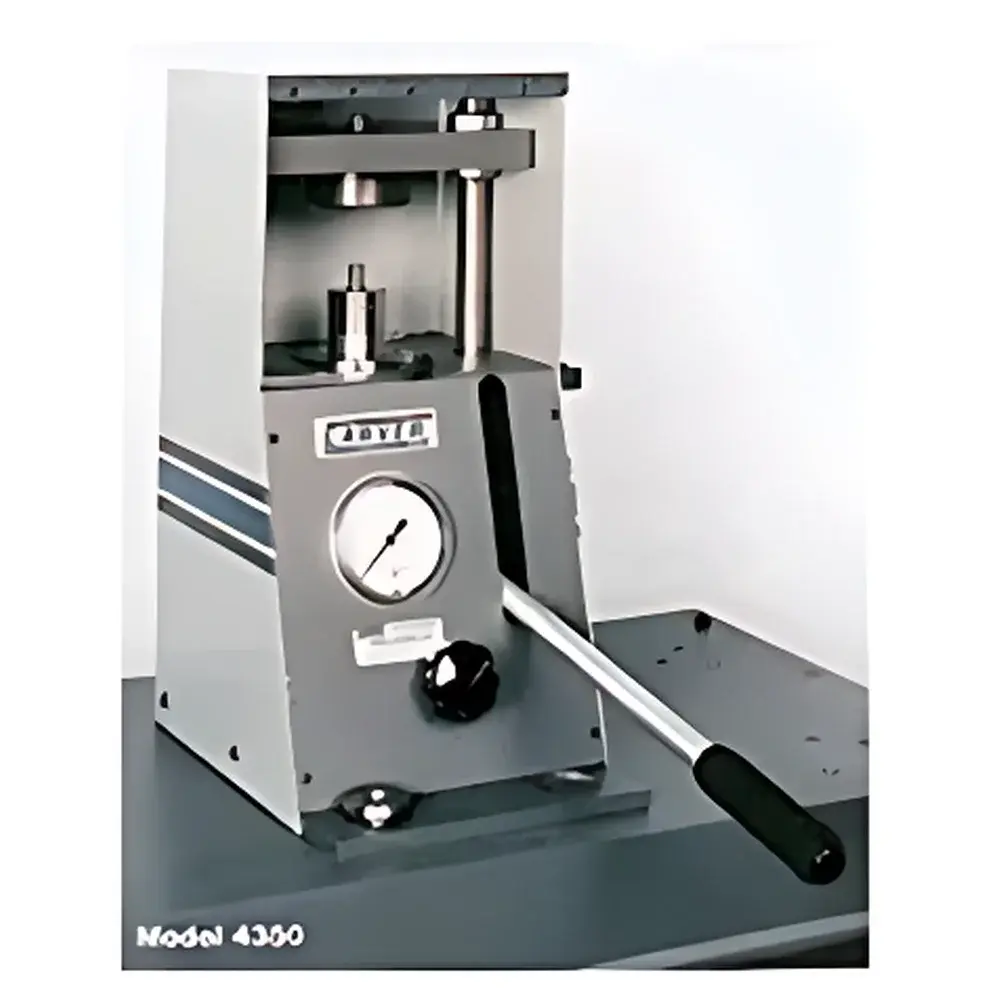
English Product Name
| Origin | USA |
|---|---|
| Supplier Type | Authorized Distributor |
| Import Status | Imported |
| Model | 4350 |
| Pricing | Upon Request |
Overview
The Specac 4350 Manual Hydraulic Pellet Press is a precision-engineered, compact laboratory press designed specifically for reproducible sample preparation in Fourier Transform Infrared (FTIR) spectroscopy and X-ray Fluorescence (XRF) analysis. Operating on a robust manual hydraulic principle, the instrument delivers a maximum compressive force of 12 tons (107 kN) with mechanical force amplification via a dual-stage lever system. Its core function centers on cold-pressing powdered or granular specimens—typically mixed with KBr, CsI, or cellulose matrices—into optically transparent, dimensionally stable pellets (e.g., 13 mm diameter KBr discs) suitable for quantitative spectral transmission measurements. The press features a fixed 4-inch (102 mm) diameter hardened steel platen, integrated safety shielding compliant with ANSI/ISO 13857 guarding principles, and a calibrated pressure feedback mechanism enabling repeatable load application without electronic control. Its low-profile, glove-box-compatible footprint (W × D × H: 25 × 30 × 42 cm) supports inert-atmosphere sample handling—critical for moisture-sensitive or air-reactive materials such as hygroscopic salts or battery cathode precursors.
Key Features
- Manual hydraulic actuation with dual-lever mechanical advantage ensures consistent 12-ton (107 kN) compressive force without external power supply or pneumatic infrastructure.
- Integrated safety guard with polycarbonate viewing window and interlocked ram travel limiter conforms to ISO 13857 Category 2 requirements for operator protection during compression cycles.
- Removable 13 mm die set includes upper and lower punches, vacuum port adapter (1/4″ NPT), and alignment sleeve—designed for ASTM E1252-compliant KBr pellet fabrication.
- Inverted counter-bore anvil plate enables precise registration with standard positive-thread dies, minimizing lateral shear and ensuring uniform pellet thickness (±0.02 mm reproducibility across 50 consecutive presses).
- Modular base plate accepts optional heated or cooled test columns (e.g., 2.25″ I.D. stainless steel cylinders), supporting auxiliary applications including compressive strength testing, coal briquette formation, plant tissue consolidation, and liquid expression studies.
- Compact dimensions (25 × 30 × 42 cm) and 52 kg mass permit benchtop deployment inside nitrogen-purged glove boxes or fume hoods—eliminating ambient humidity interference during IR-transparent pellet formation.
Sample Compatibility & Compliance
The 4350 press accommodates diverse sample morphologies: fine powders (e.g., pharmaceutical APIs, geological sediments), agglomerated granules (catalyst supports), brittle solids (ceramic oxides), and organic tissues (lyophilized plant matter). It complies with key analytical standards governing solid-sample presentation, including ASTM E1252 (FTIR pellet preparation), ISO 20059 (XRF pressed-pellet methodology), and USP (spectroscopic sample integrity). All wetted components—including die sets, punches, and buffer plates—are constructed from 316 stainless steel or hardened tool steel (HRC 60–62), ensuring corrosion resistance against halide-rich matrices (e.g., KBr, NaCl) and compatibility with GLP/GMP documentation workflows. Vacuum-assisted die evacuation (via optional Specac 3874 diaphragm pump) reduces trapped air voids, improving pellet homogeneity per ISO 18504 recommendations for quantitative XRF calibration.
Software & Data Management
As a manually operated instrument, the 4350 does not incorporate embedded microprocessors or digital control interfaces. However, its mechanical design supports full traceability under regulated environments: each compression cycle is documented via laboratory notebook entries referencing lot numbers of consumables (e.g., KBr powder batch, die set ID), applied force duration (measured with stopwatch), and environmental conditions (temperature/humidity logged separately). Optional accessories—including the Specac “PD” series programmable controllers (for automated variants)—integrate with LIMS systems via RS-232 or USB-to-serial adapters, enabling audit-trail generation compliant with FDA 21 CFR Part 11 requirements for electronic records. Raw pressure data from compatible digital load cells (e.g., Omega LCM Series) may be exported in CSV format for statistical process control (SPC) analysis using JMP or Minitab.
Applications
- Preparation of 13 mm FTIR transmission pellets from KBr/sample mixtures (typical ratio 100:1 w/w) for polymer identification, pharmaceutical polymorph screening, and forensic fiber analysis.
- Production of homogeneous XRF calibration standards via high-pressure compaction of certified reference materials (CRMs) such as NIST SRM 278, with density stabilization verified by helium pycnometry.
- Coal petrology sample consolidation: pressing pulverized bituminous coal into 31 mm discs for reflectance microscopy per ASTM D2798.
- Compressive strength evaluation of geotechnical soils and construction aggregates using standardized cylindrical molds (2.25″ I.D.) per ASTM D698/D1557.
- Extraction of aqueous extracts from botanical matrices via controlled liquid expression at ≤12 tons, followed by filtration through Specac 2090.1 membrane discs.
- Validation of tablet formulation mechanical integrity prior to dissolution testing—using 13 mm punches to simulate industrial tablet press dwell times and ejection forces.
FAQ
What is the maximum achievable pellet density using the 4350 press with KBr?
Typical densities range from 1.95–2.05 g/cm³ for 13 mm KBr pellets compressed at 12 tons for 60 seconds—within the optimal window for >85% IR transmittance at 4000–400 cm⁻¹.
Can the 4350 be used inside an argon-filled glove box?
Yes. Its fully mechanical operation, absence of electrical components, and compact footprint (25 × 30 cm base) enable seamless integration into Class 1000 inert-atmosphere enclosures.
Is vacuum evacuation mandatory for IR pellet preparation?
Vacuum assistance (≤25 inHg) is recommended to minimize scattering artifacts from entrapped air; however, acceptable spectra can be obtained without vacuum for non-hygroscopic, low-surface-area samples.
What maintenance is required for long-term accuracy?
Annual recalibration of hydraulic seal integrity and platen parallelism (±0.01 mm tolerance) per ISO 7500-1, plus biannual replacement of O-rings in die assemblies exposed to aggressive solvents.
Are replacement dies traceable to NIST standards?
Specac provides dimensional certification (±0.005 mm on diameter/thickness) for all stainless-steel dies, with optional NIST-traceable calibration reports available upon request.



