
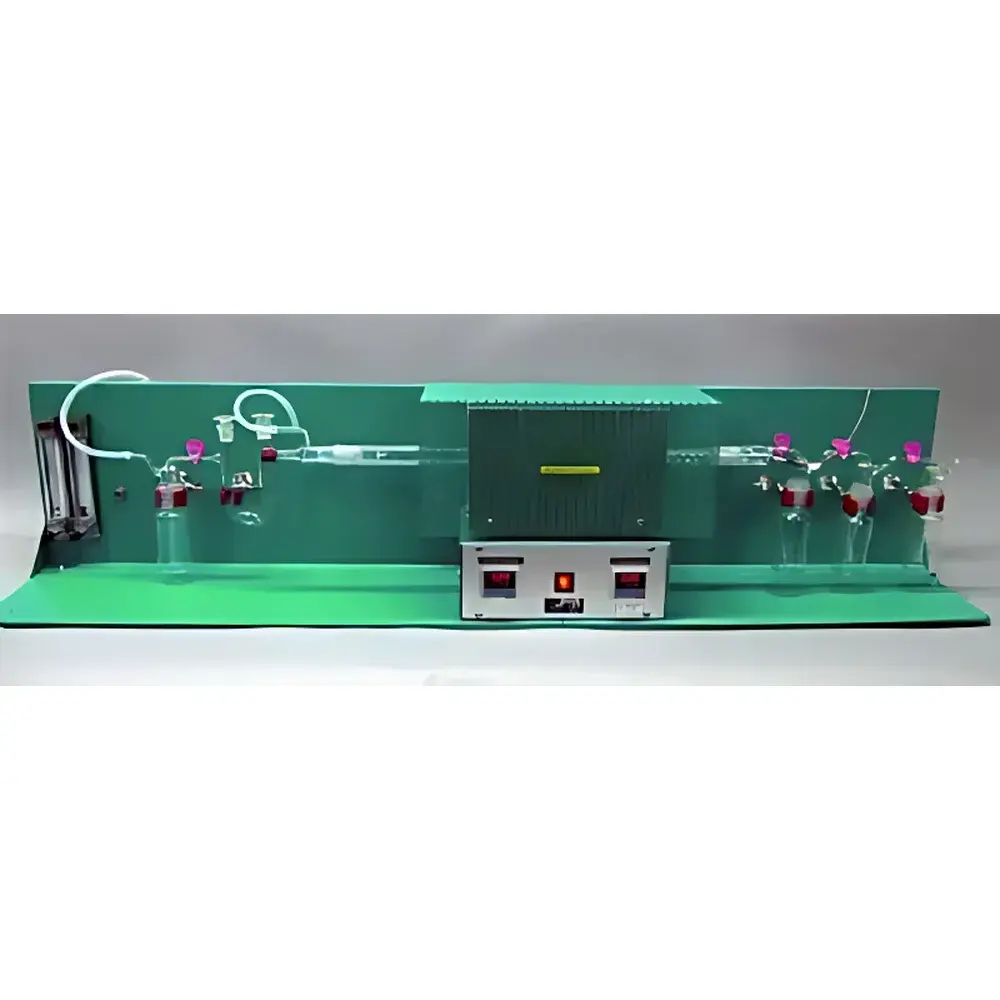
ES14 Carbon Black Content Analyzer
| Origin | Imported |
|---|---|
| Manufacturer Type | Authorized Distributor |
| Origin Category | Imported |
| Model | ES14 |
| Price | Upon Request |
| Temperature Range | 100–950 °C |
| Temperature Accuracy | ±10 °C |
| Thermocouple Type | Type K (max. 1200 °C), Type N (max. 1300 °C) |
| Furnace Tube Material | Fused quartz (Ø25 × 500 mm ID) |
| Reaction Vessel Material | Borosilicate glass |
| Furnace Housing & Structural Plate | Stainless steel (AISI 304) |
| Air Flow Control Range | 0.1–2.0 L/min (adjustable via needle valve and rotameter, calibrated 60–600 cm³/min) |
| Over-Temperature Protection | Independent dual-stage cutoff controller |
| Power Supply | 230 V AC, 50 Hz, 500 W |
| Net Weight | 22 kg |
| External Dimensions (W×D×H) | 1350 × 275 × 355 mm |
Overview
The ES14 Carbon Black Content Analyzer is a precision-controlled, benchtop high-temperature combustion system engineered for quantitative determination of carbon black content in polymer matrices—primarily thermoplastics (e.g., polyethylene, polypropylene) and elastomers (e.g., SBR, EPDM, NR). It operates on the principle of controlled pyrolysis under regulated oxidative atmosphere: a weighed sample is placed in a quartz boat and introduced into a horizontal fused-quartz tube furnace, where it undergoes complete thermal decomposition at elevated temperatures (100–950 °C) in a precisely metered airflow. Volatile organic components are oxidized and swept away as gaseous CO2 and H2O, while the residual inorganic fraction—including carbon black, ash, and filler residues—remains as a stable, non-volatile char. The mass difference before and after combustion, corrected for moisture and ash contribution (where applicable), yields the carbon black mass fraction per ASTM D1603, ISO 1408, and GB/T 13021.
Key Features
- Horizontal tube furnace architecture with fused-quartz reaction tube (Ø25 × 500 mm ID), resistant to thermal shock and chemical corrosion from halogenated byproducts
- Dual thermocouple input (Type K and Type N) with independent over-temperature protection circuitry—ensuring compliance with IEC 61000-4-2 and functional safety requirements for Class II laboratory equipment
- Integrated air flow control system featuring a calibrated rotameter (60–600 cm³/min) and fine-adjustment needle valve, enabling reproducible gas velocity across the sample zone per ISO 1408 Annex A
- Stainless steel (AISI 304) furnace housing and support structure, combined with borosilicate glass condensate traps and drying tubes, minimizing contamination and ensuring long-term calibration stability
- Microprocessor-based temperature controller with PID algorithm, maintaining setpoint accuracy within ±10 °C over full operating range (100–950 °C)
- Comprehensive safety suite: solid-state relay (SSR) power switching, redundant thermal cutoff, and fail-safe airflow interlock preventing uncontrolled heating under low-flow conditions
Sample Compatibility & Compliance
The ES14 supports standardized analysis of carbon black in polyolefin compounds (PE, PP), styrenic polymers, and rubber formulations per internationally recognized test methods. Its design aligns with the geometric and procedural constraints defined in ASTM D1603 (for plastics), ISO 1408 (for rubber), ISO 247 (ash determination in rubber), and GB/T 13021 (Chinese national standard for polyethylene pipe materials). The instrument meets mechanical and electrical safety requirements per EN 61010-1:2010 for laboratory equipment. When operated with documented SOPs and calibrated reference materials, data generated satisfies GLP audit criteria and supports 21 CFR Part 11-compliant reporting when integrated with validated LIMS or ELN platforms.
Software & Data Management
The ES14 is a standalone hardware platform without embedded firmware or proprietary software. All operational parameters—including target temperature, ramp rate, dwell time, and airflow setpoint—are configured manually via front-panel controls. Mass measurements are performed externally using analytical balances meeting ISO/IEC 17025 traceability requirements (e.g., METTLER TOLEDO XP series, Sartorius Entris). Final carbon black content (%) is calculated per ASTM D1603 Equation 1: CCB = [(m1 − m2) / m0] × 100, where m0 = initial sample mass, m1 = residue mass post-combustion, and m2 = ash mass determined separately (if required). Laboratories may integrate calculation workflows into Excel templates or validated statistical software (e.g., JMP, Minitab) compliant with ALCOA+ data integrity principles.
Applications
- Quality control of carbon-black-loaded polyethylene pipes and geomembranes per ASTM D3350 and ISO 4427
- Batch release testing of automotive rubber compounds (tires, seals, hoses) per OEM specifications (e.g., Ford WSS-M99P1111-A, GMW15635)
- R&D screening of conductive polymer composites for ESD/EMI shielding applications
- Regulatory submission support for medical-grade polyolefins requiring elemental composition verification (ISO 10993-12)
- Third-party certification testing accredited to ISO/IEC 17025 (e.g., UL, TÜV, SGS)
FAQ
Does the ES14 include an integrated balance or data logging capability?
No. The ES14 is a dedicated combustion furnace system. Gravimetric measurements must be performed using an external analytical balance with ≥0.1 mg readability and certified calibration traceable to NIST or equivalent NMIs.
Can the furnace accommodate larger samples or alternative crucibles?
The standard configuration accepts five 25 mL quartz boats (included). Custom quartz or ceramic boats up to 30 mL volume may be used, provided they fit within the 25 mm inner diameter and do not obstruct airflow uniformity.
What maintenance intervals are recommended for long-term accuracy?
Quartz tube inspection every 200 cycles; thermocouple verification annually or per 500 operating hours; rotameter recalibration biannually using certified flow standards per ISO 6789.
Is nitrogen purge functionality available?
No. The ES14 is designed exclusively for air-assisted oxidative pyrolysis per ASTM/ISO protocols. Inert-atmosphere operation requires retrofitting with gas manifold and mass flow controllers—not supported out-of-the-box.
How is compliance with ISO/IEC 17025 demonstrated during method validation?
Validation requires documented evidence of system suitability (temperature uniformity mapping, airflow linearity, repeatability ≤1.5% RSD across n=10 replicates), reference material testing (e.g., NIST SRM 2841), and uncertainty budgeting per EURACHEM/CITAC Guide CG4.






