
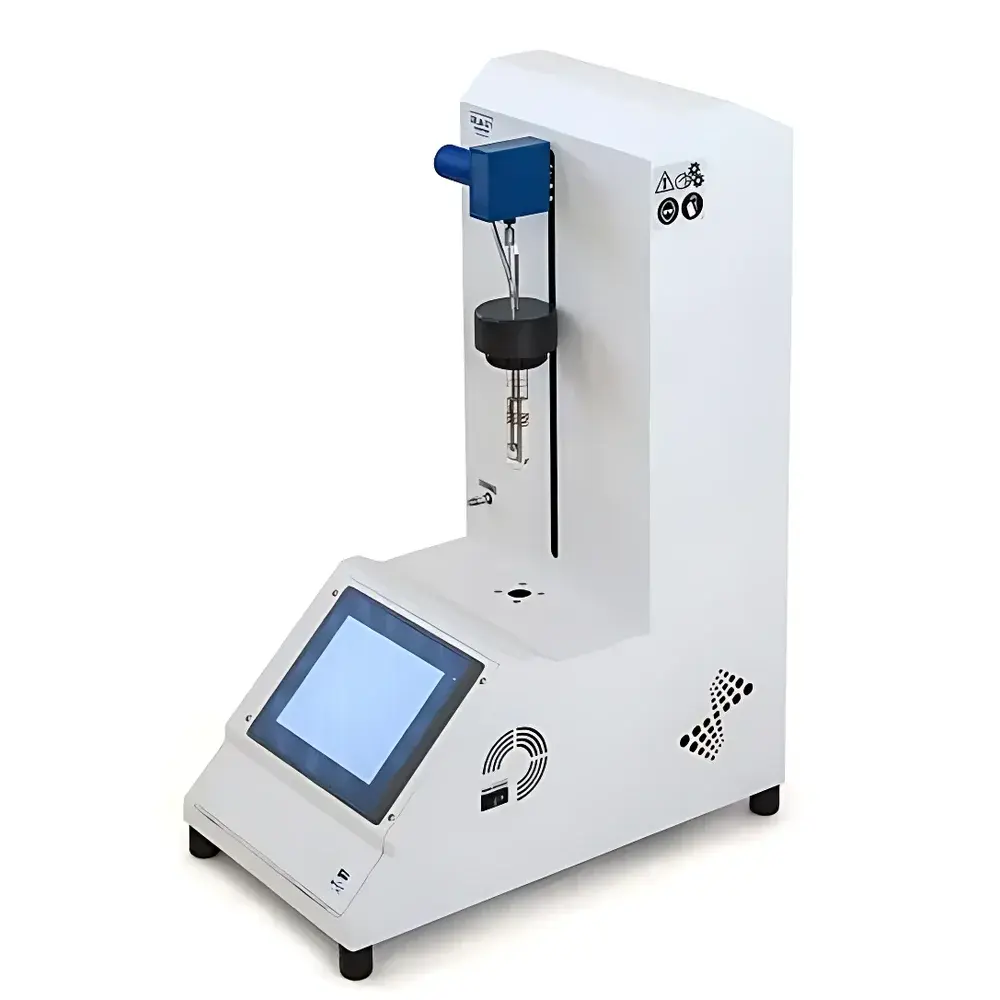
Linetrionic OILLAB 611 Automatic Aniline Point Tester
| Brand | Linetrionic |
|---|---|
| Origin | Switzerland |
| Model | OILLAB 611 |
| Measurement Range | –15 °C to +160 °C |
| Temperature Resolution | 0.01 °C |
| Temperature Accuracy | ±0.1 °C |
| Temperature Sensor | PT100 Class A |
| Detection Principle | Dual-channel photometric phase transition detection |
| Sample Compatibility | Transparent, turbid, and opaque (including black) hydrocarbon samples |
| Cooling System | Hybrid air-cooling (fan) + Peltier-based liquid cooling |
| Heating System | Immersion-type electronic heater with PID control |
| Stirring | Motor-driven magnetic stirrer with programmable speed profile |
| Display | 8-inch TFT/LCD touchscreen (1024 × 768, 16M color) |
| Onboard Storage | 49 GB SSD |
| Interfaces | 2 × USB 2.0 |
| Compliance | ASTM D611 (Methods A, B, E), IP 2 (Methods A, B, E), ISO 2977, GB/T 262–2010 |
Overview
The Linetrionic OILLAB 611 Automatic Aniline Point Tester is a fully integrated, benchtop analytical instrument engineered for precise, reproducible determination of the aniline point and mixed aniline point of petroleum products and hydrocarbon solvents. Based on the fundamental thermodynamic principle that aniline and hydrocarbons form a homogeneous liquid phase above a characteristic upper critical solution temperature (UCST), the OILLAB 611 employs dual-channel photometric detection to identify the exact temperature at which phase separation—manifested as cloud point formation—occurs upon controlled cooling. This measurement serves as a critical indicator of aromatic content, solvent power, and refining severity in base oils, diesel fuels, jet fuels, and industrial solvents. Designed and manufactured in Switzerland, the system implements a rigorous, standards-aligned methodology compliant with ASTM D611 (Methods A, B, and E), IP 2 (A, B, E), ISO 2977, and GB/T 262–2010. Its architecture integrates closed-loop thermal control, optical phase transition sensing, and embedded computing to eliminate operator subjectivity and manual endpoint interpretation.
Key Features
- Photometric dual-sensor detection system optimized for high-contrast discrimination of phase boundaries—capable of unambiguous endpoint identification in transparent, hazy, and fully opaque (e.g., dark refinery streams or spent solvents) samples.
- High-stability temperature control architecture featuring a Class A PT100 platinum resistance thermometer immersed directly in the sample-aniline mixture, coupled with PID-regulated electronic immersion heating and hybrid active cooling (fan-assisted convection + semiconductor Peltier module).
- U-shaped vacuum-jacketed sample cell with quick-release mounting and chemically inert, easily cleanable borosilicate glass construction—minimizing carryover and enabling rapid turnaround between analyses.
- Motor-driven magnetic stirring with adjustable torque and speed profiles ensures uniform mixing without introducing mechanical vibration or bubble nucleation artifacts.
- Integrated 8-inch TFT/LCD touchscreen interface with 1024 × 768 resolution and 16-million-color display—hosting a dedicated firmware environment supporting method setup, real-time curve visualization, result logging, and audit-ready reporting.
- Onboard 49 GB solid-state storage enables local retention of raw thermal curves, metadata (operator ID, sample ID, date/time stamp), and calibration history—fully traceable per GLP/GMP data integrity expectations.
Sample Compatibility & Compliance
The OILLAB 611 accommodates a broad spectrum of hydrocarbon-based matrices—including naphthas, kerosenes, gas oils, lubricating base stocks, biodiesel blends, and technical-grade solvents—regardless of color or optical density. Its dual photodetector configuration compensates for variable light transmission characteristics, eliminating reliance on visual assessment or sample dilution. Regulatory compliance extends beyond method adherence: the instrument’s firmware supports user access levels, electronic signature capability, and immutable audit trails—aligning with FDA 21 CFR Part 11 requirements for electronic records in regulated laboratories. Calibration verification routines, documented temperature uniformity mapping, and sensor drift monitoring are embedded in routine operation protocols to satisfy ISO/IEC 17025 accreditation criteria.
Software & Data Management
The embedded operating system provides intuitive method configuration—including ramp rate selection, hold times, stirring parameters, and endpoint sensitivity thresholds. All measurements generate time-stamped thermal profiles (.CSV exportable) with interpolated aniline point values reported to 0.01 °C resolution. USB 2.0 ports support direct connection to label printers, external storage, or network gateways for LIMS integration. Data export formats include ASCII-delimited tables compatible with statistical process control (SPC) platforms and laboratory information management systems (LIMS). Firmware updates are delivered via secure authenticated channels, preserving configuration integrity and version-controlled validation documentation.
Applications
- Quality control of crude assay fractions and distillate cuts in refineries.
- Assessment of aromatic saturation efficiency during hydrotreating and hydrofinishing operations.
- Specification testing of aviation turbine fuels (Jet A/A-1) per ASTM D1655 Annex A3.
- Formulation support for specialty solvent blends used in coatings, adhesives, and cleaning agents.
- Research into structure-property relationships between hydrocarbon composition and solvency behavior.
- Regulatory submission testing for product registration under REACH and EPA fuel specifications.
FAQ
Does the OILLAB 611 require external chillers or cryogenic fluids?
No—the integrated Peltier-based liquid cooling module and forced-air heat dissipation eliminate dependency on external refrigeration units or dry ice.
Can the system be validated for GMP environments?
Yes—its electronic signature support, audit trail generation, role-based access control, and calibration traceability meet core elements of FDA 21 CFR Part 11 and EU Annex 11 requirements.
What maintenance is required for long-term accuracy?
Annual verification of PT100 sensor calibration against NIST-traceable references and periodic optical path cleaning using certified lens-grade solvents are recommended; no consumables beyond standard lab-grade aniline are required.
Is mixed aniline point measurement supported out-of-the-box?
Yes—predefined methods for ASTM D611 Method E and IP 2 Method E are included, enabling automated sequential addition, mixing, and cooling cycles for multi-component aniline blends.
How is sample carryover prevented between runs?
The U-tube cell design permits full drainage, and the system includes an optional post-run purge cycle using inert gas or solvent vapor—configurable within the method editor.




