
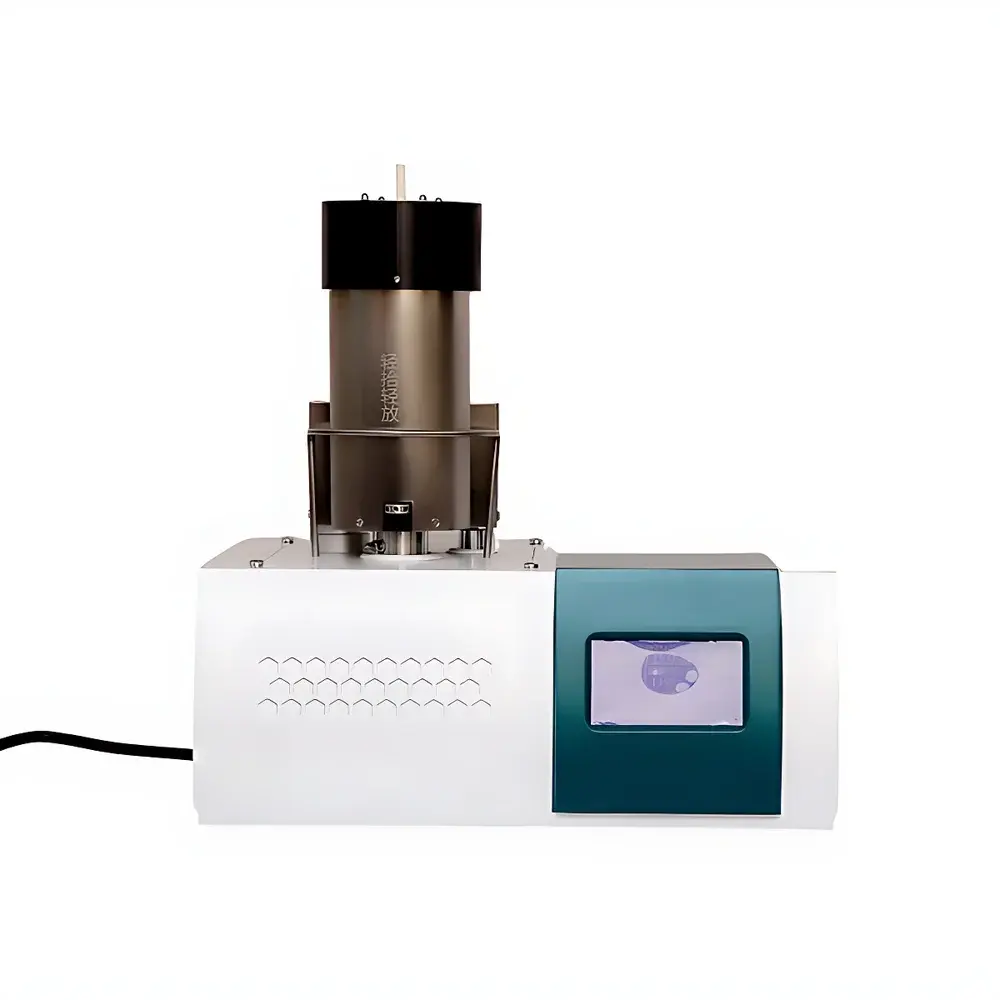
Henven HCR-3 Differential Thermal Analyzer
| Brand | Henven |
|---|---|
| Origin | Beijing, China |
| Manufacturer Type | Direct Manufacturer |
| Instrument Type | DTA (Differential Thermal Analysis) |
| Model | HCR-3 |
| Sample Capacity | Single-sample |
| Temperature Range | Ambient to 1450 °C |
| Temperature Accuracy | ±0.1 °C |
| Temperature Precision | ±0.1 °C |
| Temperature Stability (Drift) | ≤0.1 °C |
| Heating/Cooling Rate | 0.1–100 K/min (user-definable) |
| DTA Signal Range | ±10 µV to ±2000 µV (auto-ranging) |
| DTA Resolution | 0.01 µV |
| DTA Noise Level | <0.01 µV |
| DSC Measurement Range | ±1 mW to ±500 mW |
| DSC Sensitivity | ±0.1 µW |
| Atmosphere Control | Dual-channel MFC-controlled gas system (N₂, Ar, O₂, air |
| Vacuum Option | 2.5×10⁻² Pa (with optional vacuum unit) |
| Isothermal Hold Duration | Up to 72 h at any temperature within range |
| Standard Crucibles | Al₂O₃ (0.06 mL or 0.12 mL) |
| Optional Crucibles | Aluminum, graphite, quartz, platinum |
| Software Features | Oxidation Induction Time (OIT) analysis, crystallization kinetics modeling, step-cooling curve generation, peak integration, enthalpy calculation, activation energy determination (multiple model algorithms), Tg identification, specific heat comparison method, real-time screenshot capture, auto-scale signal acquisition, calibration support (In, Sn, Pb standards) |
Overview
The Henven HCR-3 Differential Thermal Analyzer (DTA) is an engineered benchtop thermal analysis system designed for precise detection and quantification of endothermic and exothermic transitions in solid and powdered materials under controlled atmospheric and thermal conditions. Operating on the fundamental principle of differential thermometry—measuring the temperature difference (ΔT) between a sample and an inert reference material as both are subjected to identical programmed thermal profiles—the HCR-3 delivers high-fidelity thermal event resolution across a wide operational range. Its core architecture integrates furnace control, dual thermocouple measurement (furnace and sample), and low-noise analog signal conditioning into a single robust platform, minimizing thermal lag and electrical interference. The instrument supports both classical DTA mode and quantitative DSC-like data interpretation through calibrated signal conversion, enabling direct correlation of peak area with enthalpy change when referenced against certified standards (e.g., In, Sn, Pb). With a maximum operating temperature of 1450 °C and programmable heating/cooling rates from 0.1 to 100 K/min, the HCR-3 serves laboratories requiring reproducible characterization of phase transformations, decomposition kinetics, oxidation stability, and glass transition behavior in metallurgical, ceramic, polymer, pharmaceutical, and geochemical applications.
Key Features
- High-stability dual thermocouple system: One Type-K thermocouple continuously monitors furnace temperature (active or idle); a second independently measures actual sample temperature during operation—ensuring traceable thermal gradient assessment.
- Auto-ranging microvolt-level DTA signal acquisition: Full-scale range from ±10 µV to ±2000 µV with 0.01 µV resolution and noise floor <0.01 µV, optimized for detecting subtle thermal events such as solid-state reactions or weak polymorphic transitions.
- Programmable isothermal capability: Sustained temperature holds up to 72 hours at any point within the 25–1450 °C range, critical for oxidation induction time (OIT) testing per ASTM D3895 and ISO 11357-6.
- Integrated dual-gas atmosphere control: Mass flow controllers (MFCs) regulate two independent gas streams with high repeatability (<±0.5% FS) and fast response (<1 s), supporting automated switching during multi-step protocols—customizable for aggressive environments (e.g., H₂S, Cl₂, HF).
- Modular vacuum compatibility: Optional vacuum pump integration achieves base pressure ≤2.5×10⁻² Pa, enabling high-temperature studies under inert or reduced-pressure conditions to suppress volatilization artifacts.
- Comprehensive software toolkit: Includes built-in OIT analysis, Avrami-based crystallization modeling, step-cooling curve simulation, multi-algorithm activation energy calculation (Ozawa, Kissinger, Friedman), comparative specific heat estimation, and GLP-compliant audit trail logging.
Sample Compatibility & Compliance
The HCR-3 accommodates standard and specialty crucibles—including alumina (0.06 mL / 0.12 mL), aluminum, graphite, quartz, and platinum—to ensure chemical compatibility across diverse sample matrices (oxides, alloys, organics, composites). Its mechanical and thermal design conforms to general safety requirements for Class II laboratory thermal instruments (IEC 61010-1). While not pre-certified to ISO/IEC 17025, the system supports full method validation workflows: users may perform temperature calibration using NIST-traceable metal standards (In, Sn, Pb), energy calibration via certified reference materials, and linearity verification across the full DTA signal range. Data output complies with ASTM E1269, ISO 11357-1, and USP guidelines for thermal analysis reporting. Audit trails, electronic signatures, and raw-data immutability features align with FDA 21 CFR Part 11 readiness when deployed with validated software configurations.
Software & Data Management
The proprietary HCR-3 Control & Analysis Suite runs on Windows OS and provides real-time visualization of furnace temperature, sample ΔT, gas flow status, and signal amplitude. All acquisitions are timestamped and stored in vendor-neutral ASCII formats (.csv, .txt) alongside metadata-rich binary archives (.hcr). The software enables post-run processing including baseline correction, peak deconvolution, kinetic parameter extraction (Eₐ, A, n), and comparative overlay of multiple curves. Users may define custom calculation modules—e.g., modified Ozawa-Flynn-Wall equations or isoconversional methods—and export results directly to Excel or MATLAB-compatible structures. Raw signal capture includes automatic gain adjustment and user-triggered screenshots synchronized to thermal events, facilitating troubleshooting and regulatory documentation. Optional 21 CFR Part 11 add-ons provide role-based access control, electronic signature enforcement, and immutable audit logs meeting GLP/GMP documentation standards.
Applications
- Determination of melting points, eutectic temperatures, and latent heats of fusion/crystallization in polymers and pharmaceuticals.
- Quantitative assessment of thermal stability and oxidation induction periods (OIT) in polyolefins and lubricants per ASTM D3895.
- Characterization of phase transformations (e.g., martensitic, peritectic) and decomposition pathways in ceramics and refractory metals.
- Analysis of glass transition (Tg), cold crystallization, and devitrification kinetics in amorphous oxides and chalcogenide glasses.
- Corrosion product formation studies under reactive atmospheres (e.g., sulfidation, carburization) using custom crucible/gas combinations.
- Support for hyphenated techniques: Integration-ready interface for coupling with GC/MS or FTIR via heated transfer lines (optional 200 °C恒温带 and GC/MS adapter kit).
FAQ
What is the difference between DTA and DSC modes on the HCR-3?
The HCR-3 operates natively in DTA mode (measuring ΔT vs. T), but its calibrated signal path and software algorithms allow conversion to quasi-DSC data (heat flow vs. T) using reference standards—enabling enthalpy quantification without requiring a dedicated power-compensated DSC cell.
Can the HCR-3 perform dynamic cooling experiments?
Yes—programmable cooling rates from 0.1 to 100 K/min are fully supported, including non-linear ramps and multi-segment cooling profiles with intermediate isothermal holds.
Is remote operation or network connectivity supported?
The system includes Ethernet and USB interfaces; remote monitoring and basic control are possible via TCP/IP protocol, though full instrument control requires local host PC operation per current firmware revision.
How is temperature calibration verified?
Users perform routine calibration using high-purity indium (156.6 °C), tin (231.9 °C), and lead (327.5 °C) standards; the software guides multi-point verification and generates calibration reports with uncertainty estimates.
Are there service and maintenance contracts available outside China?
Henven partners with authorized regional distributors in EU, North America, and Southeast Asia who provide technical support, spare parts logistics, and annual preventive maintenance programs compliant with ISO 9001 service frameworks.



