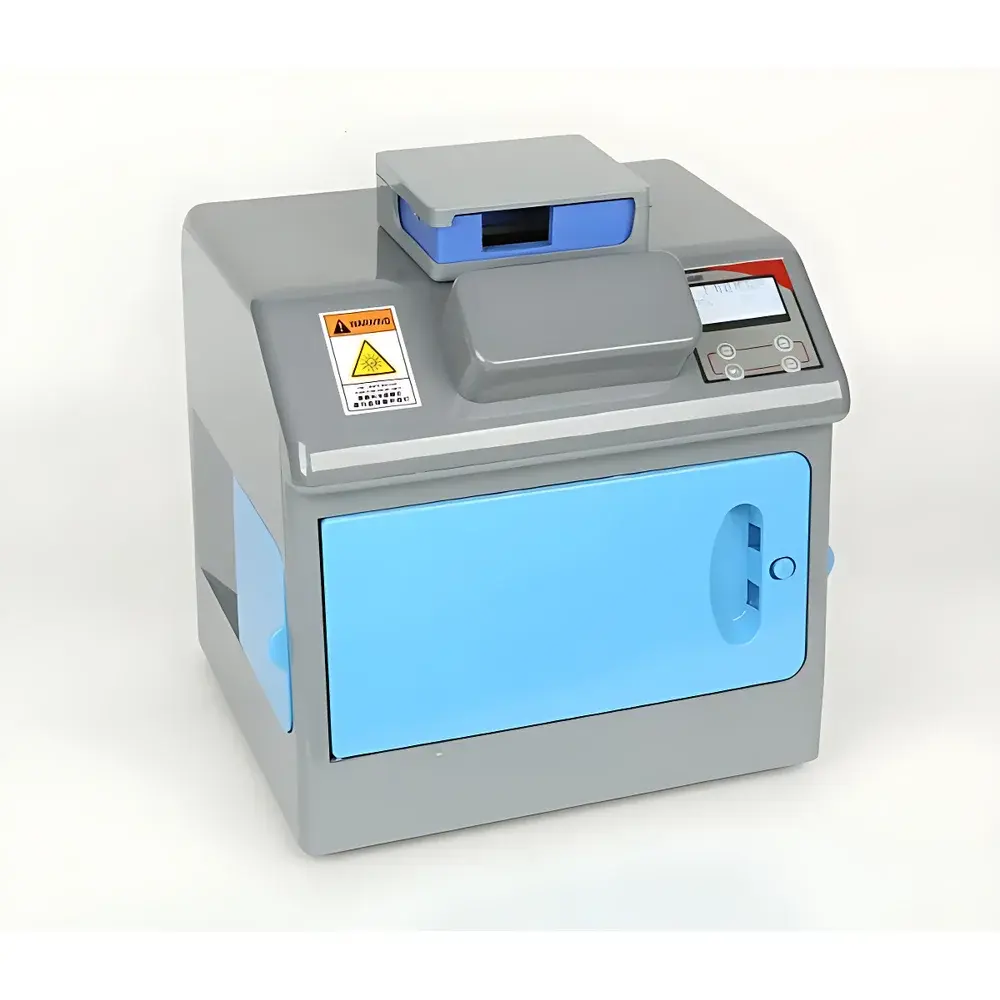
Jiapeng ZF-7N Smart Darkroom Triple-Mode UV Transilluminator
| Brand | Jiapeng |
|---|---|
| Origin | Shanghai, China |
| Model | ZF-7N |
| Instrument Type | Darkroom-style |
| Wavelength Modes | Dual UV (254 nm & 365 nm) + Visible Light |
| UV Emission | 254 nm (reflective), 365 nm (reflective) |
| Filter Type | Transparent short-wave cutoff filter |
| UV Lamp Quantity | 2 × 8 W |
| UV Filter Dimensions | 200 × 50 mm |
| UV Transillumination Area | 200 × 50 mm |
| Visible Light Lamp | 4 W (1 unit) |
| Input Power | AC 220 V, 50/60 Hz |
| Internal Chamber Dimensions | 280 × 245 × 220 mm |
| External Dimensions | 280 × 330 × 330 mm |
| Weight | 2.65 kg |
| Compliance | JJF 1936–2021 (National Verification Regulation for UV Analyzers) |
Overview
The Jiapeng ZF-7N Smart Darkroom Triple-Mode UV Transilluminator is an integrated benchtop instrument engineered for safe, precise, and reproducible fluorescence visualization of nucleic acids, proteins, and other UV-excitable biomolecules during electrophoretic analysis. It operates on the principle of ultraviolet-induced fluorescence: when DNA or RNA stained with ethidium bromide (EtBr), SYBR Safe, or similar intercalating dyes is exposed to 254 nm or 365 nm UV radiation, it emits visible orange-red light (typically ~590 nm), enabling real-time detection and documentation. The ZF-7N uniquely combines reflective UV illumination at two standard wavelengths—254 nm (optimal for high-sensitivity detection of nucleic acids) and 365 nm (lower-energy, reduced photodamage for downstream cloning or sequencing applications)—with a dedicated visible-light mode (4 W white LED) for Coomassie- or silver-stained protein gels. Its fully enclosed darkroom architecture eliminates ambient light interference while incorporating certified UV shielding, ensuring operator safety per IEC 62471 and national occupational exposure limits.
Key Features
- Triple-mode illumination system: independently switchable 254 nm (high-resolution DNA banding), 365 nm (low-photobleaching imaging), and visible-light (protein gel visualization) outputs.
- Optimized optical path design featuring 200 × 50 mm UV-transmissive filter plate with certified short-wave cutoff performance, blocking >99% of incident UV below 320 nm at the observation window.
- Adjustable dual-lamp UV source: two 8 W low-pressure mercury lamps mounted on pivoting arms allow dynamic repositioning to uniformly illuminate irregularly shaped gels or maximize intensity at specific regions.
- Intuitive human-machine interface: large-backlit LCD display with Chinese-language menu navigation; microcontroller-based timing and mode selection support programmable exposure sequences for consistent documentation.
- Robust darkroom construction: injection-molded, high-impact ABS housing with seamless enclosure, side-access ports for gloved manipulation, and ergonomic viewing window with certified UV-blocking acrylic (OD ≥ 4.0 at 254 nm).
- Calibrated UV output: verified irradiance of 20 µW/cm² at 20 cm distance under 254 nm operation, compliant with JJF 1936–2021 metrological requirements for analytical transilluminators.
Sample Compatibility & Compliance
The ZF-7N accommodates standard electrophoresis formats including agarose gels (0.5–3.0% w/v), polyacrylamide gels (8–20% T), and pre-cast mini-gels (e.g., Bio-Rad Mini-PROTEAN, Thermo Fisher Novex). It supports common fluorescent dyes such as ethidium bromide, GelRed, SYBR Gold, SYBR Green I, and UV-active stains like dansyl chloride or anthranilic acid derivatives. All UV components conform to JJF 1936–2021 verification standards, and the instrument’s mechanical and electrical design aligns with GB/T 14710 (Environmental Adaptability of Medical Electrical Equipment) and IEC 61010-1 (Safety Requirements for Laboratory Equipment). While not FDA 21 CFR Part 11–certified out-of-the-box, its stable hardware platform supports integration into GLP/GMP environments when paired with validated imaging software and audit-trail-enabled documentation workflows.
Software & Data Management
The ZF-7N operates as a standalone hardware platform without embedded firmware-based image capture. However, its standardized chamber dimensions (280 × 245 × 220 mm internal volume) and fixed focal geometry enable seamless integration with third-party imaging systems—including USB-connected CCD cameras (e.g., Canon EOS M-series, Basler acA series) mounted in optional camera frames (model ZF-CAM1, sold separately). Users may employ open-source tools (ImageJ/Fiji) or commercial packages (Bio-Rad Quantity One, AzureSpot) for densitometric analysis, molecular weight estimation, and multi-gel comparative quantification. The instrument’s manual exposure control and stable lamp output ensure high inter-run repeatability, critical for longitudinal QC tracking in academic and industrial labs.
Applications
- Visualization and excision of DNA fragments from agarose and PAGE gels for cloning, sequencing library preparation, and restriction mapping.
- Qualitative assessment of PCR amplification efficiency, plasmid integrity, and RNA degradation status.
- Fluorescence-based detection of proteins labeled with UV-active tags or post-electrophoretic staining reagents.
- Forensic sample screening (e.g., latent biological trace detection using UV-excitable dyes).
- Archaeological pigment analysis and document authentication via UV-induced luminescence signatures.
- Quality control in dye synthesis and polymer characterization where aromatic fluorophores are present.
FAQ
Is the ZF-7N suitable for use with SYBR Safe and other non-toxic alternatives to ethidium bromide?
Yes—the 365 nm mode delivers optimal excitation for SYBR Safe, GelGreen, and similar green-fluorescent dyes, minimizing DNA damage while maintaining high signal-to-noise ratios.
Can the UV lamps be replaced by the user, and what is their typical service life?
Lamps are field-replaceable using standard G6T5 base sockets; expected lifetime exceeds 1,000 hours under intermittent lab use (typical duty cycle ≤ 30 min/day).
Does the instrument include timer functionality for controlled exposure?
Yes—microprocessor-controlled digital timer supports exposure durations from 1 second to 99 minutes, programmable per wavelength mode.
What safety certifications apply to the viewing window and enclosure?
The observation port uses UV-absorbing acrylic meeting ISO 13485-compliant optical attenuation specifications (OD ≥ 4.0 at 254 nm), verified per JJF 1936–2021 Annex C.
Is the ZF-7N compatible with automated gel documentation systems?
Yes—its consistent internal geometry, uniform illumination field, and absence of moving optics make it ideal for integration with robotic gel scanners and AI-assisted band detection platforms.