R&P HST100 Thermal Stability Analyzer for Explosives and Nitrocellulose
| Brand | R&P |
|---|---|
| Origin | Germany |
| Manufacturer Status | Authorized Distributor |
| Origin Category | Imported |
| Model | HST100 |
| Price Range | USD 27,000 – 68,000 |
| Heating Method | Electrically Heated Aluminum Block |
| Sample Capacity | 21 Positions |
| Sample Tube Dimensions | Ø30 ±0.3 mm × 230 ±2 mm (Cylindrical, Round-Bottom, Glass Stopper) |
| Temperature Range | Ambient to 110 °C |
| Temperature Control Accuracy | ±0.1 °C |
| Temperature Sensor | PT100 Probe |
| Over-Temperature Safety Cut-off | 120 °C |
| Controller | Dedicated PID Temperature Program Controller |
| Power Supply | 230 V / 50 Hz, 2400 VA |
| Illumination System | Specialized Fluorescent Lamp (Non-Glare, Optimized for NO₂ Vapor Detection) |
| Viewing Assembly | Rigid Adjustable Lamp Mount with UV-Enhanced Visible Spectrum Output |
| Display | Dual Digital Readout (Setpoint & Actual Temperature) |
| Sample Holder Depth | 170 mm |
| Sample Holder Diameter | 31 mm |
Overview
The R&P HST100 Thermal Stability Analyzer is a purpose-built instrument engineered for quantitative assessment of thermal decomposition behavior in energetic materials—particularly nitrocellulose and other nitro-compounds—under standardized accelerated aging conditions. It implements the classical 100 °C thermal storage test method (aligned with NATO AOP-30, STANAG 4147, and ISO 8099:2017 Annex B), wherein a precisely weighed sample is sealed in a calibrated glass tube and subjected to controlled isothermal heating. The evolution of nitrogen dioxide (NO₂) gas—generated via thermally induced nitro-group cleavage—is quantified volumetrically using optical detection under optimized illumination. This measurement directly correlates with material shelf-life predictability, batch consistency, and compliance readiness for munitions qualification, propellant surveillance, and regulatory submissions under UN Test Series 3 and EU Directive 2014/28/EU.
Key Features
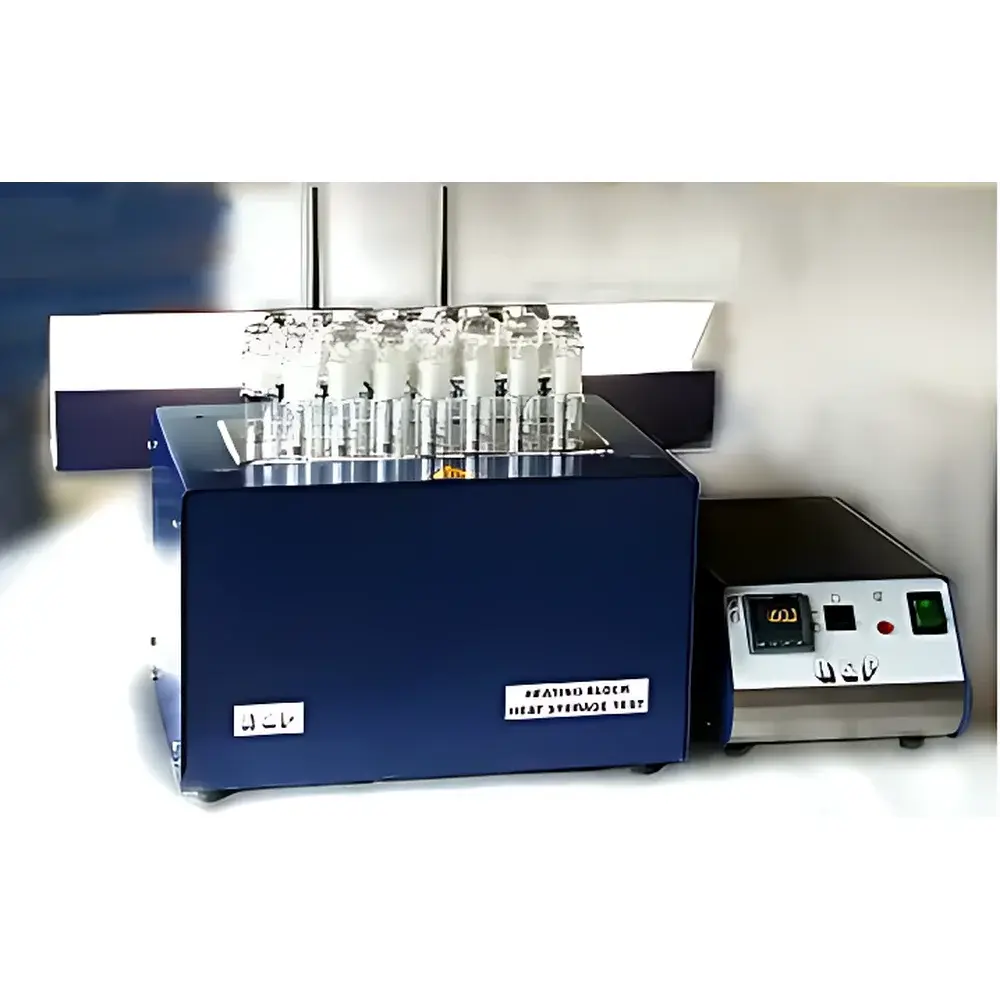
- Robust aluminum heating block with uniform thermal distribution across 21 independent sample wells (Ø31 mm × 170 mm depth), ensuring minimal inter-position temperature deviation (<±0.05 °C).
- PID-controlled temperature regulation with dual digital display (setpoint and real-time PT100 feedback), enabling stable operation within ±0.1 °C over the full range (ambient to 110 °C).
- Integrated safety architecture featuring hardware-limited over-temperature cut-off at 120 °C, independent of controller logic—meeting IEC 61010-1 Class II requirements for laboratory electrical equipment.
- Dedicated optical detection module comprising a low-intensity, UV-enhanced fluorescent lamp with non-glare spectral output (peak emission ~365 nm), specifically tuned to maximize NO₂ vapor contrast without inducing photolytic side reactions.
- Modular lamp mount with micrometer-adjustable positioning ensures reproducible light path geometry and eliminates parallax error during visual endpoint determination.
- Comprehensive sample handling system: includes 21 precision-matched glass tubes (Ø30 ±0.3 mm × 230 ±2 mm, round-bottom, ground-glass stoppered), designed to withstand thermal shock and maintain seal integrity under prolonged 100 °C exposure.
Sample Compatibility & Compliance
The HST100 is validated for use with solid-phase nitrocellulose (NC), nitroglycerin-stabilized double-base propellants, nitroguanidine formulations, and related energetic solids requiring thermal stability screening per military and civil explosives standards. All components comply with RoHS 2011/65/EU and CE marking directives. Instrument design supports GLP-compliant workflows: temperature setpoints, actual block temperatures, and test duration are manually logged or externally recorded; optional integration with LIMS via RS-232 enables traceable data capture aligned with ISO/IEC 17025:2017 Clause 7.7 (result reporting) and ASTM E2500-13 (verification of analytical instrumentation).
Software & Data Management
The HST100 operates as a standalone benchtop analyzer without embedded firmware or proprietary software—ensuring long-term operational continuity and eliminating vendor lock-in. Temperature control is managed exclusively via the dedicated PID controller unit with analog feedback loop architecture. All operational parameters (setpoint, dwell time, ambient conditions) and observed endpoints (NO₂ volume, color intensity rating per standardized grayscale chart) are documented manually in accordance with MIL-STD-883 Method 1008.2 and NATO AOP-30 Annex C. For laboratories implementing electronic records, the instrument’s stable thermal performance and repeatable optical response support validation of manual data entry protocols under FDA 21 CFR Part 11 (where handwritten logs are retained as original records).
Applications
- Batch release testing of nitrocellulose used in smokeless powders and lacquers.
- Stability trending of aged propellant stocks in depot storage surveillance programs.
- Development-stage evaluation of new stabilizer systems (e.g., diphenylamine, ethyl centralite) in nitrocellulose matrices.
- Forensic analysis of degraded explosive residues where thermal history inference is required.
- Regulatory submission support for UN Classification (Test Series 3, Subsection 3(a)) and transport safety assessments (ADR/RID/IMDG Code Chapter 2.2.5).
FAQ
Does the HST100 require calibration certification prior to first use?
Yes. Each unit ships with a factory-issued calibration certificate traceable to DKD/DAkkS-accredited standards for temperature (PT100) and dimensional tolerances (sample well geometry). Users must perform initial verification per ISO/IEC 17025 Clause 6.4.3 before routine operation.
Can the instrument be operated continuously for extended periods (e.g., 72-hour tests)?
Yes. The 2400 VA power rating, forced-air-cooled heating block, and redundant thermal protection allow uninterrupted operation up to 168 hours at 100 °C, provided ambient room temperature remains ≤25 °C and ventilation clearance ≥15 cm is maintained.
Is NO₂ quantification fully automated or visually assessed?
Quantification is performed visually using the standardized colorimetric scale defined in STANAG 4147 Annex D. The specialized lamp system enhances sensitivity to low-concentration NO₂ plumes but does not replace human endpoint judgment—consistent with current international test standards.
Are replacement sample tubes supplied with the instrument?
A starter set of 21 certified tubes is included. Additional tubes are available as consumables (P/N HST-TUBE-30×230-GG), each individually tested for thermal shock resistance and dimensional conformity per DIN EN ISO 3585.
Does R&P provide installation qualification (IQ) documentation?
Yes. Upon request, R&P supplies a customizable IQ protocol template compliant with EU GMP Annex 15 and ASTM E2500-13, including site-specific checks for electrical supply, leveling, ambient temperature stability, and lamp alignment verification.