
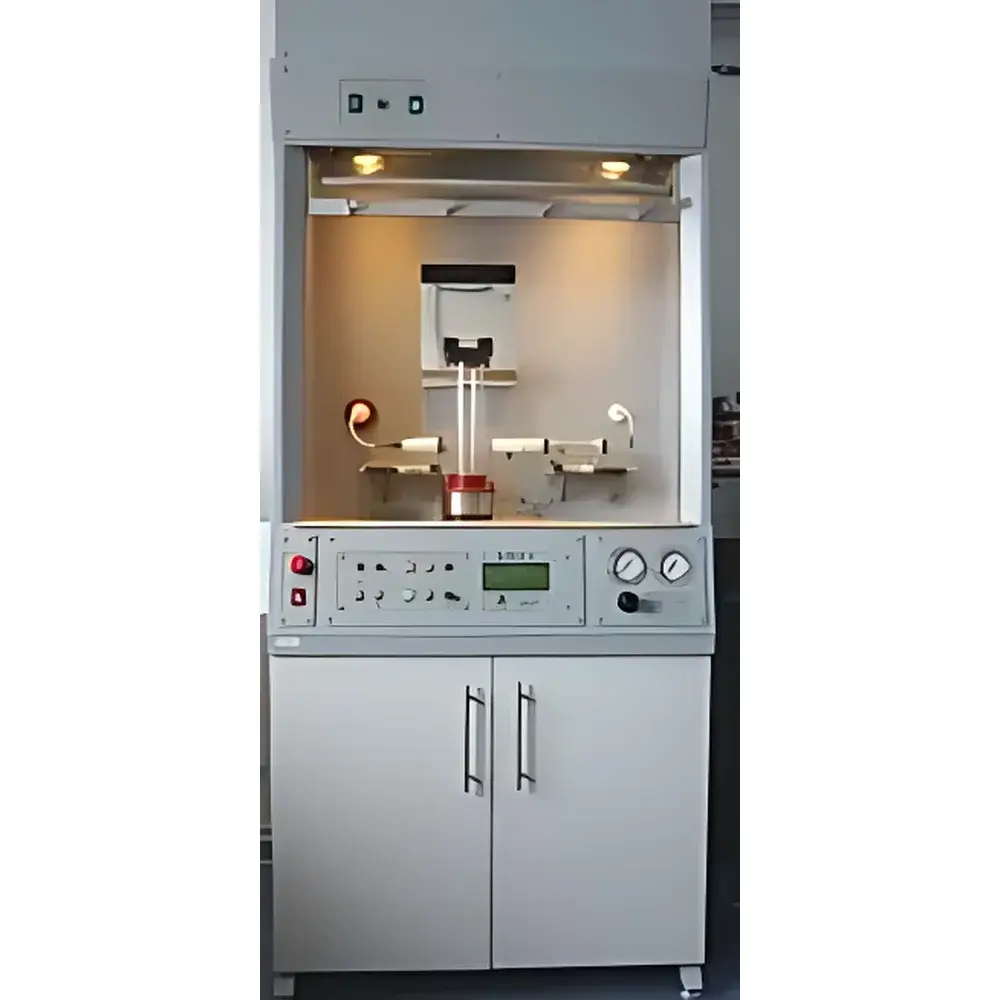
MINOR2 Minimum Ignition Energy Analyzer for Dust/Air Mixtures
| Origin | Poland |
|---|---|
| Manufacturer Type | Distributor |
| Origin Category | Imported |
| Model | MINOR2 |
| Price Range | USD 27,000 – 68,000 (estimated FOB) |
Overview
The MINOR2 Minimum Ignition Energy (MIE) Analyzer is a precision-engineered laboratory instrument designed for the quantitative determination of the lowest electrical spark energy capable of igniting a combustible dust/air mixture under standardized test conditions. Based on the electrostatic spark ignition principle, the system generates controlled, reproducible high-voltage discharges within a defined volume of suspended particulate matter—enabling rigorous assessment of explosion hazards in industrial powder handling, storage, and processing environments. Developed by Anko (Poland), the MINOR2 complies with internationally recognized test standards including ASTM E2019–02 (“Standard Test Method for Minimum Ignition Energy of a Dust Cloud”) and EN 13821 (“Explosive Atmospheres — Determination of Minimum Ignition Energy of Dust Clouds”). Its design prioritizes operator safety, measurement repeatability, and regulatory traceability—making it suitable for use in ATEX/IECEx-certified laboratories, process safety departments, and third-party testing facilities conducting hazard classification per UN GHS and CLP regulations.
Key Features
- Hartmann-type glass explosion tube (standard 1.2 L volume) with calibrated internal geometry to ensure consistent dust dispersion and flame propagation dynamics.
- High-voltage spark ignition unit delivering discrete, user-selectable energy levels: 1 mJ, 3 mJ, 10 mJ, 30 mJ, 100 mJ, 300 mJ, and 1000 mJ—each verified via calibrated capacitive discharge circuitry.
- Dedicated microprocessor control module featuring backlit LCD interface, intuitive rotary energy selector, real-time display of ignition delay (50–350 ms adjustable), and active feedback on spark timing stability.
- Integrated vacuum extraction system with front-panel speed control for precise dust suspension and post-test exhaust management; compatible with optional HEPA filtration for containment of hazardous aerosols.
- Onboard pressure calibration gauge enabling in-situ verification of chamber pressure prior to each test sequence—critical for maintaining stoichiometric consistency across replicate trials.
- USB 2.0 interface supporting direct data export to Windows-based PCs; firmware supports timestamped logging of ignition events, energy settings, delay parameters, and operator ID (where configured).
Sample Compatibility & Compliance
The MINOR2 accommodates a broad range of organic and inorganic powders—including metal dusts (Al, Mg, Ti), pharmaceutical APIs, polymer granules, food-grade starches, and carbonaceous materials—provided they can be pneumatically dispersed to form stable, homogeneous clouds within the Hartmann tube. Particle size distribution (typically D50 < 75 µm) and moisture content (< 5% w/w) are recommended parameters for method validation. The instrument’s operational protocol aligns with quality assurance requirements for GLP-compliant testing laboratories and supports audit readiness for ISO/IEC 17025 accreditation. All electrical components meet CE marking directives for low-voltage equipment (LVD 2014/35/EU) and electromagnetic compatibility (EMC 2014/30/EU).
Software & Data Management
While the MINOR2 operates as a standalone benchtop analyzer, its USB interface enables integration with custom or vendor-supplied PC software for automated test sequencing, statistical analysis of MIE thresholds (e.g., probit regression), and generation of compliant test reports. Data files include raw ignition timestamps, selected energy values, observed flame propagation (via optional external high-speed camera synchronization), and environmental metadata (ambient T/P). Audit trail functionality—including user login, parameter changes, and test initiation logs—is configurable to satisfy FDA 21 CFR Part 11 requirements when deployed in regulated pharmaceutical or chemical manufacturing settings.
Applications
- Determination of MIE for hazard classification under UN Test Series S1 (Explosibility Screening) and EU ATEX Directive 2014/34/EU Annex II.
- Supporting basis-of-design documentation for explosion protection measures—including venting area calculations (EN 14491), suppression system sizing, and inerting protocols.
- Raw material qualification in battery electrode manufacturing, additive manufacturing (powder bed fusion), and fine chemical synthesis.
- Root cause investigation of dust explosion incidents through comparative MIE profiling of suspect materials before and after process modifications.
- Method development and inter-laboratory round-robin studies coordinated under CEN/TC 305 or IEC TC 31 working groups.
FAQ
What standards does the MINOR2 explicitly support?
ASTM E2019–02 and EN 13821 are fully implemented in hardware design, test procedure logic, and reporting templates.
Is the Hartmann tube included as standard equipment?
Yes—the 1.2 L borosilicate glass Hartmann tube is supplied as part of the base configuration, along with mounting fixtures and grounding clamps.
Can the MINOR2 be used for gas/vapor mixtures?
No—it is specifically engineered for dust cloud ignition testing; gas-phase MIE requires a different cell geometry and spark gap configuration per ASTM E582.
Does the system provide automatic MIE calculation?
The instrument records pass/fail ignition outcomes at each energy level; final MIE derivation (e.g., 50% ignition probability) requires post-test statistical analysis using external software.
What maintenance is required for long-term accuracy?
Annual recalibration of the high-voltage discharge circuit and pressure transducer is recommended; optical inspection of the Hartmann tube for scratches or deposits should occur before each test series.





