
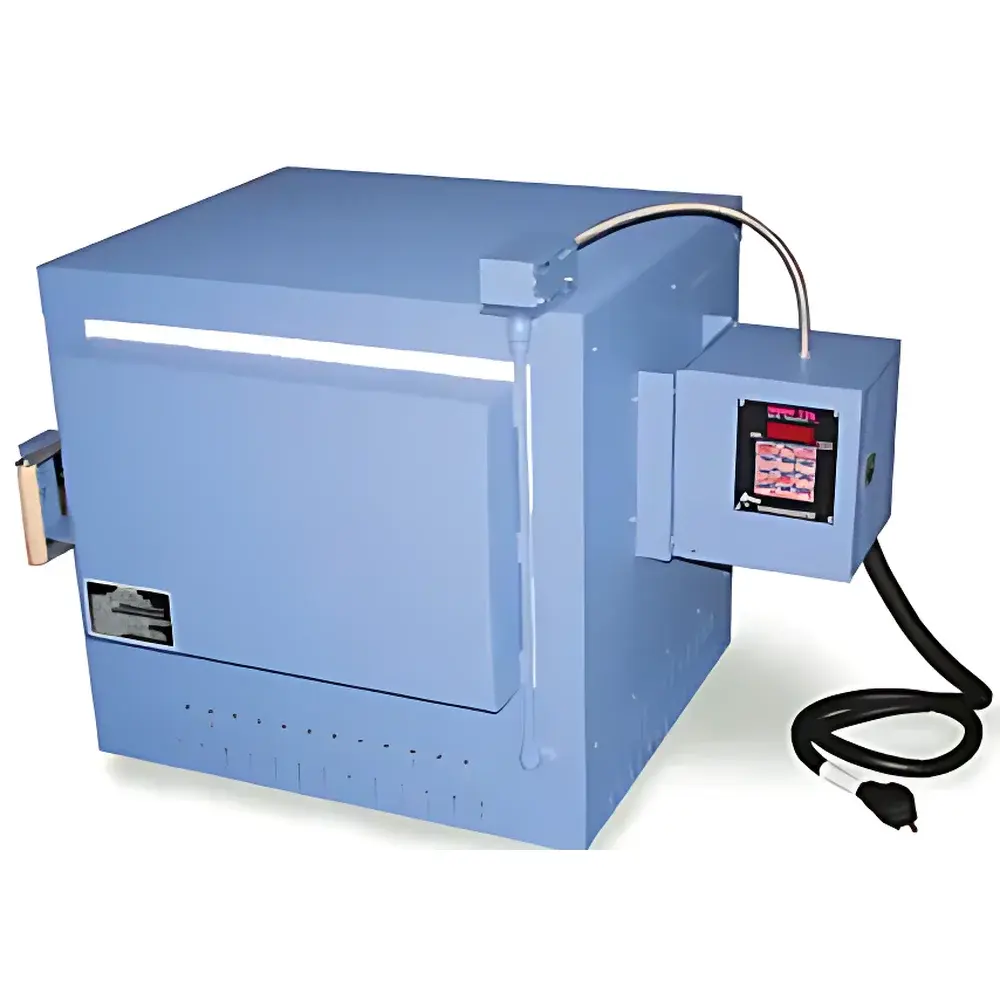
Paragon PMT21 High-Temperature Box-Type Muffle Furnace (1287°C)
| Origin | USA |
|---|---|
| Type | Box-Type Muffle Furnace |
| Model | PMT21 |
| Max Temperature | 1287°C |
| Temperature Uniformity | ±3°C |
| Max Power | 9600 W |
| Heating Rate to Max Temp | 60 min |
| Heating Element | Kanthal A1 Resistance Wire |
| Internal Dimensions (W×D×H) | 533 × 533 × 330 mm |
| Effective Chamber Volume | 93.45 L |
| Controller | Sentry 12-Key Digital Programmable Controller |
| Voltage/Frequency/Current | 230 V / 50 Hz / 40 A |
| Net Weight | 290.3 kg |
| Insulation Thickness | 150 mm Refractory Ceramic Fiber |
Overview
The Paragon PMT21 is a high-temperature, front-loading box-type muffle furnace engineered for precision thermal processing in research laboratories, materials science facilities, and industrial quality control environments. Operating on the principle of resistive heating via high-purity Kanthal A1 alloy wire embedded within a fully insulated refractory chamber, the PMT21 delivers stable, uniform thermal profiles up to 1287°C—suitable for ashing, calcination, sintering, ceramic glaze development, glass annealing, and controlled oxidation/reduction studies. Its robust architecture features 150 mm-thick ceramic fiber insulation, minimizing thermal loss and enabling rapid cooldown profiles critical for annealing small glass substrates (e.g., jewelry components) without reheating cycles. Designed for continuous-duty operation under GLP-compliant workflows, the furnace meets structural and electrical safety requirements aligned with IEC 61000-6-3 (EMC) and UL 746B (polymeric material flammability).
Key Features
- Programmable Sentry digital controller with 12-key interface supporting dual operational modes: single-setpoint hold or multi-step ramp-soak sequences (up to 8 segments per program)
- Storage capacity for four independent temperature programs with real-time editing capability—users may modify setpoints, soak durations, or ramp rates during active operation without interrupting the cycle
- Interactive program preview mode allows verification of time-temperature profiles prior to execution, reducing procedural errors
- User-configurable audible temperature alarm triggers at user-defined thresholds, facilitating manual intervention during critical thermal transitions
- Adjustable thermocouple offset compensation ensures long-term calibration traceability across extended service life
- Delay-start function enables scheduling of furnace activation to align with shift schedules or utility rate windows
- Comprehensive fault diagnostics display error codes for open-circuit thermocouples, heater failure, or overtemperature conditions, supporting predictive maintenance
- LED status indicators clearly differentiate between programming, preview, and active run states
- Heating elements mounted in accessible grooves within the refractory lining—designed for field replacement without disassembly of the chamber structure
- Temperature unit toggle (°C/°F) and dynamic display of ramp/soak progression during both heating and cooling phases
Sample Compatibility & Compliance
The PMT21 accommodates standard crucibles (alumina, silicon carbide, platinum), ceramic setters, and quartz boats within its 93.45 L working volume. Its uniform temperature distribution (±3°C at 1200°C per ASTM E220-22) supports applications requiring strict thermal consistency—including ISO 5660-1 cone calorimetry sample conditioning, USP heavy metal residue testing, and ASTM C114 cement clinker analysis. The furnace complies with CE marking requirements for electromagnetic compatibility and low-voltage directive conformity. Its construction adheres to NFPA 86 Class B oven safety standards for non-explosive atmospheres. All electrical interfaces meet NEMA 1 enclosure specifications; optional data logging modules support 21 CFR Part 11–compliant audit trails when integrated with validated software platforms.
Software & Data Management
While the PMT21 operates autonomously via its embedded Sentry controller, it supports analog output (0–5 V or 4–20 mA) for connection to external PLCs, SCADA systems, or PC-based data acquisition hardware (e.g., National Instruments DAQ devices). Optional RS-485 Modbus RTU communication enables integration into centralized lab management systems for remote monitoring, event logging, and automated report generation. When paired with Paragon’s certified validation package, the system supports IQ/OQ documentation templates aligned with GMP Annex 15 and ISO/IEC 17025 accreditation frameworks. All temperature logs—including timestamps, setpoints, actual readings, and alarm events—are exportable in CSV format for archival or statistical process control (SPC) analysis.
Applications
- Ceramic and glaze development: precise soak control enhances color saturation and crystallinity in decorative enamel formulations
- Metallurgical sample preparation: ashing of organic binders from metal powder compacts prior to sintering
- Environmental testing labs: gravimetric determination of total suspended solids (TSS) and volatile solids (VS) per EPA Method 1680
- Pharmaceutical R&D: residual solvent removal from active pharmaceutical ingredients (APIs) under inert atmosphere (when used with optional gas purge kit)
- Materials characterization: pre-firing of XRD sample holders and TGA reference crucibles
- Glass manufacturing QA: controlled annealing of optical substrates and fused silica components
FAQ
What is the recommended maintenance schedule for the PMT21 furnace?
Routine inspection of thermocouple integrity and heating element continuity is advised every 200 operating hours. Refractory liner surface checks should occur quarterly; ceramic fiber degradation is indicated by visible cracking or dust accumulation.
Can the PMT21 be operated under inert or reducing atmospheres?
Yes—when equipped with an optional gas inlet/outlet port kit and compatible mass flow controller, the chamber supports nitrogen, argon, or forming gas (5% H₂/95% N₂) purging per ASTM F1362 guidelines.
Is the Sentry controller compliant with FDA 21 CFR Part 11?
The standalone controller does not include electronic signature or audit trail functionality. However, full Part 11 compliance is achievable when interfaced with validated third-party data acquisition software meeting ALCOA+ principles.
What is the typical thermal recovery time after door opening?
At 1000°C, full recovery to setpoint requires approximately 8–12 minutes following a 15-second door opening—dependent on ambient humidity and load mass.
Does the furnace include a certificate of conformance or calibration?
Each unit ships with a factory-issued Certificate of Conformance. NIST-traceable temperature calibration certificates are available as a configurable option at time of order.



