
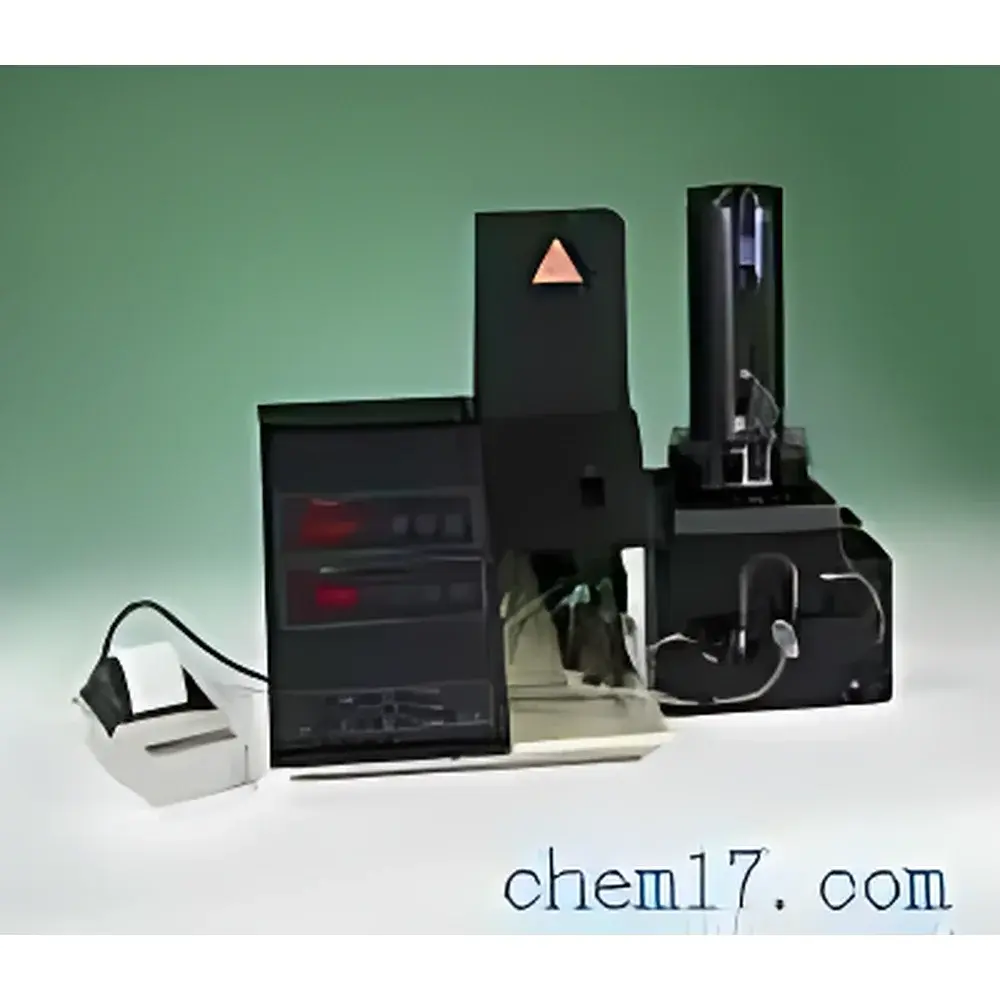
Sherwood 425 Four-Element Flame Photometer
| Brand | Sherwood |
|---|---|
| Origin | United Kingdom |
| Model | 425 |
| Optical System | Single-beam |
| Detector | Photodiode Array |
| Wavelength Range | 190–900 nm |
| Wavelength Accuracy | ±2.0 nm |
| Wavelength Repeatability | ±0.5 nm |
| Spectral Bandwidth | 4 nm |
| Stray Light | ≤0.01% T |
| Elements Measured | Na, K, Li, Ca |
| Linear Display | Dual-channel Digital LED |
| Output | 0.05–5.0 V Analog Signal |
| Interface | RS232 |
| Fuel Gas | Propane/Butane/Natural Gas (6 L/min at 15 PSI) |
| Detection Limits | Na/K: 20 ppb (S/N = 2) |
| Sensitivity | Na/K: 0.5 ppm |
| Li | 2 ppm |
| Ca | 5 ppm |
| Interference | <0.5% |
| Linearity | <1% |
| Precision (RSD) | ≤0.5% |
| Stabilization Time | ~15 s per reading |
Overview
The Sherwood 425 Four-Element Flame Photometer is a precision atomic emission instrument engineered for quantitative determination of sodium (Na), potassium (K), lithium (Li), and calcium (Ca) in aqueous biological and industrial samples. Unlike UV-Vis spectrophotometers—which absorb light across broad spectral regions—this instrument operates on the principle of flame atomic emission spectroscopy (FAES). Sample solutions are nebulized into a stable, premixed air–fuel flame, where thermal energy excites valence electrons of alkali and alkaline earth metals. As these electrons return to ground state, they emit characteristic wavelengths (e.g., Na at 589 nm, K at 766 nm, Li at 671 nm, Ca at 422 nm), which are isolated by interference filters and quantified via photodiode array detection. The 425 model integrates dual-channel optical paths with independent filter wheels, enabling simultaneous, real-time measurement and display of two elements without time-sharing or signal multiplexing—critical for clinical serum and urine analysis where Na/K ratios carry diagnostic significance.
Key Features
- Dual-channel architecture with independent photodiode detectors and selectable interference filters (four included: Na, K, Li, Ca) for true simultaneous quantification
- Integrated flame stabilization system with automatic gas flow optimization and flame height adjustment, minimizing drift during extended batch runs
- Lithium internal standard correction—automatically compensates for flame instability, aspiration rate variation, and sample dilution errors
- Three operational modes: continuous real-time display (for kinetic monitoring), peak-hold mode (for stable endpoint reporting), and manual sample hold (for operator-controlled dwell time)
- Analog output (0.05–5.0 V DC) synchronized with LED readings, compatible with strip-chart recorders or PLC-based process control systems
- RS232 serial interface supporting ASCII data export for integration with LIMS or custom data acquisition software
- Robust single-beam optical design with 4 nm spectral bandwidth ensures high signal-to-noise ratio while maintaining compliance with ISO 6497 and ASTM D511 for water and biological fluid analysis
Sample Compatibility & Compliance
The 425 photometer accepts clarified, low-viscosity aqueous matrices including serum, plasma, urine, dialysate, plant digests, and environmental water extracts. Sample introduction is via concentric pneumatic nebulizer coupled to a quartz combustion chamber, delivering consistent aerosol generation with minimal memory effect. All measurements comply with CLIA-waived requirements for point-of-care electrolyte testing when used with validated calibrators and controls. The instrument meets IEC 61010-1 safety standards for laboratory electrical equipment and supports audit-ready operation under GLP and GMP frameworks through configurable calibration logging and user-accessible calibration history. While not FDA 21 CFR Part 11–certified out-of-the-box, its RS232 output and deterministic analog signal enable validation for regulated environments when paired with compliant data capture software.
Software & Data Management
No embedded operating system or proprietary GUI is present—the 425 relies on hardware-level signal processing and direct digital readout for reliability and electromagnetic immunity in clinical labs. Calibration curves are stored as linear or quadratic coefficients in non-volatile memory following standard two- or three-point calibration protocols. All calibrations require blank measurement prior to standard introduction, enforcing procedural rigor. Raw analog voltage outputs correspond linearly to concentration within defined ranges (Na: 0–199.9 ppm; K/Li/Ca: 0–9.99 ppm), enabling traceable recalibration using NIST-traceable reference standards. Optional Sherwood DataLink software (v3.2+) provides CSV export, trend charting, and QC flagging (e.g., out-of-range blank, calibration drift >2%) when connected via RS232.
Applications
- Clinical chemistry: Quantitative Na/K/Li/Ca profiling in serum, whole blood lysates, and 24-hour urine collections per CAP-accredited protocols
- Pharmaceutical manufacturing: Monitoring electrolyte content in IV fluids, dialysis concentrates, and lyophilized formulations
- Agricultural science: Rapid analysis of soil extract cations and plant tissue digests for nutrient management
- Food & beverage QA: Verification of mineral fortification levels in dairy alternatives and sports drinks
- Environmental testing: Determination of alkali metals in wastewater effluents and drinking water per EPA Method 200.7 (modified)
FAQ
What flame gases are compatible with the Sherwood 425?
Propane, butane, or natural gas may be used at a regulated flow rate of 6 L/min at 15 PSI. A dedicated air compressor (model 850, water-cooled) is recommended for humid environments to prevent condensation in the mixing chamber.
Can the instrument measure all four elements simultaneously?
No—dual-channel optics allow only two elements to be measured concurrently. Full four-element analysis requires sequential filter changes and recalibration, though total cycle time remains under 90 seconds per sample set.
Is the 425 suitable for trace-level analysis below 1 ppm?
With a detection limit of 20 ppb for Na and K (S/N = 2), it supports low-concentration clinical applications such as lithium therapeutic drug monitoring. For sub-ppb work, ICP-OES or graphite furnace AAS is recommended.
How is interference from other cations mitigated?
Interference is minimized through narrow-band interference filters (FWHM ≤4 nm), optimized flame temperature control, and lithium internal standard correction. Documented matrix interference from common anions (Cl⁻, SO₄²⁻) and competing cations (Mg²⁺, NH₄⁺) is <0.5% at physiological concentrations.
What accessories are required for routine clinical use?
Standard configuration includes host unit, four interference filters, calibration kit (Na/K/Li/Ca standards), and air compressor. The 805 Continuous Dilutor is optional but strongly advised for undiluted serum/urine analysis to reduce pipetting error and improve throughput.




