
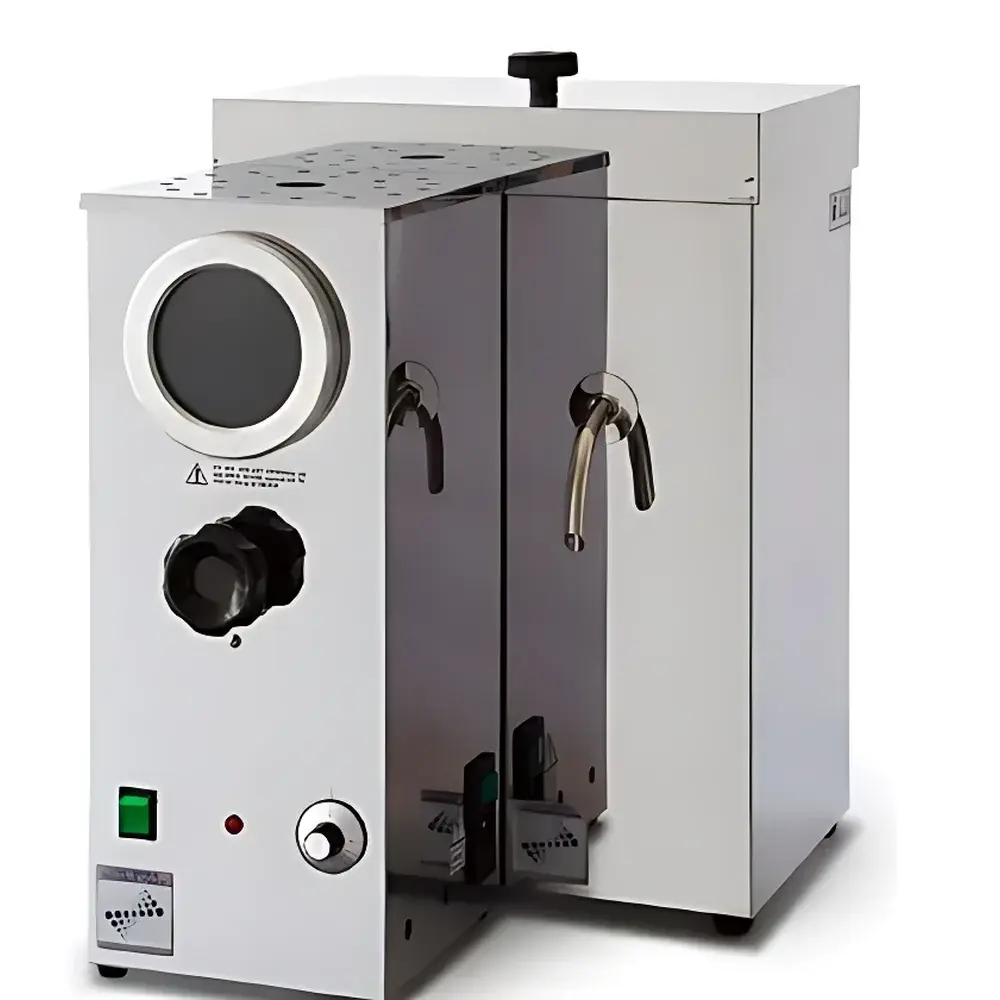
English Product Name
| Origin | Switzerland |
|---|---|
| Manufacturer Type | Authorized Distributor |
| Import Status | Imported |
| Standard Compliance | ASTM D86, IP 123, ISO 3405 |
| Model | 1000 Series |
| Configuration | Atmospheric Distillation Only |
| Heating Control | Electronically Adjustable Heating Plate |
| Condenser Type | Water-Cooled Chromium-Plated Copper Tube Assembly |
| Construction Material | Stainless Steel (Heater & Condenser Units) |
| Distillation Flask Options | 100 mL (Type A), 125 mL (Type B), 200 mL (Type C), 250 mL (Type D) |
| Receiver Flask Options | 25 mL (Type A), 100 mL (Type B), 200 mL (Type C) |
| Temperature Measurement | ASTM/IP Certified Thermometers (e.g., ASTM 2C, 3C, 105C–107C) |
Overview
The Swiss-made 1000 Series ASTM D86 Manual Distillation Apparatus is a precision-engineered laboratory instrument designed for standardized atmospheric distillation of petroleum products in accordance with ASTM D86, ISO 3405, and IP 123. This method determines the boiling range distribution—expressed as initial boiling point (IBP), 10%, 50%, 90% recovery temperatures, and final boiling point (FBP)—by subjecting a representative sample to controlled, ambient-pressure vaporization and condensation. Unlike automated or vacuum-based systems, the 1000 Series implements classical manual distillation methodology, ensuring full procedural transparency and direct operator control over heating rate, coolant flow, and fraction collection timing. Its design prioritizes repeatability under GLP-compliant conditions and is routinely employed in refinery QC labs, independent testing facilities, and regulatory compliance laboratories where adherence to legacy test protocols remains mandatory. The apparatus does not accommodate highly contaminated, polymerized, or thermally unstable feedstocks; it is validated exclusively for clean, volatile hydrocarbon fractions meeting specification purity thresholds per ASTM D86 Annex A1.
Key Features
- Stainless steel construction throughout both heater (Model 990/A) and condenser (Model 990/B) units, ensuring long-term corrosion resistance and mechanical stability in aggressive hydrocarbon environments.
- Electronically adjustable heating plate with external manual calibration interface—enabling precise ramp-rate control per ASTM D86 Section 7.2 (e.g., 4–5 °C/min initial heating, followed by 1–2 °C/min during fractional recovery).
- Height-adjustable base platform for the distillation flask, operated via external handwheel—facilitating optimal alignment between flask neck, adapter, and condenser inlet without disassembly.
- Dual-hand configuration available for the 990/B condenser unit (left- or right-handed orientation), supporting ergonomic lab layout integration and multi-station workflow optimization.
- Integrated water-cooling circuit with calibrated inlet/outlet valves and transparent flow indicators—ensuring consistent condenser jacket temperature (typically 15–25 °C) across repeated runs.
- Reinforced borosilicate glass viewport on the heater unit—allowing real-time visual monitoring of boiling behavior, foam formation, and distillate reflux dynamics.
Sample Compatibility & Compliance
This apparatus is validated for use with light to medium distillates including but not limited to: straight-run naphthas, motor gasoline (spark-ignition), aviation gasoline (AVGAS), jet fuel (Jet A-1, JP-5), kerosene, lamp oils (Grade 1 & 2), low-sulfur diesel fuels (1-D & 2-D), and specialty refined solvents (e.g., white spirit, Stoddard solvent). Samples must be free of suspended solids, water, or high-boiling residues that could cause bumping, superheating, or thermal decomposition. ASTM D86 explicitly excludes application to heavy fuel oils, residual fuels, cracked stocks with high olefin content, or samples containing >0.1% w/w non-volatile residue (per ASTM D189 or D4294). All operational procedures align with ISO/IEC 17025 documentation requirements and support audit-ready traceability when paired with certified reference thermometers and calibrated volumetric receivers.
Software & Data Management
As a fully manual apparatus, the 1000 Series does not incorporate embedded electronics or digital data logging. However, its modular design supports seamless integration into paperless QA/QC workflows via external documentation systems. Users may record temperature vs. volume recovery data using ASTM-certified mercury-in-glass thermometers (e.g., ASTM 105C, 106C) and class-A volumetric receivers traceable to NIST or UKAS standards. When deployed in regulated environments (e.g., EPA-certified labs or API Monogram facilities), operators commonly pair this system with LIMS-compatible electronic notebooks (e.g., LabWare LIMS, Thermo Fisher SampleManager) to capture raw observations, technician signatures, environmental conditions (ambient temperature/humidity), and equipment calibration status—all satisfying FDA 21 CFR Part 11 audit trail requirements through third-party validation protocols.
Applications
- Quality assurance of gasoline blending components prior to tank farm transfer.
- Verification of jet fuel volatility specifications per DEF STAN 91-91 or MIL-DTL-83133.
- Distillation curve profiling for kerosene used in aviation turbine engine fuel certification.
- Batch release testing of diesel fuel against EN 590 or ASTM D975 cold flow property correlations.
- Educational demonstration of fractional distillation principles in university petroleum engineering curricula.
- Reference method validation for automated simdis (gas chromatography-based simulated distillation) instruments.
FAQ
Is this apparatus compliant with current ASTM D86 revision (2023 edition)?
Yes—the mechanical configuration, dimensional tolerances, and procedural controls fully satisfy all requirements specified in ASTM D86–23, including flask geometry, condenser immersion depth, thermometer positioning, and heating rate tolerances.
Can I use this unit for vacuum distillation?
No. The 1000 Series is engineered exclusively for atmospheric pressure operation per ASTM D86. Vacuum distillation requires separate instrumentation conforming to ASTM D1160 or D2887.
What calibration documentation is supplied with ASTM-certified thermometers?
Each thermometer is delivered with a manufacturer’s certificate of conformance and a UKAS/NIST-traceable calibration report valid for 12 months from date of issue.
Are replacement flasks and receivers supplied with metrological certification?
All volumetric glassware (flasks and receivers) is manufactured to ISO 4787 and supplied with individual class-A certification labels indicating tolerance limits and calibration temperature (20 °C).
Does the system require electrical safety certification for use in Zone 1 hazardous areas?
No—the heater unit operates at surface temperatures below autoignition thresholds for common petroleum fractions and carries CE marking for general laboratory use only; it is not rated for installation in classified hazardous locations.






