
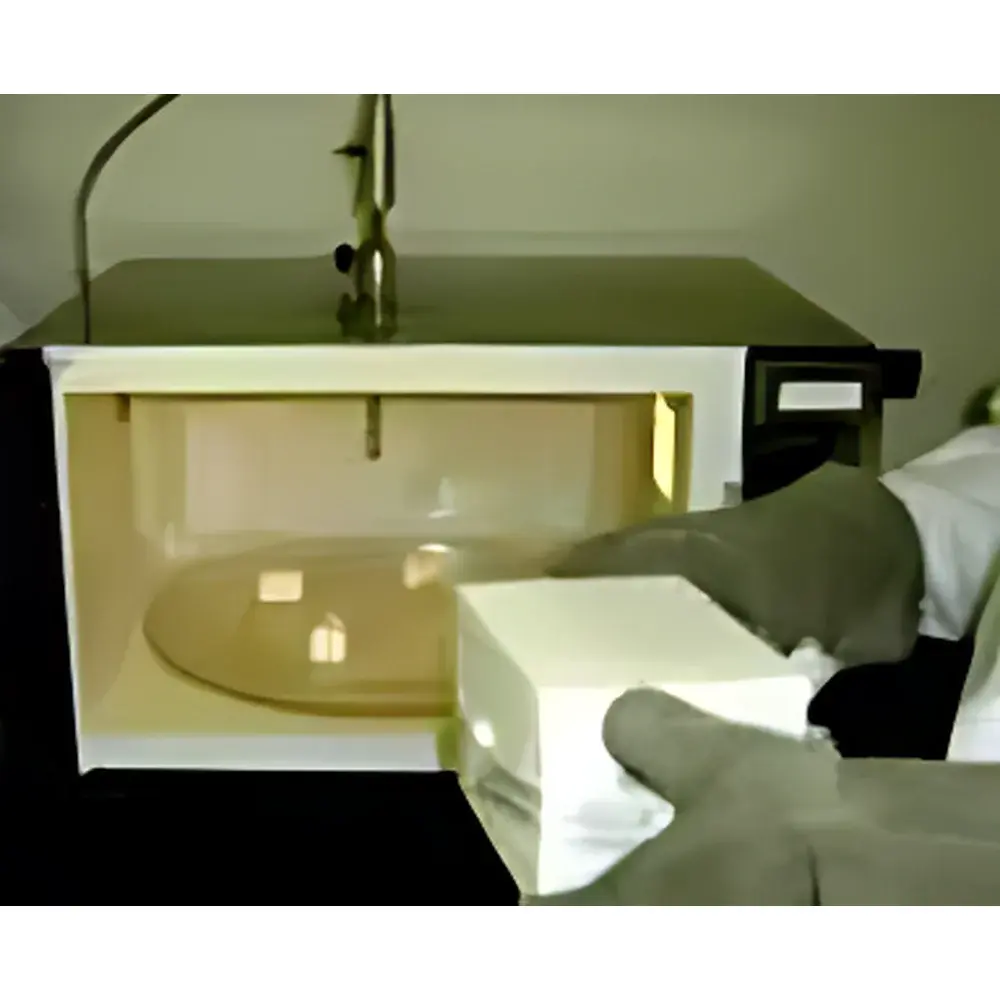
RMS Series 1700°C Microwave High-Temperature Muffle Furnace
| Origin | USA |
|---|---|
| Manufacturer Type | Authorized Distributor |
| Origin Category | Imported |
| Model | RMS Series |
| Temperature Range | Ambient to 1400°C or Ambient to 1700°C |
| Controller Interface | RS-232/USB with PC connectivity |
| Cooling System | Liquid-cooled cavity jacket |
| Input Power | 1400 W, 12.0 A (230 V AC) |
| Rotating Sample Platform | Motor-driven quartz turntable for uniform microwave energy distribution |
| Atmosphere Control | Optional inert gas inlet (N₂, Ar) with flow regulation |
| Thermocouple Mounting | Adjustable-height Type S thermocouple port |
| Crucible Compatibility | Dual-range refractory crucibles (≤1400°C and ≤1700°C), multiple dimensions and geometries available |
| Support Stand | Ceramic-fiber–insulated crucible holder isolating sample from rotating quartz components |
Overview
The RMS Series 1700°C Microwave High-Temperature Muffle Furnace is a precision-engineered laboratory system designed for rapid, volumetric, and controllable heating of refractory materials under controlled atmospheres. Unlike conventional resistance-heated muffle furnaces, this system employs single-mode or multimode microwave energy (2.45 GHz) coupled into a liquid-cooled, sealed cavity, enabling faster thermal ramp rates, improved energy efficiency, and reduced thermal gradients across heterogeneous samples. The furnace supports two operational temperature regimes—up to 1400°C using high-purity alumina-based crucibles, and up to 1700°C using specialized zirconia- or graphite-reinforced ceramic crucibles—making it suitable for sintering advanced ceramics, synthesis of ultra-high-temperature materials (e.g., MAX phases, rare-earth oxides), and thermal stability testing of aerospace-grade composites. Its compact footprint (356 × 610 × 495 mm) allows integration into standard fume hoods or glovebox interfaces without structural modification.
Key Features
- Thermal Flexibility: Dual-range operation (ambient–1400°C or ambient–1700°C) with interchangeable, application-optimized crucible systems certified for long-term stability at peak temperatures.
- Precision Temperature Management: Integrated Type S thermocouple with vertically adjustable mounting sleeve enables in-situ, spatially resolved temperature monitoring at multiple axial positions within the sample zone.
- Atmosphere Control Capability: Standard 1/4″ VCR fittings support regulated purging with inert gases (N₂, Ar) or reducing atmospheres (5% H₂/Ar), with optional mass flow controller integration for GLP-compliant process documentation.
- Active Microwave Uniformity System: Motorized quartz turntable rotates at programmable speeds (0–15 rpm), ensuring consistent field coupling and mitigating standing-wave hotspots during extended dwell cycles.
- Liquid-Cooled Cavity Architecture: Closed-loop deionized water jacket maintains external cavity surface temperature below 45°C during continuous 1700°C operation, meeting IEC 61000-6-3 EMC and UL 61010-1 safety requirements.
- Regulatory-Ready Control Interface: Iseries ActiveX-compatible controller provides real-time parameter logging (time, setpoint, actual temp, power %, gas flow) directly to Excel-compatible .csv files; audit trail functionality supports FDA 21 CFR Part 11 compliance when deployed with validated Windows OS environments.
Sample Compatibility & Compliance
The RMS furnace accommodates a broad spectrum of solid-state samples—including powders, green bodies, monoliths, and fiber preforms—in crucibles ranging from 25 mm to 80 mm in diameter and up to 100 mm in height. All high-temperature crucibles are manufactured to ASTM C20 and ISO 2732 specifications for dimensional tolerance and thermal shock resistance. The system complies with EN 60519-12 (electromagnetic compatibility for industrial microwave equipment) and meets Class II laser safety requirements per IEC 60825-1 for optical pyrometer integration options. When operated with documented SOPs and calibrated thermocouples traceable to NIST SRM 1747, data generated satisfies ISO/IEC 17025 requirements for accredited materials testing laboratories.
Software & Data Management
The embedded Iseries controller firmware supports both local touchscreen operation and remote PC-based supervision via USB or RS-232. Logged datasets include timestamped records of all process variables at user-selectable intervals (100 ms to 5 min resolution). Exported files conform to ASTM E2918 standards for thermal analysis data formatting and are compatible with third-party platforms including MATLAB, OriginLab, and Thermo Scientific™ OMNIC™ for post-acquisition kinetic modeling. Optional software modules provide PID auto-tuning, multi-segment ramp/soak profiles, and deviation alarms with email/SNMP notification—features routinely specified in GMP manufacturing environments for ceramic component annealing validation.
Applications
- Sintering of silicon carbide (SiC), silicon nitride (Si₃N₄), and yttria-stabilized zirconia (YSZ) ceramics
- Thermal decomposition studies of metal-organic frameworks (MOFs) and layered double hydroxides (LDHs)
- Rapid ashing of geological and metallurgical samples per ASTM D3174 and ISO 1171
- Heat treatment of tungsten and molybdenum alloys under vacuum or inert gas
- In-situ XRD sample preparation requiring precise thermal history control
- Development of solid-state electrolytes for next-generation batteries (e.g., LLZO, LATP)
FAQ
What cooling method is used to manage cavity temperature during 1700°C operation?
The furnace employs a closed-loop, deionized water cooling system integrated into the cavity jacket, maintaining external surface temperatures below 45°C even during prolonged high-temperature cycles.
Can the system be integrated into an automated lab workflow?
Yes—RS-232 and USB interfaces support SCPI command sets for integration with LabVIEW, Python-based orchestration tools, or centralized LIMS platforms.
Is calibration documentation provided with the instrument?
Each unit ships with a factory calibration certificate for the controller’s temperature input channel, traceable to NIST-traceable reference standards; on-site thermocouple calibration services are available under separate service agreement.
What safety interlocks are implemented?
Dual redundant door safety switches, cavity temperature over-limit cutoff, coolant flow monitoring, and microwave leakage detection (<0.5 mW/cm² at 5 cm) per IEEE C95.1-2019 are standard.
Are custom crucible geometries supported?
Yes—OEM crucible design and fabrication services are offered for specialized applications including crucible-with-lid configurations, multi-zone sample holders, and RF-transparent inserts for hybrid heating experiments.



