
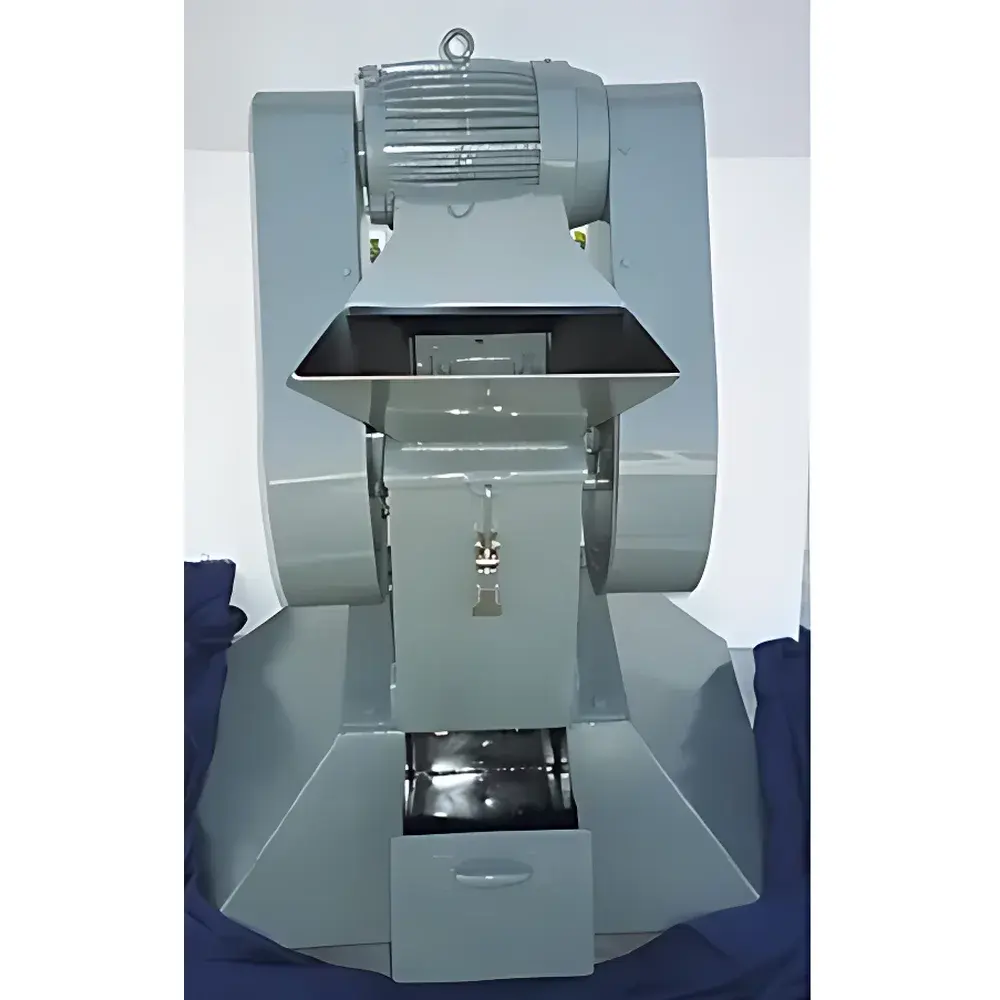
Badger Model Jaw Crusher Instrument
| Origin | USA |
|---|---|
| Manufacturer Type | Authorized Distributor |
| Origin Category | Imported |
| Model | Badger |
| Instrument Type | Jaw Crusher |
| Sample Applicability | Brittle Materials (e.g., rocks, ores, ceramics, metals, chemicals) |
| Feed Size | < 15 mm |
| Discharge Size | ≥ 0.5 mm |
| Batch Capacity | 60 mL |
| Jaw Opening | 127 mm × 178 mm |
| Motor | 3 HP, 3-Phase, 380 V, 400 rpm |
| Bearing Type | Sealed Spherical Roller Bearings |
| Crushing Capacity | 590 kg/h |
| Jaw Plate Material | Chrome Steel (standard) |
| Base & Guard | Stainless Steel |
Overview
The Badger Model Jaw Crusher Instrument is a precision-engineered laboratory-scale primary crushing device designed for consistent, high-reproducibility size reduction of hard and brittle materials. Based on the classic single-toggle jaw crusher architecture—refined over more than a century of industrial and analytical application—it operates on the principle of compressive force generation between two opposing jaws: a fixed jaw and a moving swing jaw driven by an eccentric shaft. This mechanical configuration delivers controlled, repeatable fracture mechanics ideal for sample homogenization prior to downstream analysis (e.g., XRF, ICP-OES, XRD, or geochemical assay). Unlike impact or rotary grinders, the Badger design minimizes heat generation and particle amorphization, preserving sample integrity—critical for mineralogical and metallurgical characterization where phase stability and elemental distribution must remain unaltered.
Key Features
- Single-toggle kinematic design with patented bi-directional jaw motion—enables higher throughput per unit motor power while maintaining low operational inertia and mechanical stress.
- Adjustable discharge gap (0.5–12 mm range) via manual wedge mechanism, allowing precise control over output particle size distribution without tooling changes.
- Chrome steel jaw plates (standard configuration) provide exceptional wear resistance against abrasive geological and metallurgical samples; optional tungsten carbide or manganese steel plates available for extended service life in high-volume applications.
- Stainless steel base frame and full perimeter guarding meet ISO 13857 and ANSI B11.1 safety requirements for stationary crushing equipment.
- Sealed spherical roller bearings support high radial and axial loads under continuous duty—rated for >10,000 hours MTBF with standard lubrication intervals.
- Compact footprint (W × D × H ≈ 610 × 560 × 890 mm) optimizes benchtop integration in QA/QC labs, core logging facilities, and field-deployable analytical units.
- 3 HP, 3-phase, 380 V induction motor delivers stable torque across variable feed conditions—engineered for duty cycles exceeding 8 h/day in routine laboratory operation.
Sample Compatibility & Compliance
The Badger Jaw Crusher is validated for processing a broad spectrum of inorganic, non-fibrous, and non-ductile specimens—including quartzite, basalt, iron ore, slag, ceramic sinter, catalyst supports, and alloy fragments. It is not suitable for elastomeric, fibrous, or highly ductile metals (e.g., pure copper or aluminum), nor for moisture-sensitive or pyrophoric materials. All structural components comply with ASTM E11-22 (specifications for test sieves) dimensional tolerances. The instrument meets CE Machinery Directive 2006/42/EC requirements when installed with appropriate local grounding and emergency stop integration. For GLP/GMP-regulated environments, optional audit-trail-enabled motor control modules support 21 CFR Part 11-compliant operation when paired with validated LIMS interfaces.
Software & Data Management
This is a manually operated, analog-control jaw crusher with no embedded firmware or digital interface. Operational parameters (feed rate, gap setting, run duration) are recorded manually in lab notebooks or integrated into electronic lab notebooks (ELNs) via standardized SOP templates. Optional accessories include calibrated feed funnels with volumetric markings and certified reference material (CRM) traceable sieve sets (ISO 3310-1, R20 series) for post-crushing particle size verification. For automated workflow integration, third-party PLC gateways can be deployed to monitor motor current draw and thermal signatures—serving as indirect proxies for load consistency and jaw wear progression.
Applications
- Preparation of representative subsamples from bulk rock cores or drill cuttings for geochemical assay (e.g., fire assay, aqua regia digestion).
- Routine size reduction of metallurgical concentrates prior to fusion bead preparation for XRF quantification.
- Primary comminution step in ASTM D2974 (moisture, ash, and volatile matter in coal) and ISO 18283 (manual sampling of coal and coke) workflows.
- Crushing of refractory ceramics and spent catalysts for SEM-EDS cross-sectional analysis.
- Fragmentation of construction aggregates for Los Angeles abrasion testing (ASTM C131/C131M) specimen conditioning.
FAQ
What is the maximum feed size this instrument accepts?
The nominal feed opening measures 127 mm × 178 mm; however, effective maximum feed dimension is limited to ≤15 mm to ensure consistent feeding, avoid bridging, and prevent premature jaw wear.
Can this crusher handle wet or sticky samples?
No—this instrument is strictly intended for dry, free-flowing, brittle solids. Moisture content above 2% w/w may cause clogging and uneven crushing due to adhesion between particles and jaw surfaces.
Is calibration required before use?
While no metrological calibration is mandated, users must verify jaw alignment and gap setting using certified feeler gauges prior to first operation and after each jaw plate replacement, per manufacturer’s maintenance schedule.
What safety certifications does it carry?
The unit complies with IEC 60204-1 (electrical equipment of machines) and carries CE marking under the EU Machinery Directive; local installation must conform to national electrical codes (e.g., NEC Article 430 in the U.S.).
How often should the jaw plates be replaced?
Under typical laboratory use (≤2 kg/h average throughput), chrome steel plates require replacement every 1,200–1,800 operating hours, depending on sample abrasivity—as confirmed by visual inspection of tooth profile degradation and increased discharge size variability.



