
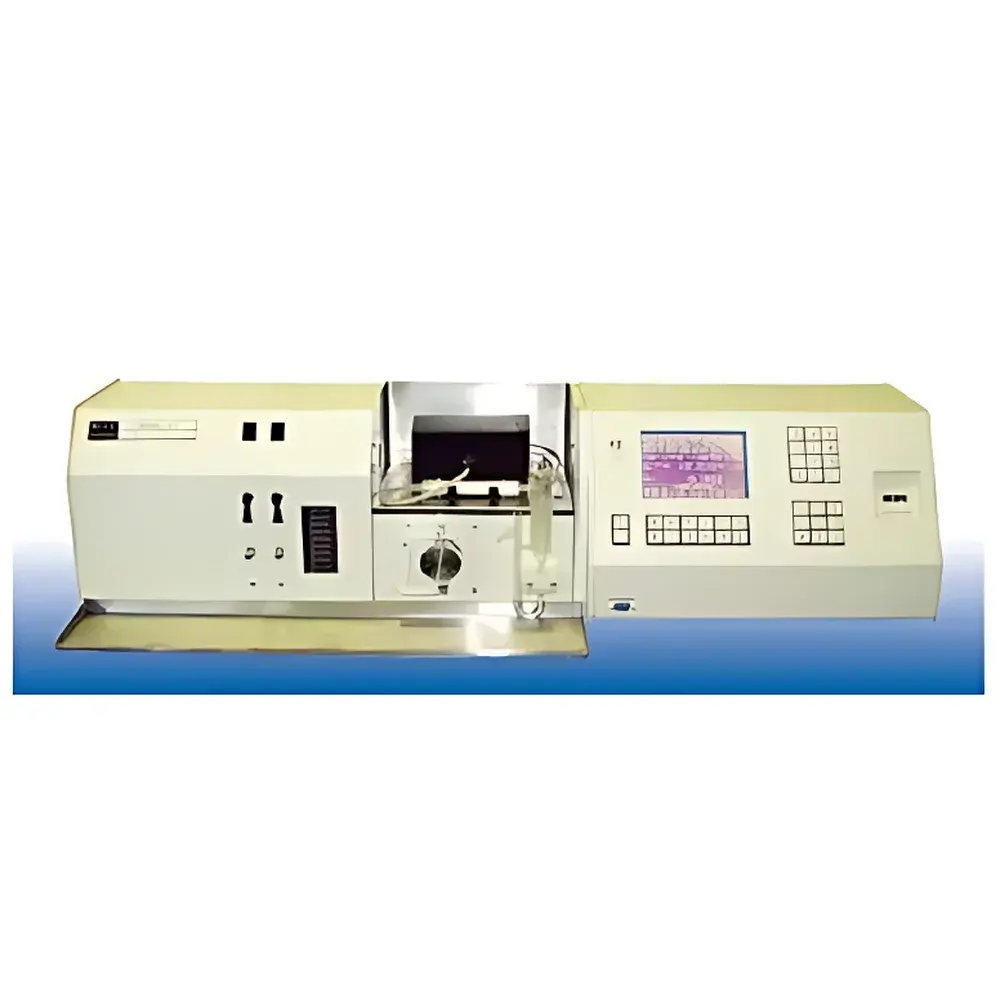
PerkinElmer 411 Hydride Generation Atomic Absorption Spectrometer for Arsenic Analysis
| Origin | USA |
|---|---|
| Manufacturer Type | Authorized Distributor |
| Origin Category | Imported |
| Model | 411 |
| Pricing | Available Upon Request |
Overview
The PerkinElmer 411 Hydride Generation Atomic Absorption Spectrometer (HG-AAS) is a dedicated, high-sensitivity analytical system engineered for trace-level arsenic quantification in environmental and regulatory compliance laboratories. It operates on the well-established hydride generation principle—where inorganic arsenic species (AsIII and AsV) are chemically reduced to volatile arsine gas (AsH3) in acidic medium using sodium borohydride, followed by atomization in a high-temperature quartz tube furnace. This method delivers exceptional selectivity and sensitivity by separating arsenic from complex matrices prior to detection, minimizing spectral interferences and enhancing signal-to-noise ratio. The instrument is fully compliant with U.S. EPA Methods 200.7, 200.9, and SW-846 Chapters 7060 and 7061, as well as NPDES and RCRA regulatory testing protocols. Its design integrates a sealed, electronically heated quartz T-tube atomizer and an integrated continuous-flow hydride generation module—enabling rapid, reproducible analysis of aqueous samples, digested soils, sludges, and solid waste extracts without manual intervention or external gas manifolds.
Key Features
- Sub-ppt detection limit: Achieves a method detection limit (MDL) of 500 ppt (0.5 ng/L) for total inorganic arsenic under optimized conditions using certified peristaltic pump tubing and standardized reagent delivery.
- Sealed, temperature-controlled quartz T-tube atomizer (150 mm length, annealed fused silica): Maintains precise thermal stability up to 600 °C, ensuring consistent arsine decomposition and atomic vapor formation for high signal reproducibility.
- Integrated continuous-flow hydride generation system: Eliminates batch processing delays; enables real-time data acquisition with minimal carryover and automated reagent/sample mixing via calibrated peristaltic pumping.
- Dual-gas purge capability: Supports economical argon or nitrogen carrier gas with integrated flow meters and pressure regulators for optimized transport efficiency and background suppression.
- Deuterium lamp background correction: Fully automated, real-time D2 continuum correction compensates for non-specific absorption and matrix-induced scatter, improving accuracy in high-salinity or turbid samples.
- Comprehensive software suite: Includes multi-point linear and quadratic calibration algorithms, statistical reporting (mean, SD, RSD, confidence intervals), audit-trail-enabled data logging, and 21 CFR Part 11–compliant electronic signature support.
- Direct thermal printer interface + RS-232 serial port + 1 V analog output: Ensures flexible data export, instrument control integration, and regulatory documentation readiness.
Sample Compatibility & Compliance
The 411 system accepts acid-digested aqueous extracts prepared per EPA Method 3050B, 3051A, or 3052, as well as filtered surface water, groundwater, wastewater effluents, and leachates generated via TCLP (Method 1311) or SPLP procedures. It meets ISO/IEC 17025 requirements for method validation when operated within documented SOPs, and supports GLP/GMP-aligned workflows through built-in calibration verification, system suitability checks, and user-accessible audit logs. All hardware and firmware configurations comply with IEC 61000-4 electromagnetic compatibility standards and UL/CSA safety certifications.
Software & Data Management
The embedded instrument control software provides intuitive method setup, automated sequence execution, and post-run statistical evaluation. Calibration curves support up to 12 standards with forced zero or non-zero intercept options. Raw absorbance, peak height/area, and concentration values are timestamped and stored with operator ID, method version, and instrument configuration metadata. Optional PC-based data transfer software enables secure export to CSV, Excel, or LIMS-compatible formats. Full 21 CFR Part 11 compliance—including electronic signatures, role-based access control, and immutable audit trails—is available via licensed software modules validated for regulated environments.
Applications
This system is routinely deployed in environmental testing laboratories accredited to NELAC/NELAP standards for drinking water (EPA 100 series), wastewater discharge monitoring (NPDES permits), hazardous waste characterization (RCRA), and site remediation verification. It also serves pharmaceutical QC labs performing elemental impurity screening per ICH Q3D guidelines, and food safety laboratories conducting arsenic speciation pre-screening (e.g., total As in rice flour or seaweed extracts). Its robustness and low operational cost make it suitable for high-throughput contract labs requiring long-term method stability and minimal maintenance downtime.
FAQ
What sample preparation is required prior to analysis?
Acid digestion (e.g., HNO3/HCl mixture) is mandatory for solid or suspended matrices; aqueous samples require filtration (0.45 µm) and pH adjustment to ≤2. Pre-reduction with KI/ascorbic acid is recommended for As(V) conversion to As(III) to ensure full hydride yield.
Does the system support speciation analysis?
No—the 411 measures total inorganic arsenic only. Speciation requires coupling with HPLC-ICP-MS or HG-AFS systems equipped with chromatographic separation modules.
Is routine maintenance labor-intensive?
Maintenance is limited to periodic replacement of peristaltic pump tubing (every 2–3 months at typical throughput), quartz T-tube inspection, and annual lamp alignment verification—no optical realignment or vacuum system servicing is required.
Can the instrument be integrated into a laboratory information management system (LIMS)?
Yes—via RS-232 or optional Ethernet adapter, using ASTM E1384 or HL7-compliant data exchange protocols supported by third-party middleware.
What consumables are essential for daily operation?
High-purity sodium borohydride (NaBH4), concentrated HCl, certified arsenic standards (NIST-traceable), quartz T-tubes, PTFE pump tubing, and inert carrier gas (Ar or N2) with moisture/organics traps.




