
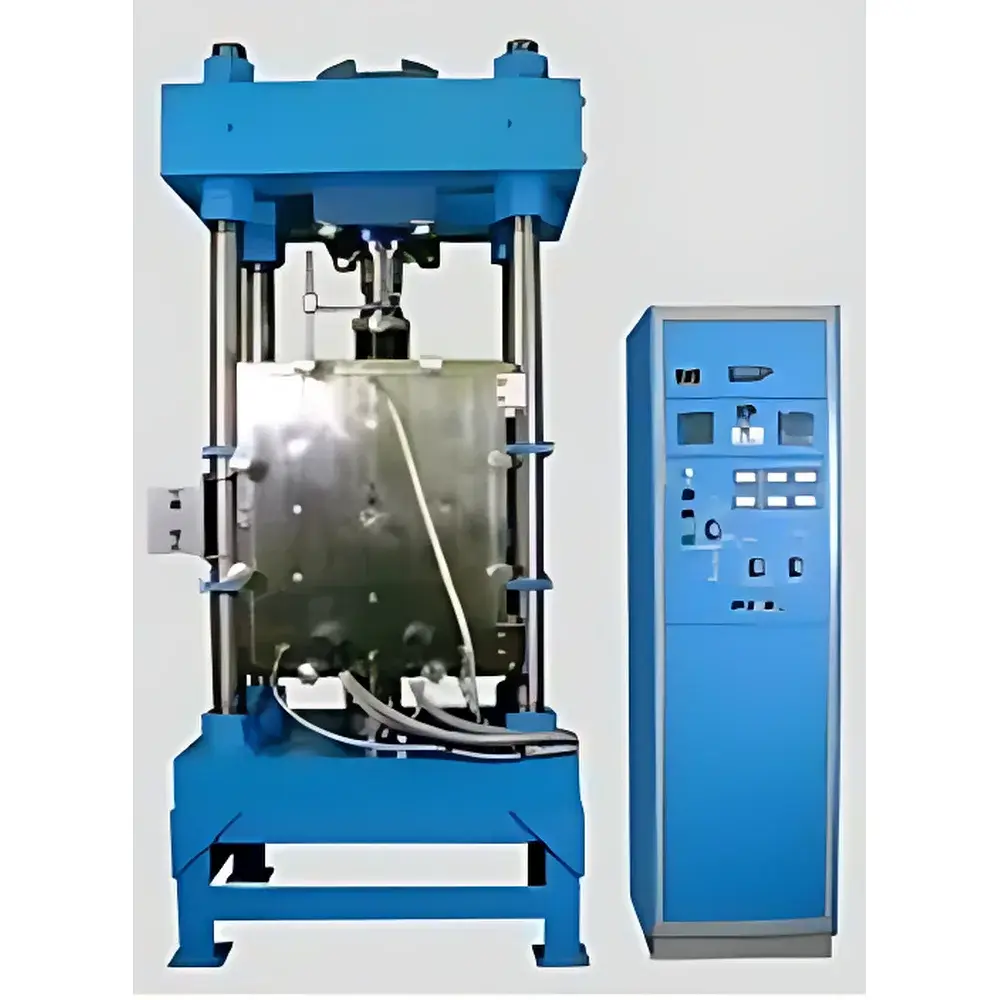
UHP2500 High-Temperature Vacuum Hot Press Furnace
| Origin | USA |
|---|---|
| Manufacturer Type | Authorized Distributor |
| Origin Category | Imported |
| Model | UHP2500 |
| Instrument Type | Box-Type Hot Press Furnace |
| Max Temperature | 2500 °C |
| Temperature Control Accuracy | ±3 °C |
| Max Power | 35 kW |
| Ramp Time to Max Temp | ≤60 min |
| Heating Method | Resistive (Molybdenum, Tungsten Mesh, High-Purity Graphite, or Tantalum Elements) |
| Internal Chamber Dimensions | 2.54–35.56 cm (1″–14″ diameter), up to 30.48 cm (12″) depth |
| Pressure Range | 5–100 metric tons |
| Vacuum Range | 10⁻² to 10⁻⁶ Torr (at 2300 °C) |
| Gas Compatibility | N₂, H₂, Ar, vacuum, or controlled atmosphere (up to 2 PSIG at 2500 °C) |
| Structural Housing | Electropolished 304L stainless steel dual-wall chamber with viewport, thermocouple ports, and optical pyrometer access |
Overview
The UHP2500 High-Temperature Vacuum Hot Press Furnace is an engineered solution for advanced materials synthesis under simultaneous high temperature and uniaxial pressure. Designed and assembled in the United States, this system integrates resistive heating, programmable thermal profiling, high-vacuum capability, and precision hydraulic force application—enabling solid-state densification of refractory ceramics, intermetallics, cermets, and ultra-high-temperature composites. Its core operational principle relies on concurrent application of thermal energy (up to 2500 °C) and mechanical load (5–100 metric tons) within a tightly controlled atmosphere—vacuum, inert gas (N₂, Ar), or reducing gas (H₂)—to achieve near-theoretical density via solid-state diffusion and plastic deformation. The furnace conforms to NFPA 86 (2003 Edition) for industrial ovens and muffle furnaces, with integrated safety interlocks for overtemperature, overpressure, and gas leak detection.
Key Features
- Triple-layer thermal architecture: Electropolished 304L stainless steel dual-wall vacuum chamber with integrated water-cooled outer jacket, minimizing radiative loss and ensuring long-term vacuum integrity down to 10⁻⁶ Torr.
- Modular heating zone: Interchangeable heating elements—including high-purity graphite, molybdenum, tungsten mesh, or tantalum—optimized for specific temperature ranges and chemical compatibility (e.g., graphite for inert/reducing atmospheres; Mo/W for high-vacuum oxidation resistance).
- Hydraulic press system with real-time force feedback: Dual-cylinder design with servo-controlled proportional valves, LVDT displacement monitoring, and ISO-63 graphite hot punches coupled to water-cooled 17-4PH stainless steel rams—ensuring axial alignment tolerance < ±0.05° and thermal decoupling between hot and cold zones.
- Programmable multi-segment temperature controller with dual-sensor redundancy: Type C (W-5%Re/W-26%Re) thermocouples + optional optical pyrometer (0.65–1.0 µm spectral band) for non-contact verification above 1000 °C; overtemperature cutoff set independently from process profile.
- Integrated gas handling manifold: Standard N₂ purge/inerting capability with mass flow controllers, pressure transducers, and automated vent/purge cycles; optional H₂ blending system compliant with CGA G-1.1 and equipped with catalytic recombiners, flame arrestors, and automatic purge-to-atmosphere sequencing.
- PLC-based vacuum automation: Configurable sequence logic for rough pumping (rotary vane or dry scroll), high-vacuum stage (turbomolecular or cryo-pumped), bake-out, gas backfill, and pressure ramping—all logged with timestamped event history per GLP/GMP audit requirements.
Sample Compatibility & Compliance
The UHP2500 accommodates cylindrical and rectangular green bodies ranging from 1″ (25.4 mm) to 14″ (355.6 mm) in diameter and up to 12″ (304.8 mm) in height. It supports sintering of oxide ceramics (Al₂O₃, ZrO₂, Y₂O₃-stabilized systems), non-oxides (SiC, Si₃N₄, BN, TiB₂, TaC), metal matrix composites (Cu-W, Al-SiC), and functionally graded materials requiring stoichiometric control under reducing conditions. All vacuum and gas pathways meet ASTM E595 outgassing specifications. The system satisfies key regulatory frameworks including ISO 9001:2015 (design and manufacturing controls), FDA 21 CFR Part 11 (electronic records and signatures when paired with validated software), and EU Machinery Directive 2006/42/EC (CE marking applicable upon site-specific risk assessment).
Software & Data Management
Control is executed via a ruggedized industrial touchscreen HMI interfaced with a Siemens S7-1500 PLC. Process recipes—including temperature ramps, dwell times, pressure application profiles, vacuum sequences, and gas partial pressures—are stored in encrypted project files with user-level access control. Raw data (temperature, pressure, displacement, vacuum level, power draw) are sampled at 1 Hz and exported in CSV or .tdms format. Optional integration with LabVIEW or MATLAB enables real-time data streaming for in-situ modeling of densification kinetics. Audit trails record all operator actions, parameter changes, and alarm events with digital signature timestamps—fully traceable for GLP-compliant laboratories.
Applications
- Densification of ultra-refractory carbides and borides for nuclear fuel cladding and hypersonic leading-edge components.
- Diffusion bonding of dissimilar metals (e.g., Ti–Al, Ni–Fe alloys) without interfacial brittle phases.
- Spark plasma sintering (SPS)-compatible pre-forming of nanocrystalline powders prior to rapid consolidation.
- Thermal shock testing of ceramic matrix composites under constrained geometry and controlled atmosphere.
- Processing of oxygen-sensitive superconductors (e.g., MgB₂, REBCO precursors) under high-purity argon or dynamic vacuum.
- Development of transparent ceramics (e.g., spinel, YAG) requiring sub-ppm impurity control and uniform thermal gradients.
FAQ
What vacuum levels can the UHP2500 achieve—and at what temperatures?
The standard configuration reaches 10⁻⁵ Torr at 2300 °C using a turbomolecular pump backed by a dry scroll pump. With optional cryogenic or ion pump augmentation, base pressure improves to ≤10⁻⁶ Torr at operating temperature.
Is hydrogen processing certified and safe?
Yes—the optional H₂ system includes ASME B31.12-compliant tubing, UL-listed hydrogen sensors, automatic purging to <1% LEL before ignition, and NFPA 55-compliant venting architecture.
Can the furnace be validated for GMP production environments?
Fully. IQ/OQ documentation packages are available; DQ support includes FMEA analysis of critical process parameters (CPPs) such as ΔT across the hot zone, pressure repeatability (±0.5% FS), and vacuum leak rate (<1×10⁻⁸ mbar·L/s).
What maintenance intervals are recommended for the heating elements and hydraulic seals?
Graphite elements typically last 150–200 cycles at 2200 °C; Mo/W elements require annealing every 50 cycles above 1800 °C. Hydraulic seal replacement is scheduled every 12 months or after 500 press cycles—whichever occurs first.
Does the system support remote monitoring and diagnostics?
Yes. OPC UA server integration enables secure SCADA connectivity; predictive diagnostics monitor pump vibration spectra, heater resistance drift, and valve actuation timing deviations—flagging potential failures ≥72 hours in advance.



