
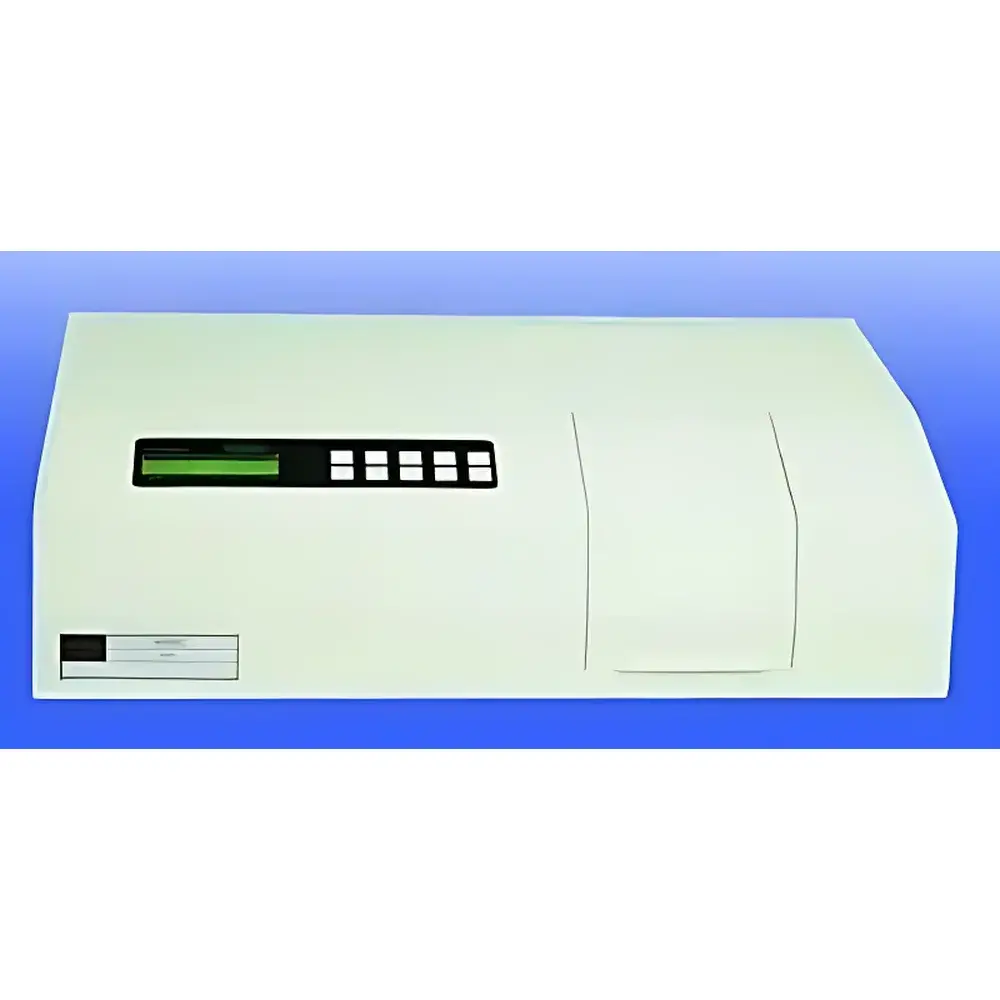
M500 Infrared Spectrometer
| Origin | Imported |
|---|---|
| Manufacturer Type | Authorized Distributor |
| Model | M500 |
| Price | Upon Request |
| Wavelength Range | 4000–600 cm⁻¹ |
| Scan Speed Options | 3 / 6 / 12 / 24 min per scan |
| Data Points per Scan | 4,250 (3 min) to 34,000 (24 min) |
| Detector | 1×2 mm DLaTGS (Deuterated L-Alanine doped Triglycine Sulfate), Sensitivity: 1 V/mW |
| Sample Compartment Area | 150 mm² |
| Display | Built-in LCD for wavenumber/absorbance readout |
| Interface | RS-232, analog recorder output |
| Heater Element | NiCr wire on sintered ceramic core |
| Dimensions | 66.7 × 38.7 × 18.4 cm (26.25″ × 15.25″ × 7.25″) |
| Weight | 17.2 kg (38 lbs) |
| Power Supply | 115/230 V AC, 50/60 Hz, 150 W |
Overview
The M500 Infrared Spectrometer is a compact, benchtop dispersive or filter-based infrared instrument engineered for routine qualitative and semi-quantitative analysis across diverse laboratory environments. Unlike Fourier Transform Infrared (FTIR) systems relying on interferometry and moving mirrors, the M500 employs a fixed-grating or monochromator-based optical architecture—offering mechanical simplicity, enhanced long-term alignment stability, and reduced sensitivity to environmental vibration. Its spectral coverage spans 4000–600 cm⁻¹ (2.5–16.7 µm), fully encompassing the mid-infrared fingerprint region essential for functional group identification in organic and inorganic compounds. Designed for robust operation in QC labs, teaching facilities, field-deployable units, and resource-constrained settings, the M500 delivers reproducible absorbance measurements with high optical throughput—enabling reliable detection of low-concentration analytes in transmission, ATR, or diffuse reflectance configurations.
Key Features
- Compact footprint (66.7 × 38.7 × 18.4 cm) and lightweight design (17.2 kg) optimize bench space without compromising optical path integrity.
- DLaTGS detector (1×2 mm active area, 1 V/mW responsivity) provides stable thermal detection performance across ambient temperature fluctuations, eliminating the need for liquid nitrogen cooling.
- Four selectable scan durations (3, 6, 12, or 24 minutes) allow trade-offs between spectral resolution, signal-to-noise ratio, and throughput—supporting both rapid screening and high-fidelity characterization.
- Integrated LCD display enables real-time monitoring of wavenumber position and absorbance values during acquisition—critical for manual sample alignment and diagnostic checks.
- Onboard zero-point calibration software grants users direct access to instrument control, baseline correction, and raw interferogram-free data acquisition—minimizing dependency on external PCs for basic operation.
- Modular heater assembly (NiCr wire wound on sintered ceramic core) ensures consistent source temperature stability, contributing to spectral repeatability over extended duty cycles.
Sample Compatibility & Compliance
The M500 accommodates standard 150 mm² sample compartments compatible with KBr pellets, thin films, liquids in sealed cells, and solid samples mounted on ATR crystals (e.g., ZnSe, diamond). Its mechanical architecture supports routine maintenance—including mirror alignment verification, source lamp replacement, and detector window cleaning—by trained end users, reducing downtime and service contract reliance. While not certified for GMP-regulated release testing under USP or ASTM E1421, the system complies with general laboratory safety standards (IEC 61010-1) and electromagnetic compatibility (EN 61326-1). Audit-ready data export (CSV, ASCII) and timestamped spectral metadata support GLP-aligned documentation practices when integrated into validated workflows.
Software & Data Management
The M500’s native software suite includes two operational tiers: a base-level interface for instrument control, real-time plotting, and peak annotation; and an advanced module incorporating AI-assisted spectral deconvolution, multivariate curve resolution (MCR), and library search algorithms compliant with ASTM E1252-98 guidelines. The embedded spectral library contains >12,000 reference spectra (including NIST, SDBS, and industry-specific collections), enabling match-factor-based identification via correlation coefficient ranking. All processed reports—quantitative calibrations, comparative overlays, and derivative spectra—are exportable in PDF or XML formats with embedded metadata (operator ID, date/time stamp, instrument serial number) to meet FDA 21 CFR Part 11 traceability requirements when deployed on validated Windows platforms.
Applications
The M500 serves as a primary analytical tool in food authenticity verification (e.g., adulterant detection in edible oils), pharmaceutical excipient profiling (lactose vs. microcrystalline cellulose differentiation), polymer batch consistency monitoring (PET vs. PVC discrimination), environmental soil screening (hydrocarbon contamination), forensic fiber analysis, and academic spectroscopy instruction. Its portability and low power draw (150 W) facilitate deployment in mobile labs, customs inspection points, and remote field stations where FTIR infrastructure is impractical. In clinical research settings, it supports rapid identification of biofluid biomarkers (e.g., serum protein secondary structure shifts) when coupled with standardized ATR protocols.
FAQ
Is the M500 compliant with FDA 21 CFR Part 11 for electronic records?
Yes—when operated on a validated Windows environment with user access controls, audit trail logging, and digital signature integration enabled, the software meets predicate rule requirements for electronic record retention.
Can the M500 perform quantitative analysis?
It supports univariate and multivariate calibration models (e.g., PLS regression) using reference standards; however, full validation per ICH Q2(R2) requires lab-specific protocol development and system suitability testing.
What maintenance is required for long-term wavelength accuracy?
Annual verification using polystyrene film (ASTM E1421) is recommended; the instrument’s fixed-optic design eliminates daily alignment but requires periodic source intensity normalization.
Does the M500 support external accessories such as gas cells or temperature-controlled stages?
Yes—standard 1/4″–20 threaded ports and analog voltage outputs enable integration with third-party accessories, including flow-through gas cells (up to 10 atm) and Peltier-cooled sample holders.
How does the M500 compare to FTIR in terms of resolution and sensitivity?
Its nominal resolution is 4 cm⁻¹ (configurable to 2 cm⁻¹ with extended scan time); while lower than high-end FTIR (95% of routine industrial identification tasks per ISO 17025 scope definitions.
Related Products





