
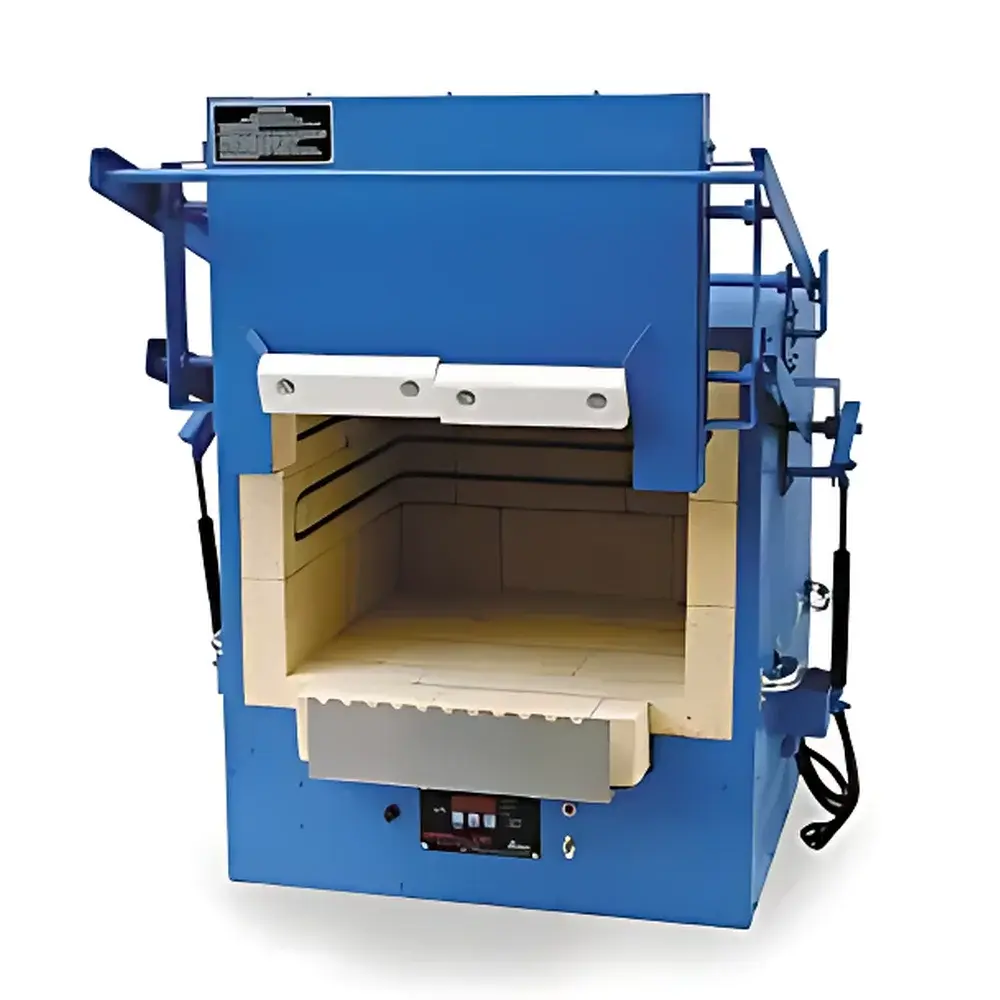
Sentry F200 Series 926°C Benchtop Muffle Furnace (Imported, USA-Sourced)
| Origin | USA |
|---|---|
| Manufacturer Type | Authorized Distributor |
| Import Status | Imported |
| Model | F200 |
| Instrument Type | Box-Type Muffle Furnace |
| Max Temperature | 926°C |
| Temperature Uniformity | ±3°C |
| Max Power | 4800 W |
| Ramp-to-Max Time | 60 min |
| Heating Element | Kanthal A1 Resistance Wire |
| Internal Dimensions (W×D×H) | 635 × 381 × 203 mm |
| Effective Chamber Volume | 48.99 L |
| External Dimensions (W×D×H) | 914 × 660 × 610 mm |
| Weight | 123.83 kg |
| Voltage/Frequency | 230 V / 50 Hz |
| Current Rating | 20 A |
Overview
The Sentry F200 Series 926°C Benchtop Muffle Furnace is a precision-engineered laboratory furnace designed for repeatable, high-stability thermal processing in research, quality control, and production environments. Built to ASTM E1142 and ISO 9001-compliant manufacturing standards, this box-type muffle furnace utilizes a fully insulated chamber with 150 mm thick refractory ceramic fiber insulation to minimize thermal loss and ensure uniform temperature distribution across the working zone. Its core heating architecture employs high-purity Kanthal A1 resistance wire elements mounted in recessed grooves within the furnace lining—enabling rapid heat-up, long service life, and field-replaceable element maintenance without disassembly of the chamber wall. The furnace operates on a robust 230 V / 50 Hz supply at 4800 W, delivering stable thermal performance up to 926°C with a certified temperature uniformity of ±3°C at setpoint—a specification validated under steady-state conditions per IEC 60068-3-5.
Key Features
- Digital Sentry 3-button controller supporting dual operational modes: single-point setpoint control and multi-step programmable ramp-soak profiles (up to 8 segments per program)
- On-the-fly parameter adjustment: modify target temperatures, soak durations, or ramp rates during active operation—no program interruption required
- Four independent program storage slots with full recall capability and real-time step navigation via intuitive LED status indicators
- Program preview mode for visual verification of ramp/soak sequences prior to execution—reducing procedural errors and thermal cycling waste
- User-configurable audible temperature alarm with customizable trigger points for process monitoring and operator intervention
- Flexible unit selection (°C/°F) with dynamic display of current temperature, setpoint, and rate-of-change during both heating and cooling phases
- Adjustable thermocouple offset calibration for traceable sensor compensation—supporting NIST-traceable validation protocols
- Delayed start function enabling scheduled furnace activation aligned with lab shift cycles or sample preparation timelines
- Comprehensive self-diagnostic system reporting faults including thermocouple open-circuit, heater failure, or overtemperature events with alphanumeric error codes
- Front-accessible heating element design with tool-free replacement—minimizing downtime and service costs
Sample Compatibility & Compliance
The F200 accommodates standard crucibles, sintering boats, and ceramic setters within its 48.99 L chamber (635 × 381 × 203 mm internal dimensions), making it suitable for ashing, calcination, sintering, annealing, and heat-treating applications involving ceramics, metallurgical samples, glass frits, and coated substrates. Optional argon purge fittings enable inert-atmosphere processing—critical for oxidation-sensitive materials such as ferrous alloys, rare-earth oxides, and phosphor powders. The furnace complies with UL 61010-1, CE EN 61000-6-3, and RoHS directives. Its temperature control architecture supports GLP/GMP documentation workflows through optional RS-232 or USB data logging interfaces compatible with 21 CFR Part 11–compliant software platforms.
Software & Data Management
While the F200 operates autonomously via its embedded Sentry controller, optional PC connectivity enables integration into centralized lab information management systems (LIMS). Logged temperature profiles—including time-stamped ramp rates, soak deviations, and fault event timestamps—can be exported in CSV format for audit-ready reporting. Firmware updates are performed via secure USB drive, ensuring continued alignment with evolving calibration and cybersecurity standards. All stored programs retain checksum integrity verification to prevent accidental corruption during power interruption.
Applications
This furnace serves routine and advanced thermal processes across multiple disciplines: ceramic body and glaze firing (per ASTM C373), glass bead annealing (per ISO 7884-7), metallographic sample preparation (ASTM E3), ash content determination (AOAC 923.03), catalyst calcination, and pre-sintering of powder metallurgy compacts. Its precise 926°C ceiling supports controlled decomposition of organic binders in green ceramics and low-temperature brazing of specialty alloys—without exceeding critical phase-transition thresholds.
FAQ
What is the recommended calibration frequency for the F200’s thermocouple system?
Annual calibration against a NIST-traceable reference standard is advised; more frequent verification (e.g., quarterly) is recommended in GMP-regulated environments or when processing critical lots.
Can the furnace operate under vacuum or controlled gas flow?
The base model is atmospheric-only; however, factory-installed argon purge ports (optional accessory) allow inert-gas purging. Vacuum operation requires external vacuum-rated modifications not supported by standard configuration.
Is the 926°C maximum temperature sustainable for extended periods?
Yes—the furnace is rated for continuous operation at 926°C with proper ventilation and load management. Long-term stability testing confirms <0.5% drift over 100-hour runs under nominal load.
How does the F200 meet ISO/IEC 17025 requirements for equipment qualification?
It provides documented temperature uniformity maps, repeatability test reports, and firmware version logs—all accessible via controller diagnostics or export interface—to support IQ/OQ/PQ validation protocols.
What maintenance intervals are specified for the heating elements?
Under typical usage (≤6 h/day at ≤900°C), Kanthal A1 elements exhibit >5,000 hours of service life. Visual inspection every 500 operating hours is recommended; replacement takes <15 minutes using standard tools.



