
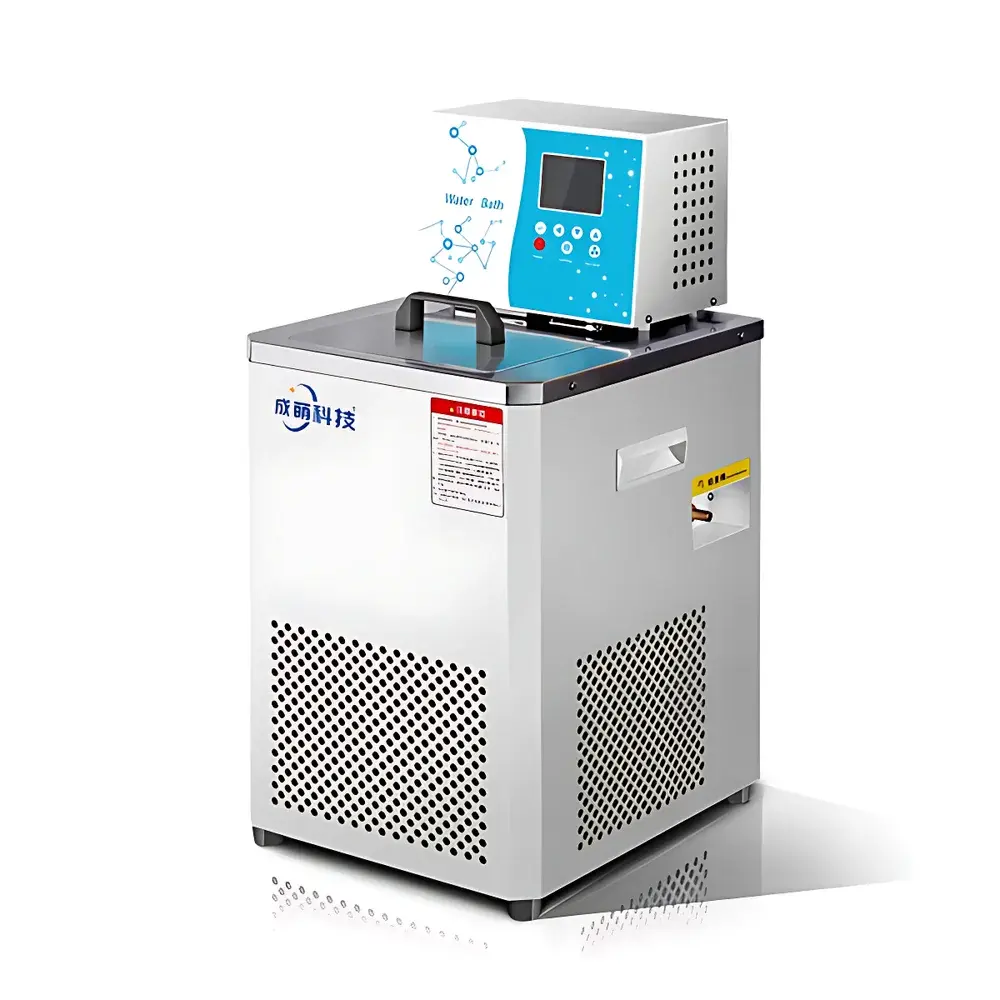
Chengmeng HX-1020 Precision Cryogenic Circulating Thermostat
| Brand | Chengmeng |
|---|---|
| Origin | Beijing, China |
| Model | HX-1020 |
| Instrument Type | Vertical |
| Temperature Range | −10 to 100 °C |
| Temperature Stability | ±0.05 °C |
| Temperature Uniformity | ±0.05 °C |
| Setpoint Resolution | ±0.01 °C |
| Bath Opening | 260 mm |
| Heating Power | 2.2 kW |
| Bath Volume | 20 L |
| Circulation Flow Rate | 5–20 L/min (adjustable) |
| Maximum Head | 3 m |
| Pressure Range | 0.05–0.15 MPa (adjustable) |
| External Dimensions (W×D×H) | 400 × 450 × 1040 mm |
| Net Weight | 40 kg |
| Compatible Fluid | Ethanol |
| Vibration Stability | ≤1 µm peak-to-peak (at sensor mounting point) |
| Supply Voltage | 220 V, 50 Hz |
Overview
The Chengmeng HX-1020 Precision Cryogenic Circulating Thermostat is an engineered temperature control platform designed for high-stability external and internal circulation applications in analytical laboratories, material testing environments, and R&D facilities. It operates on a dual-mode thermal regulation principle—combining resistive heating with vapor-compression refrigeration—to maintain precise setpoint temperatures across a wide operational range of −10 °C to +100 °C. The unit features a vertically oriented stainless-steel bath (20 L capacity) with integrated U-shaped nickel-plated copper cooling coils mounted along the inner wall perimeter, ensuring rapid thermal equilibration and minimizing axial and radial gradients. Its closed-loop circulation system delivers adjustable flow rates (5–20 L/min) at up to 3 m head pressure, enabling reliable temperature transfer to external apparatus such as spectrophotometer cells, calorimeters, or reaction jackets without compromising stability.
Key Features
- PID-based digital temperature controller with auto-tuning capability and manual parameter override for application-specific optimization.
- High-accuracy PT100 platinum resistance thermometer (three-wire U-type configuration), calibrated to IEC 60751 Class A tolerance, providing real-time bath temperature feedback with 0.01 °C resolution and repeatability.
- Backlit LCD interface with intuitive navigation, displaying setpoint, actual bath temperature, flow rate, and system status simultaneously.
- Dual-stage thermal safety architecture: independent electronic overtemperature cutoff (settable up to 105 °C) plus audible alarm activation upon deviation exceeding ±2 °C from setpoint.
- Programmable timer function supporting total runtime scheduling (up to 99 hours, 59 minutes), compatible with unattended overnight operation under GLP-compliant protocols.
- Low-vibration, brushless DC circulation pump with copper-core rotor motor and ceramic shaft bearings—designed to minimize mechanical perturbation (<1 µm p–p) critical for optical or microcalorimetric setups.
- Corrosion-resistant internal wetted path: nickel-plated copper cooling coils and 304 stainless-steel bath chamber compatible with ethanol, methanol, and aqueous glycol solutions.
Sample Compatibility & Compliance
The HX-1020 is validated for use with low-viscosity heat-transfer fluids including anhydrous ethanol (recommended), isopropanol, and 30/70 ethylene glycol–water mixtures. Its sealed circulation path prevents fluid evaporation and oxidation during extended operation. The unit conforms to IEC 61000-6-3 (EMC emission standards) and IEC 61010-1 (safety requirements for laboratory equipment). While not certified for medical device manufacturing, its temperature stability (±0.05 °C), traceable calibration support, and audit-ready operational logging make it suitable for ISO/IEC 17025-accredited testing labs performing ASTM D1550 (thermal conductivity of insulating oils), ISO 2556 (gas permeability through plastics), or USP (temperature-controlled dissolution apparatus qualification).
Software & Data Management
The thermostat supports optional RS485 Modbus RTU communication (via standard DB9 port) for integration into LabVIEW, MATLAB, or SCADA-based monitoring networks. Logged data—including timestamped temperature readings, setpoint history, and pump status—can be exported in CSV format via USB memory stick. Firmware supports configurable data sampling intervals (1–60 seconds) and includes built-in event tagging for alarm triggers and timer completions. All stored records retain metadata required for 21 CFR Part 11 compliance when paired with validated third-party electronic lab notebook (ELN) systems.
Applications
- Temperature stabilization of UV-Vis, FTIR, and fluorescence spectrometers requiring sub-0.1 °C thermal drift control.
- Circulating coolant supply for rotary evaporators, vacuum jacketed reactors, and Peltier-based thermal desorption units.
- Calibration verification of thermistors, RTDs, and infrared thermometers against NIST-traceable references.
- Accelerated aging studies per ASTM F1980 (sterile barrier systems) and ISO 11607 (packaging validation) where controlled ramp-and-hold thermal profiles are essential.
- Material property testing—including coefficient of thermal expansion (CTE), dynamic mechanical analysis (DMA) sample conditioning, and polymer crystallinity assessment via DSC pre-equilibration.
FAQ
What fluids are compatible with the HX-1020 bath system?
Ethanol is the recommended primary medium; methanol, isopropanol, and aqueous glycol solutions (≤50% concentration) are also supported. Avoid chlorinated solvents, acetone, or highly viscous oils.
Can the HX-1020 be used for sub-zero operation with water-based solutions?
No—water freezes below 0 °C. For temperatures below 0 °C, only non-aqueous, low-freezing-point fluids such as ethanol (freezing point −114 °C) must be used.
Is the unit suitable for GMP-regulated environments?
While not GMP-certified out-of-the-box, its programmable logging, alarm traceability, and calibration documentation support qualify it for use in GMP-aligned QC labs when operated under documented SOPs and periodic verification per ISO 17025 Clause 6.5.
Does the circulation pump support continuous duty cycle?
Yes—the brushless DC motor and sealed ceramic bearing assembly are rated for uninterrupted operation up to 10,000 hours under nominal load conditions.
How is temperature uniformity verified across the bath volume?
Uniformity is validated using three calibrated PT100 probes positioned at center, corner, and mid-wall locations per ASTM E741 methodology; results consistently meet ±0.05 °C spatial deviation at steady state.



