
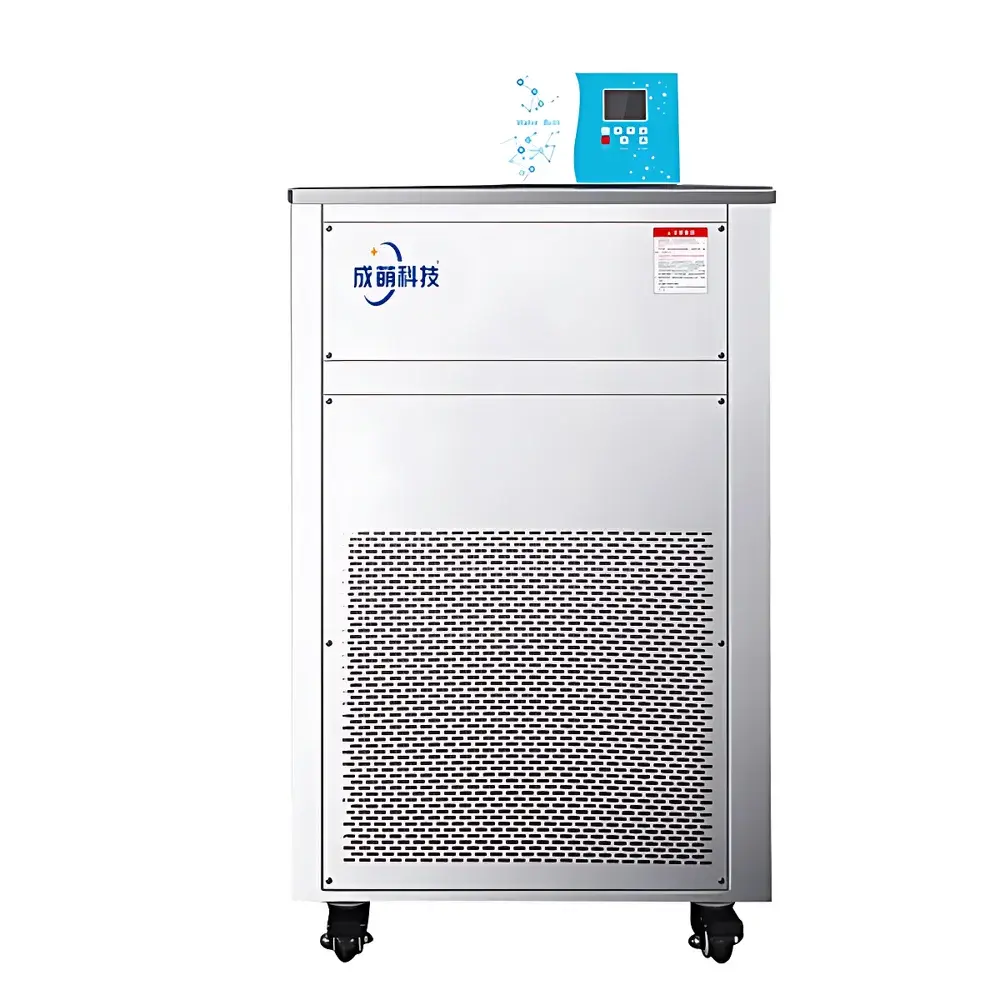
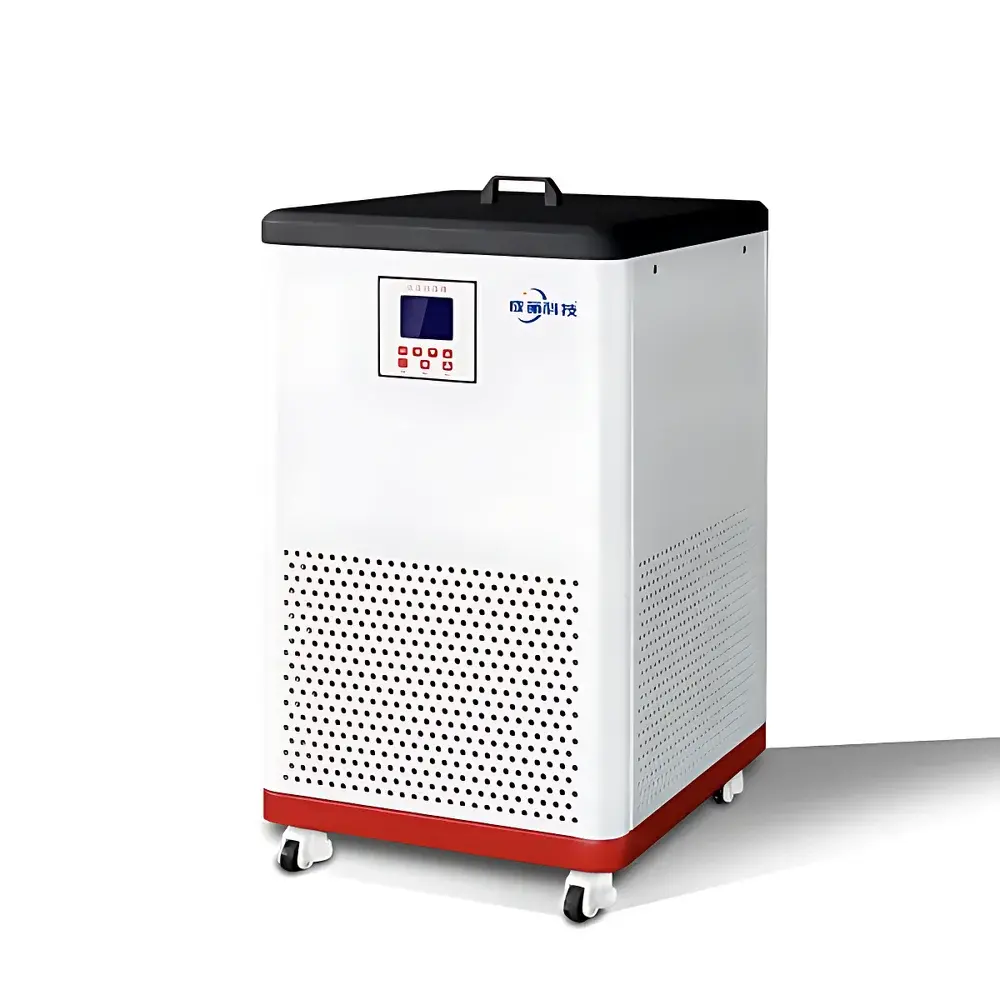
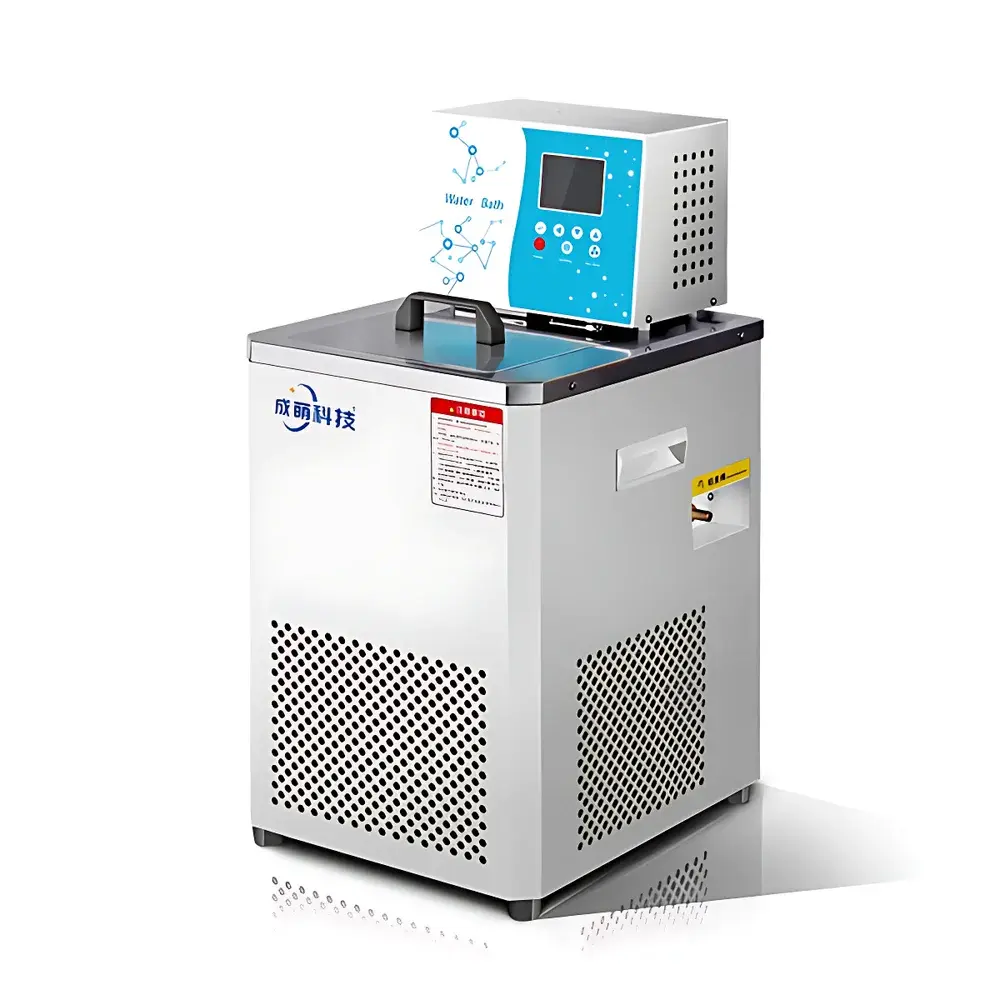
Chengmeng DC-2006 Cryogenic Circulating Thermostat
| Brand | Chengmeng |
|---|---|
| Origin | Beijing, China |
| Manufacturer Type | Authorized Distributor |
| Country of Origin | China |
| Model | DC-2006 |
| Instrument Type | Vertical |
| Temperature Range | −20 °C to 100 °C |
| Temperature Stability (Fluctuation) | ±0.05 °C |
| Temperature Uniformity | ±0.05 °C |
| Setpoint Resolution | 0.05 °C |
| Bath Opening | 180 mm |
| Bath Volume | 6 L |
| Heating Power | 1 kW |
| Circulating Medium | Ethanol |
| External Dimensions (W×D×H) | 320 mm × 370 mm × 675 mm |
| Net Weight | 50 kg |
| Vibration Stability | ≤1 µm RMS |
| Working Distance (from bath surface to top of circulation port) | 3 cm |
Overview
The Chengmeng DC-2006 Cryogenic Circulating Thermostat is a vertically configured, precision temperature control system engineered for laboratory applications requiring stable, programmable thermal environments across a wide operational range (−20 °C to +100 °C). It operates on a closed-loop refrigeration–heating principle, integrating a hermetic compressor, high-efficiency condenser, expansion valve, and electric heating element within a single compact chassis. Temperature regulation is achieved via PID-controlled dual-mode operation—refrigeration for sub-ambient cooling and resistive heating for above-ambient stabilization—ensuring seamless transition across the full setpoint range without manual mode switching. The unit employs forced-circulation thermofluid dynamics, delivering consistent thermal energy transfer to external devices (e.g., spectrophotometer cells, viscometer jackets, or reaction blocks) through an integrated centrifugal pump with adjustable flow output. Designed for integration into analytical workflows governed by GLP, ISO/IEC 17025, and ASTM E29–22 compliance frameworks, the DC-2006 meets essential requirements for traceable, reproducible temperature conditioning in QC labs, material science research, and pharmaceutical stability testing.
Key Features
- Precision temperature control with ±0.05 °C stability and uniformity—validated per ASTM E742 and ISO 17025 calibration protocols
- Vertical footprint optimized for benchtop space efficiency (320 mm × 370 mm × 675 mm), minimizing lab floor occupancy while maintaining 6 L working volume
- Integrated circulation pump with adjustable flow rate and 1.4 m head capacity, compatible with external systems up to 15 m tubing length
- Corrosion-resistant stainless-steel bath vessel and ethanol-compatible fluid path—certified for use with aqueous ethanol mixtures (up to 99.5% v/v)
- Dual-sensor architecture: independent Pt100 resistance thermometer for control loop feedback and redundant sensor for real-time deviation monitoring and alarm triggering
- Front-panel digital interface with 0.05 °C setpoint resolution, real-time display of bath temperature, setpoint, and system status indicators (compressor, heater, pump, error codes)
- Vibration-damped mechanical design achieving ≤1 µm RMS displacement at operating frequencies—critical for optical interferometry, AFM staging, and high-resolution spectroscopy support
Sample Compatibility & Compliance
The DC-2006 supports immersion-based and external jacketed sample conditioning for a broad class of instruments and experimental setups, including UV-Vis cuvette holders, rotary viscometer spindles, calorimetry cells, and chromatographic column ovens. Its 180 mm square bath opening accommodates standard 150 mm depth accessories and permits direct insertion of test probes or custom fixtures. The system is certified for operation with ethanol as primary circulating medium—selected for its low freezing point (−114 °C), chemical inertness toward glass and stainless steel, and absence of halogenated compounds that may interfere with GC-MS or ICP-MS environments. All electrical components comply with IEC 61010-1:2010 safety standards for laboratory equipment. Documentation includes factory calibration certificate (NIST-traceable reference standard), CE marking, and RoHS 2011/65/EU conformance statement.
Software & Data Management
While the DC-2006 operates autonomously via its embedded controller, optional RS232/RS485 serial interface enables bidirectional communication with host PCs running third-party LabVIEW™, MATLAB®, or Python-based acquisition platforms. Communication protocol adheres to Modbus RTU standard, supporting remote setpoint adjustment, real-time temperature logging, and alarm event reporting. For regulated environments, optional firmware upgrade provides 21 CFR Part 11-compliant audit trail functionality—including user authentication, electronic signatures, and immutable timestamped records of all parameter changes. Data export is supported in CSV format with configurable sampling intervals (1 s to 60 min), facilitating integration into LIMS or ELN ecosystems.
Applications
- Calibration of temperature-sensitive sensors (thermistors, RTDs, infrared detectors) per ISO/IEC 17025 Clause 6.4
- Thermal preconditioning of polymer samples prior to DSC or TMA analysis
- Stabilization of laser diode mounts and optical benches in metrology labs
- Controlled-rate cooling for crystallization studies in organic synthesis
- Temperature-dependent viscosity measurements using rotational or capillary viscometers
- Accelerated stability testing of pharmaceutical formulations under ICH Q1A(R3) guidelines
FAQ
What is the recommended maintenance schedule for the DC-2006?
Perform visual inspection of coolant level and pump inlet filter every 30 days; replace ethanol medium annually or after 500 operational hours, whichever occurs first.
Can the DC-2006 be used with water-glycol mixtures?
No—only ethanol or ethanol–water blends are approved. Glycol-based fluids risk pump seal degradation and thermal efficiency loss due to increased viscosity below −10 °C.
Is external temperature probe input supported?
Not natively; however, the RS485 interface allows connection to external Pt100 probes via programmable logic controllers (PLCs) for cascade control configurations.
Does the unit include a calibration certificate?
Yes—a NIST-traceable factory calibration certificate is supplied with each unit, documenting verification at −20 °C, 25 °C, and 100 °C using Fluke 1524 thermometers.
What safety interlocks are implemented?
Overtemperature cutoff (105 °C), low-level fluid sensor, compressor high-pressure cutout, and open-circuit heater protection—all independently wired to fail-safe relay outputs.
Related Products



