
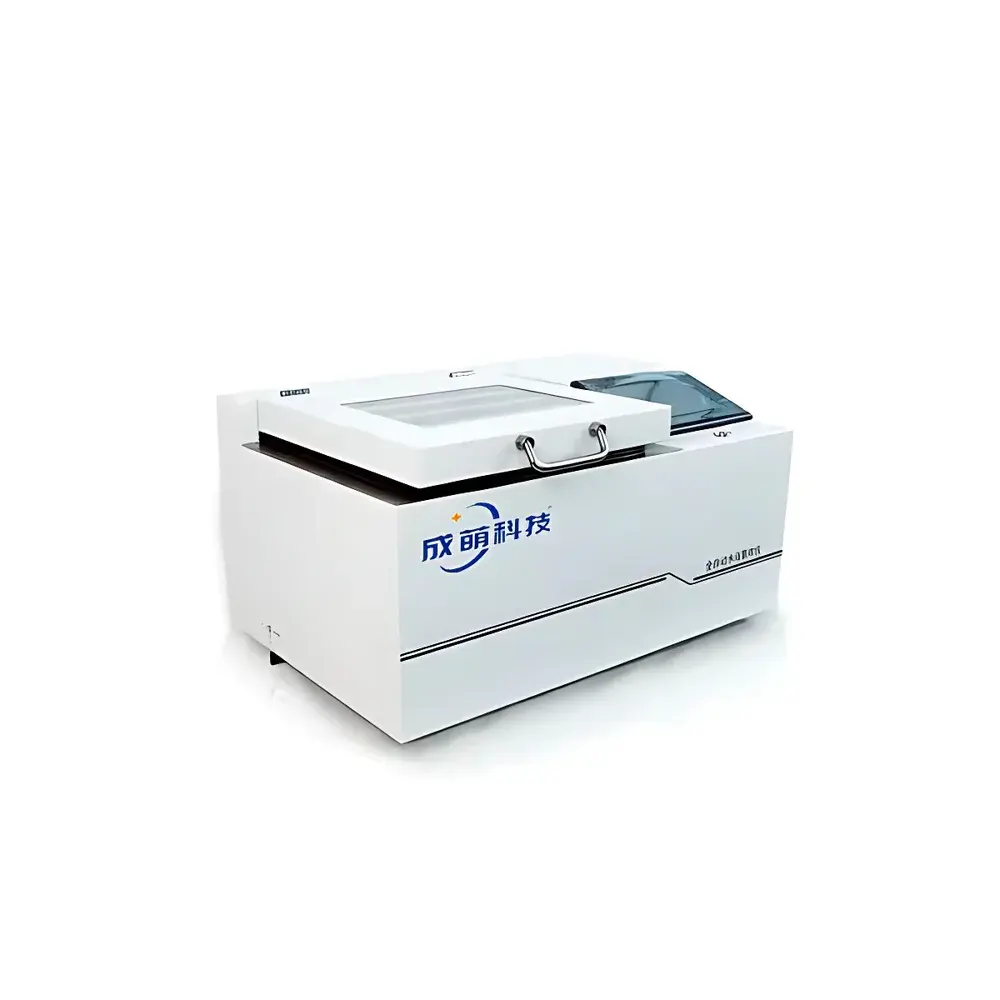
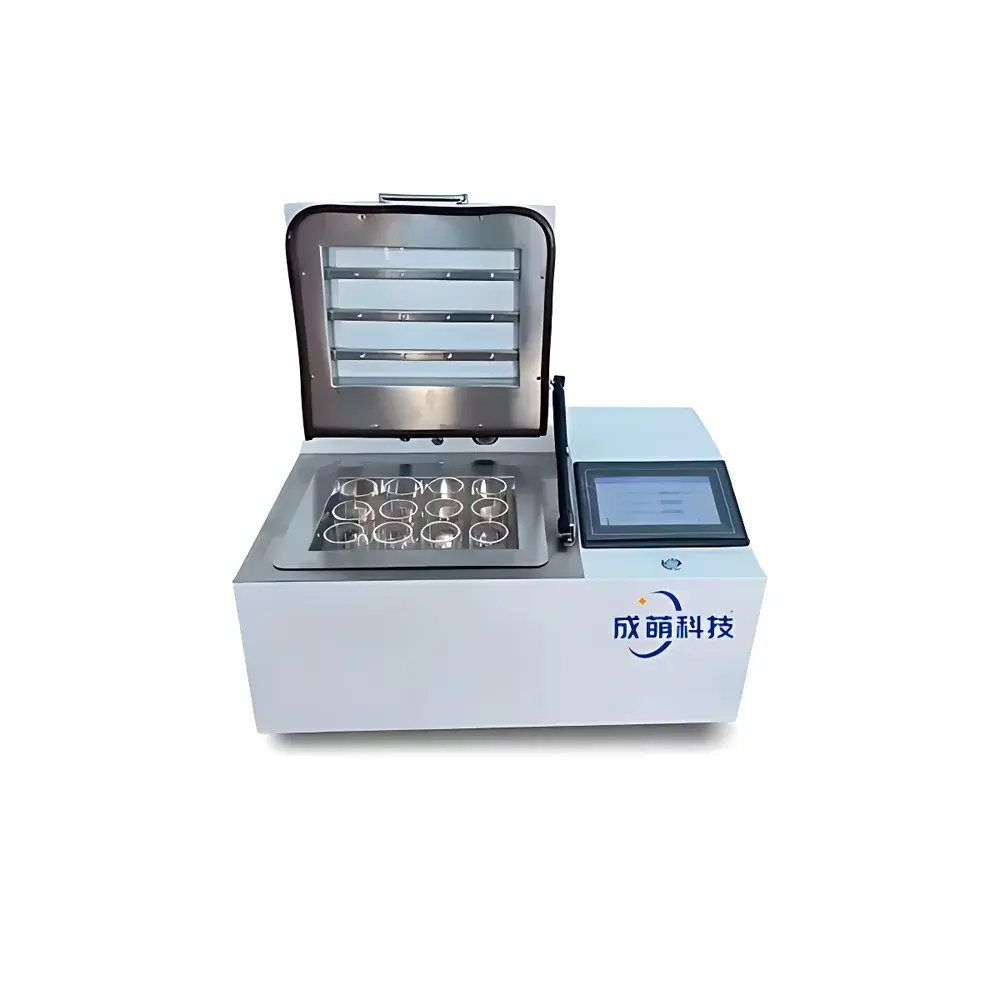
Chengmeng CMDS-24D Automated Nitrogen Evaporator
| Brand | Chengmeng Technology |
|---|---|
| Origin | Beijing, China |
| Manufacturer Type | Authorized Distributor |
| Region of Manufacture | Domestic (China) |
| Model | CMDS-24D |
| Instrument Category | Automated Quantitative Concentrator |
| Temperature Range | Ambient to 99 °C |
| Temperature Control Accuracy | ±0.5 °C |
| Sample Capacity per Vial | 150 mL |
| Heating Method | Dry-Block (Water Bath Optional) |
| Endpoint Detection | Optical Sensor per Channel |
| Adjustable Endpoint Volumes | 1.0 mL, 0.5 mL, or Near-Dry (~0.1 mL) |
| Nitrogen Pressure Control | 0–0.1 MPa (adjustable in 0.01 MPa increments) |
| Inlet N₂ Supply Requirement | 0.2–0.8 MPa (max tolerance: 1.0 MPa) |
| Gas Consumption | ~500 mL/min per channel at 0.1 MPa |
| Endpoint Sensitivity | 10-Level Adjustable |
| Dimensions | 650 × 450 × 308 mm |
| Weight | 21 kg |
Overview
The Chengmeng CMDS-24D Automated Nitrogen Evaporator is an engineered solution for quantitative solvent removal in analytical sample preparation workflows. Designed around controlled nitrogen gas flow and precise dry-block thermal regulation, it implements a validated evaporation principle based on forced convective heat transfer and inert gas displacement—minimizing oxidative degradation and thermal stress on thermolabile analytes. Unlike open-vessel or rotary evaporation methods, the CMDS-24D delivers reproducible endpoint control across up to 24 independent channels, enabling parallel processing of diverse sample matrices without cross-contamination or manual intervention. Its integrated exhaust management system—including a built-in centrifugal blower and directed venting path—eliminates reliance on fume hoods, allowing safe deployment on standard laboratory benches while complying with occupational exposure limits (OELs) for volatile organic compounds (VOCs) per OSHA and EU-OSHA guidelines.
Key Features
- 24-channel independent endpoint detection: Each position is equipped with a calibrated optical sensor capable of detecting liquid meniscus changes across variable vial geometries (50 mL and 150 mL formats), supporting simultaneous use of mixed vessel types.
- Stable nitrogen pressure regulation: An onboard proportional pressure controller maintains constant gas delivery (0–0.1 MPa, 0.01 MPa resolution) regardless of channel activation sequence or count—ensuring uniform evaporation kinetics and inter-channel comparability.
- Dry-block heating architecture: Aluminum alloy heating blocks provide rapid thermal response (ambient to 99 °C in <12 min) and exceptional spatial uniformity (<±0.5 °C setpoint deviation), with optional water bath modules available for applications requiring gentler thermal gradients.
- Multi-level endpoint sensitivity: Ten-step optical threshold adjustment accommodates solvents with differing refractive indices and chromatic properties (e.g., acetone, hexane, DMSO, methanol), improving volumetric accuracy during final concentration steps.
- Fail-safe operational monitoring: Real-time diagnostics trigger audible/visual alerts for lid-open events, low water-bath level (if configured), insufficient inlet N₂ pressure (<0.2 MPa), and completion of all active channels.
- Chemically inert fluid path: All gas-contact surfaces—including regulators, manifolds, and needle guides—are constructed from electropolished 316 stainless steel and PTFE-coated components, certified for trace-metal-free operation per ISO 17025-compliant laboratories.
Sample Compatibility & Compliance
The CMDS-24D supports standard 150 mL borosilicate glass test tubes and 50 mL conical vials with compatible threaded caps. It is routinely deployed in regulated environments handling environmental extracts (EPA Methods 508, 525), clinical biofluids (plasma, urine), food residue testing (AOAC 2007.01), and pharmaceutical impurity profiling (ICH Q2(R2)). While not pre-certified to FDA 21 CFR Part 11, its event-logged operation mode—including timestamped start/stop records, pressure/temperature profiles, and endpoint confirmation—supports audit-ready documentation when integrated with validated LIMS or ELN systems. The device conforms to IEC 61010-1:2010 for electrical safety and meets CE marking requirements for laboratory equipment within the European Economic Area.
Software & Data Management
The CMDS-24D operates via an embedded 4.3-inch capacitive touchscreen interface with intuitive icon-driven navigation. All method parameters—including temperature ramp profiles, dwell times, pressure setpoints, and endpoint volume selection—are stored as user-defined protocols (up to 99 methods). System logs retain the last 1,000 run records locally, exportable via USB 2.0 to CSV format for traceability. No proprietary software installation is required; however, optional RS-232 or Ethernet connectivity enables remote status polling and integration into centralized lab automation frameworks compliant with ASTM E1578-18 (Laboratory Information Management Systems).
Applications
- Environmental analysis: Pre-concentration of pesticide residues, PAHs, PCBs, and organochlorines from solid-phase extraction (SPE) eluates prior to GC-MS or LC-MS/MS injection.
- Clinical toxicology: Reduction of large-volume urine or serum extracts to microvolumes suitable for high-sensitivity immunoassay or tandem mass spectrometry quantification.
- Food safety testing: Final cleanup step in multi-residue methods for veterinary drug screening (e.g., β-agonists, sulfonamides) per EU Commission Decision 2002/657/EC.
- Forensic chemistry: Solvent exchange and volume reduction of hair digestates or tissue homogenates under inert atmosphere to prevent analyte oxidation.
- Academic research: High-throughput library preparation for metabolomics, where consistent recovery of low-abundance polar metabolites demands minimal thermal exposure and no carryover.
FAQ
Can the CMDS-24D be used with corrosive solvents such as concentrated HCl or TFA?
Yes—provided appropriate corrosion-resistant vial liners (e.g., PFA-coated inserts) are used and exhaust ducting is chemically rated for acid vapors. Standard configurations support chlorinated and fluorinated solvents but require periodic inspection of O-rings and pressure seals.
Is calibration verification supported out-of-the-box?
The unit includes a factory calibration certificate traceable to NIST standards for temperature and pressure sensors. Users may perform field verification using external Class A thermometers and digital pressure gauges per ISO/IEC 17025 Section 6.5.
Does the system meet GLP requirements for regulated labs?
It supports GLP adherence through full parameter logging, operator ID tagging (via optional RFID badge reader), and electronic signature-capable audit trails when paired with compliant third-party data management software.
What maintenance intervals are recommended?
Optical sensors should be cleaned weekly with lint-free isopropanol swabs; pressure regulator filters require replacement every 6 months under continuous operation; blower motor bearings are rated for 20,000 hours and do not require scheduled lubrication.
Can the instrument be integrated into robotic liquid handling workcells?
Yes—via TTL-compatible I/O ports (included) for start/stop triggering and status feedback, enabling synchronization with autosamplers, gripper arms, and track-based sample carriers per SLAS ANSI/SLAS 2-2015 specifications.



