
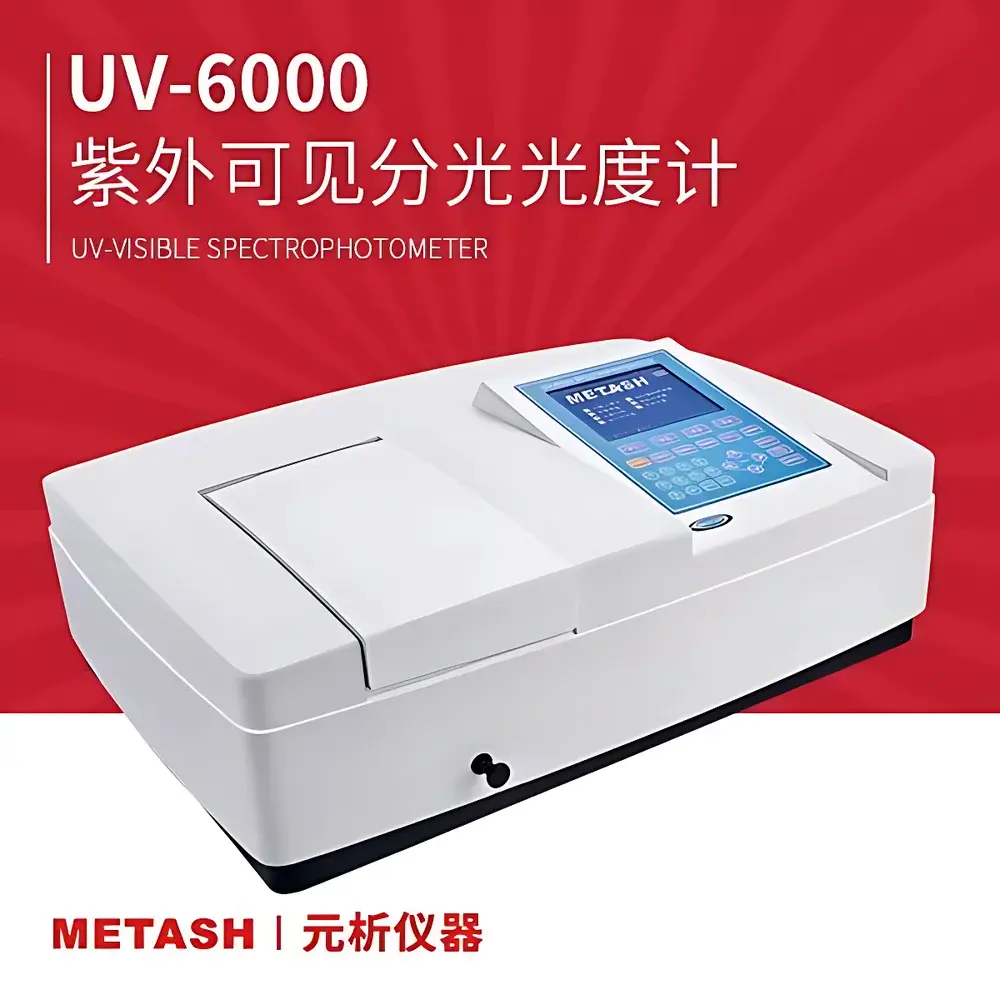
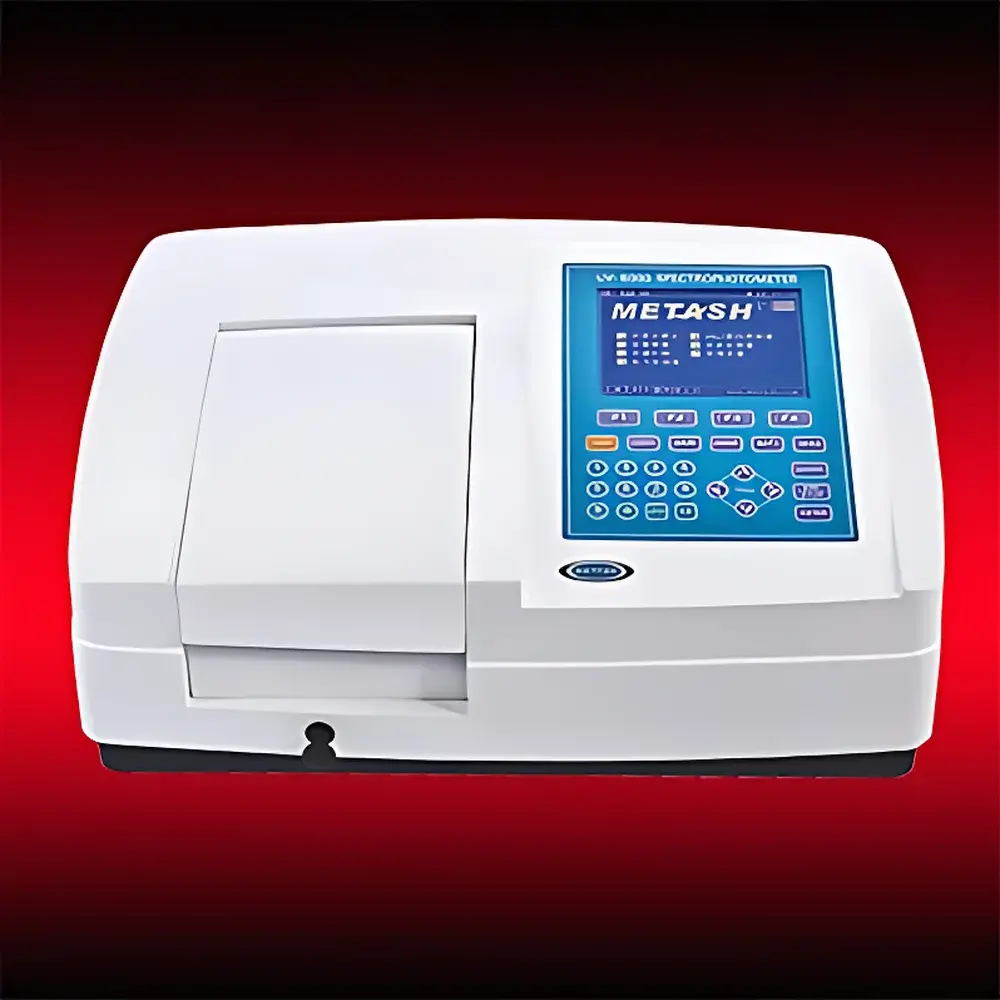
Metash UV-6000 Dual-Beam Ratio-Monitoring UV-Vis Spectrophotometer
| Brand | Metash Instruments |
|---|---|
| Origin | Shanghai, China |
| Manufacturer | Yes |
| Type | Domestic |
| Model | UV-6000 |
| Price Range | USD 2,800–4,200 (FOB Shanghai) |
| Optical System | Dual-beam ratio-monitoring |
| Detector | Photodiode Array (PDA) |
| Wavelength Range | 190–1100 nm |
| Wavelength Accuracy | ±0.5 nm |
| Wavelength Repeatability | ≤0.2 nm |
| Spectral Bandwidth | 1.8 nm |
| Stray Light | ≤0.05% T |
| Automation Level | Automatic wavelength scanning and calibration |
| Display | 6-inch full-color LED touchscreen |
| Data Interface | USB 2.0 |
| Software Compliance | GLP/GMP-compliant audit trail, user management, electronic signature support (21 CFR Part 11 ready) |
Overview
The Metash UV-6000 is a dual-beam ratio-monitoring ultraviolet-visible spectrophotometer engineered for high-stability quantitative and qualitative analysis in regulated and research laboratory environments. Unlike conventional single-beam instruments, the UV-6000 employs a real-time reference beam path that continuously monitors source intensity fluctuations—enabling dynamic compensation of lamp drift, thermal instability, and power supply variance. This architecture ensures exceptional photometric reproducibility (<0.002 A at 0.5 A, 2σ over 4 hours) without requiring frequent zeroing or baseline recalibration. The optical bench is constructed from a monolithic 8-mm-thick aerospace-grade aluminum baseplate, isolating the suspended optical train from mechanical vibration and structural deformation. Combined with imported deuterium and tungsten-halogen lamps and precision-machined quartz optics, this design delivers low-stray-light performance (≤0.05% T at 220 nm and 340 nm), essential for accurate absorbance measurements in trace-level applications such as nucleic acid quantification and low-concentration pharmaceutical assays.
Key Features
- Dual-beam ratio-monitoring optical system with real-time reference channel correction for enhanced long-term photometric stability
- 6-inch full-color LED touchscreen display enabling standalone operation—no PC required for basic photometry, kinetics, multi-wavelength analysis, or spectral scanning
- Suspended optical assembly mounted on rigid 8-mm aluminum optical baseplate to minimize sensitivity to ambient vibration and thermal expansion
- Photodiode array (PDA) detector providing rapid spectral acquisition (full 190–1100 nm scan in 300:1 at 500 nm)
- Pre-aligned, factory-optimized optical path with imported UV-grade deuterium and visible-range tungsten-halogen lamps
- Comprehensive built-in functionality: photometric mode, quantitative analysis (single/multi-point calibration), kinetic time-course monitoring, DNA/protein A260/A280 ratio calculation, and multi-wavelength absorbance comparison
Sample Compatibility & Compliance
The UV-6000 supports standard 10-mm rectangular cuvettes (quartz, glass, or plastic), as well as optional accessories including an automated 8-position sample changer, micro-volume cuvette holder (down to 50 µL pathlength), Peltier-controlled temperature-regulated cell holder (±0.1 °C), and integrating sphere reflectance module for solid-sample analysis. All hardware and firmware comply with ISO/IEC 17025:2017 requirements for testing laboratories. The instrument’s software architecture conforms to Good Laboratory Practice (GLP) and Good Manufacturing Practice (GMP) standards, featuring role-based user access control, immutable electronic logbooks with timestamped entries, full audit trail for all method changes and data modifications, and exportable PDF/CSV reports compliant with FDA 21 CFR Part 11 when used with validated electronic signature modules.
Software & Data Management
The UV-6000 is supplied with Metash SpectraPro™ PC software (Windows 10/11 compatible), which extends instrument capabilities with advanced spectral processing tools—including baseline correction, peak identification, derivative spectroscopy, and spectral subtraction. Data files are stored in vendor-neutral .csv and .jdx formats, ensuring long-term archival integrity and third-party software interoperability (e.g., OriginLab, MATLAB, UNIFI). The software implements secure authentication protocols, automatic backup scheduling, and encrypted local database storage. All analytical methods—including calibration curves, kinetic parameters, and DNA concentration algorithms—are saved with metadata (operator ID, timestamp, instrument serial number), satisfying traceability requirements under ISO 17025 Clause 7.7 and USP .
Applications
The UV-6000 serves critical roles across quality control, R&D, and academic laboratories. It is routinely deployed for: quantification of nucleic acids and proteins using A260/A280 ratios per established protocols (e.g., Nanodrop-equivalent workflows); dissolution testing of solid oral dosage forms per USP ; colorimetric enzyme assays (e.g., ELISA, LDH, ALP); purity assessment of organic intermediates via UV cutoff analysis; verification of filter transmission characteristics in optical component manufacturing; and environmental water analysis (e.g., nitrate, phosphate, COD via Hach-style colorimetric methods). Its 1.8 nm spectral bandwidth meets resolution requirements for pharmacopeial monographs involving overlapping absorption bands.
FAQ
Does the UV-6000 support 21 CFR Part 11 compliance?
Yes—when operated with SpectraPro™ software configured with electronic signatures, audit trail logging, and role-based permissions, the system meets core technical controls for Part 11 compliance.
Is the optical system truly dual-beam or is it a pseudo-dual design?
It implements a true dual-beam ratio-monitoring configuration: both sample and reference beams are simultaneously measured via beam-splitting optics and synchronized PDA readout—no moving parts or chopper wheels are involved.
Can the instrument be integrated into a LIMS environment?
Yes—via ASCII-based USB communication protocol and configurable CSV export templates, enabling direct ingestion into major LIMS platforms including LabWare, STARLIMS, and Thermo Fisher SampleManager.
What is the recommended maintenance interval for lamp replacement?
Deuterium lamp lifetime is rated at ≥1,500 hours; tungsten-halogen lamp at ≥3,000 hours. Automatic lamp usage tracking and end-of-life warnings are embedded in firmware.
Are NIST-traceable calibration certificates available?
Yes—certified wavelength and photometric accuracy verification kits (NIST SRM 2034, 930D) are supported; factory calibration certificates with uncertainty budgets are provided upon request.




