
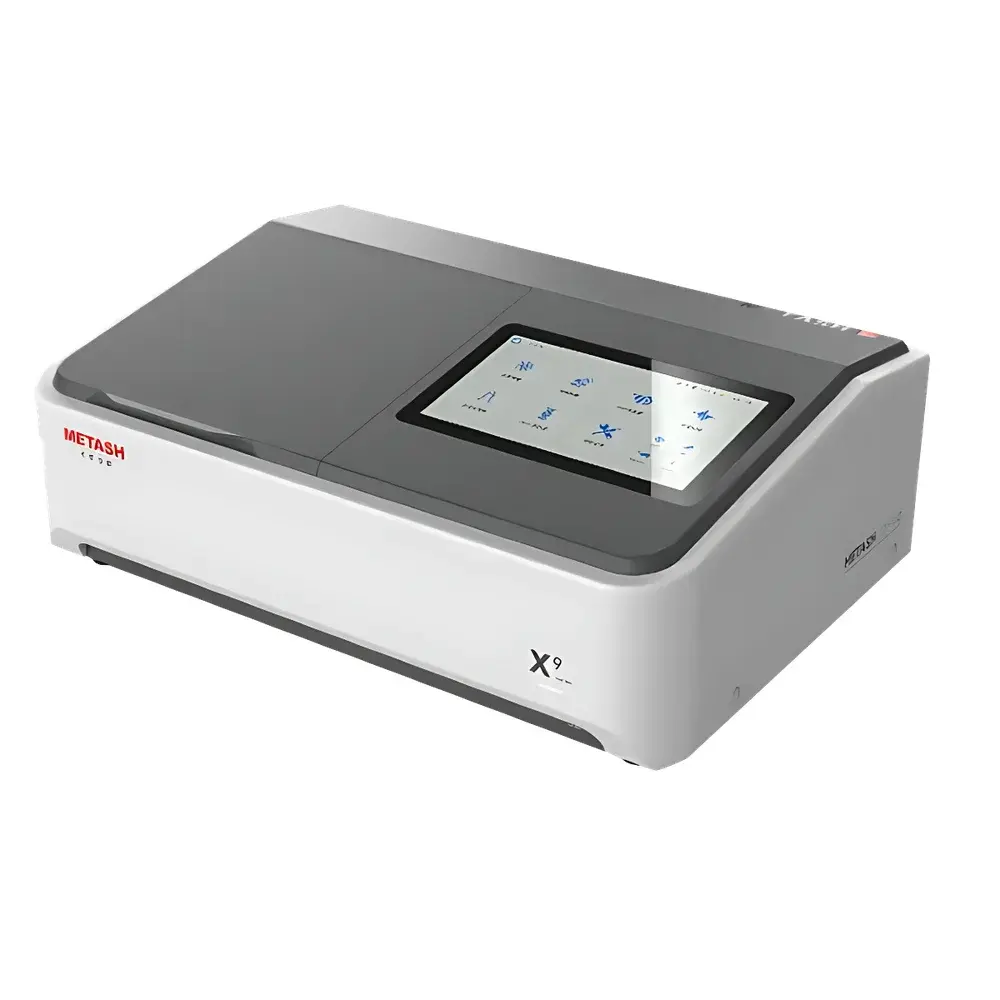
Metash X-9D Dual-Beam UV-Vis Spectrophotometer
| Brand | Metash Instruments |
|---|---|
| Origin | Shanghai, China |
| Manufacturer | Yes |
| Type | Domestic |
| Model | X-9D |
| Price Range | USD 9,800 – 13,900 (FOB Shanghai) |
| Optical Design | Dual-beam |
| Detector | Silicon Photocell |
| Wavelength Range | 190–1100 nm |
| Wavelength Scanning | Automatic |
| Spectral Bandwidth | 1.8 nm |
| Wavelength Accuracy | ±0.3 nm |
| Wavelength Repeatability | ≤0.1 nm |
| Stray Light | ≤0.01%T |
| Photometric Repeatability | ≤0.1%T (0–100%T) |
| Noise Level | ≤0.3%T |
| Display | 10-inch capacitive touchscreen (1024 × 600) |
| Connectivity | USB, Bluetooth, Wi-Fi (optional) |
| Data Output | A4 printer support (inkjet/laser), customizable file naming, GLP-compliant audit trail |
Overview
The Metash X-9D Dual-Beam UV-Vis Spectrophotometer is engineered for high-precision absorbance, transmittance, and reflectance measurements across the full ultraviolet–visible–near-infrared spectrum (190–1100 nm). Based on a rigorously validated dual-beam optical architecture, it continuously compares sample and reference beam intensities in real time—minimizing errors from source drift, thermal fluctuation, and solvent refractive index variation. Its sealed optical chamber, combined with SiO₂-coated mirrors and precision-machined aluminum baseplate (20 mm thick), ensures long-term mechanical stability and resistance to environmental perturbations—including ambient temperature gradients, humidity shifts, and mechanical vibration. The instrument complies with fundamental photometric principles defined in ISO 6223, ASTM E275, and USP , and supports routine calibration verification per NIST-traceable standards.
Key Features
- Dual-beam optical path with real-time reference compensation for enhanced photometric stability and reduced baseline drift
- 10-inch multi-touch capacitive display (1024 × 600 resolution) with <3 ms response time, adjustable brightness, and glove-compatible sensitivity
- Suspended optical system rigidly mounted on a CNC-machined aluminum base—reducing weight by ~30% versus cast-iron alternatives while maintaining dimensional integrity under thermal and mechanical stress
- Plug-and-play deuterium and tungsten-halogen lamps; lamp replacement requires only two screws—no optical realignment necessary
- Automatic wavelength initialization and onboard self-calibration at power-on, ensuring persistent wavelength accuracy (±0.3 nm) without manual intervention
- Optical isolation design: fully sealed compartment with SiO₂-protected mirror coatings to suppress stray light (<0.01%T) and extend component lifetime in lab environments with trace corrosive vapors or particulate exposure
Sample Compatibility & Compliance
The X-9D accommodates standard 10-mm cuvettes (quartz, glass, or plastic), as well as specialized accessories including an optional 8-position automated cell changer, 5-position variable-pathlength holder, Peltier-controlled temperature-regulated autosampler, integrating sphere (for diffuse reflectance), and specular reflectance module. All hardware and firmware are designed to support Good Laboratory Practice (GLP) and Good Manufacturing Practice (GMP) workflows: user-level access control, encrypted data storage, immutable electronic logbooks with timestamped operator ID, and full audit trail generation compliant with FDA 21 CFR Part 11 requirements for regulated pharmaceutical and biotech applications.
Software & Data Management
The embedded operating system delivers native single-unit operation—supporting photometric, quantitative, kinetic, spectral scanning, multi-wavelength, and nucleic acid/protein analysis modes within one unified interface. Data export options include USB mass storage (with custom filename assignment), Bluetooth wireless transfer to paired PCs or mobile devices, and optional Wi-Fi connectivity for network integration. Reporting conforms to ISO/IEC 17025 documentation standards: all spectra, calibration records, method parameters, and raw absorbance values are stored with metadata (date/time, operator ID, instrument serial number, lamp hours). Exported reports are PDF/A-1a compatible and printable directly to A4-format inkjet or laser printers with vector-based graphics rendering.
Applications
The X-9D is routinely deployed in QC laboratories for raw material identification (e.g., excipient verification per USP monographs), concentration quantification of small-molecule APIs (via Beer–Lambert law), enzymatic reaction kinetics (NADH/NADPH assays at 340 nm), DNA/RNA purity assessment (A260/A280 ratios), and colorimetric endpoint assays (e.g., Bradford, Lowry, BCA). Its extended near-IR range enables characterization of organic dyes, semiconductor nanoparticles, and polymer film thickness via interference fringe analysis. Academic users leverage its high wavelength repeatability (≤0.1 nm) for teaching spectroscopic fundamentals, while environmental labs apply it to nitrate/nitrite determination in water samples using EPA Method 353.2.
FAQ
Does the X-9D meet regulatory requirements for pharmaceutical testing?
Yes—it supports 21 CFR Part 11 compliance through role-based user authentication, electronic signatures, and tamper-evident audit logs.
Can I perform kinetic measurements without connecting to a PC?
Yes—kinetic mode is fully functional in standalone operation with configurable time intervals, point count, and real-time curve visualization.
Is the stray light specification verified across the entire 190–1100 nm range?
Yes—stray light ≤0.01%T is confirmed at critical wavelengths (e.g., 220 nm with NaI solution, 340 nm with acetone) per ISO 9022-12 test protocols.
What lamp lifetime can be expected under typical usage conditions?
Deuterium lamp: ≥2,000 hours; Tungsten-halogen lamp: ≥5,000 hours—both monitored via integrated hour counters and displayed in system diagnostics.
Are method files transferable between instruments of the same model?
Yes—methods, calibration curves, and measurement templates are saved in vendor-neutral XML format and interoperable across all X-9D units running firmware v3.2 or later.






