
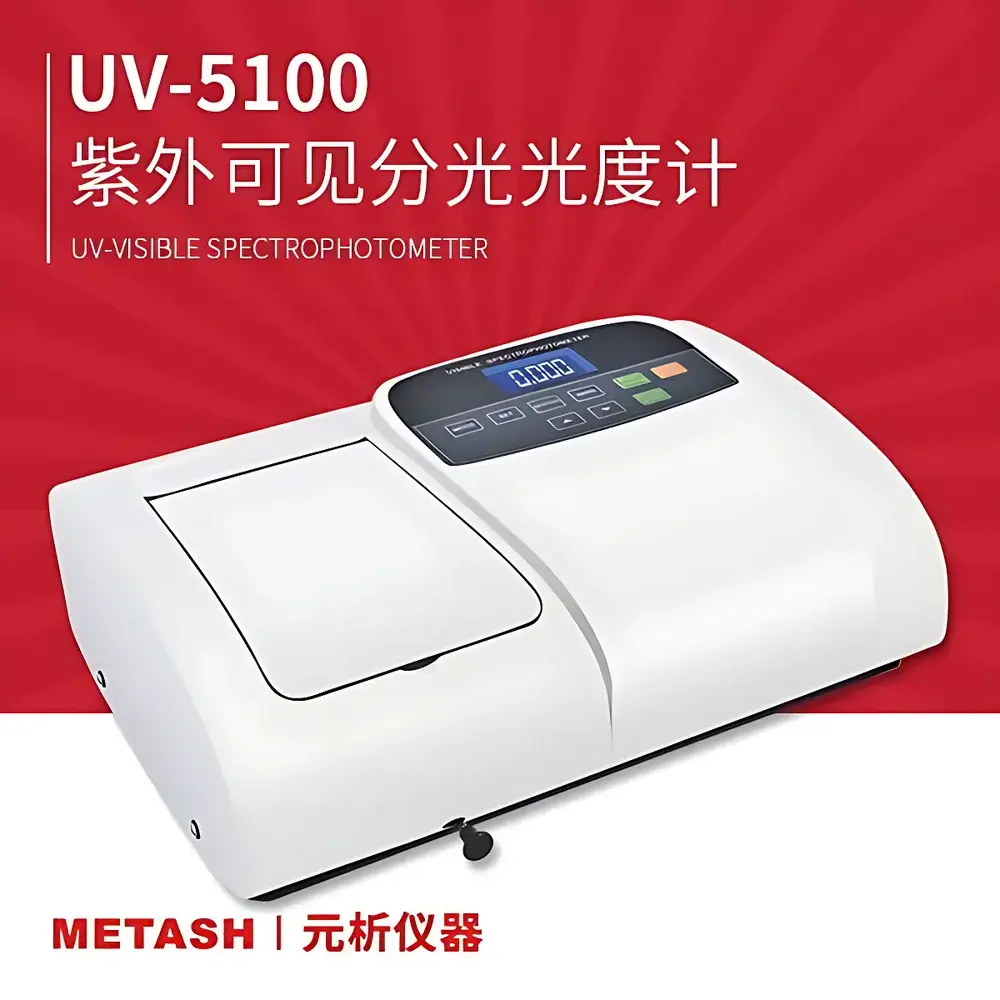
Metash UV-5100 Single-Beam Ultraviolet-Visible Spectrophotometer
| Brand | Metash Instruments |
|---|---|
| Origin | Shanghai, China |
| Manufacturer Type | Original Equipment Manufacturer (OEM) |
| Product Category | Domestic |
| Model | UV-5100 |
| Optical System | Single-beam |
| Detector Type | Photocell |
| Wavelength Range | 190–1000 nm |
| Wavelength Accuracy | ±2 nm |
| Wavelength Repeatability | ≤0.5 nm |
| Spectral Bandwidth | 2 nm or 4 nm (selectable) |
| Stray Light | ≤0.1% T |
| Wavelength Scanning Mode | Automatic |
| Data Storage Capacity | 200 measurement sets + 200 calibration curves |
| Display | 128 × 64 dot-matrix LCD |
| Lamp Configuration | Plug-in deuterium and tungsten lamps with flange-mount base |
| Interface | USB data output port + parallel printer port |
| Software Option | Metash Quantitative Analysis Software (optional) |
Overview
The Metash UV-5100 is a single-beam ultraviolet-visible (UV-Vis) spectrophotometer engineered for routine quantitative and qualitative analysis in academic laboratories, quality control environments, and industrial R&D settings. It operates on the principle of Beer–Lambert law-based absorbance measurement, utilizing a fixed optical path with selectable spectral bandwidth (2 nm or 4 nm) to deliver consistent photometric performance across the 190–1000 nm wavelength range. Its dual-lamp configuration—comprising a deuterium lamp for UV region (190–350 nm) and a tungsten-halogen lamp for visible/NIR region (350–1000 nm)—ensures broad spectral coverage without manual lamp switching. The instrument features automatic wavelength initialization and self-calibration routines that correct for mechanical drift, enhancing long-term operational stability and reducing operator dependency during daily startup procedures.
Key Features
- Flange-mounted, plug-in deuterium and tungsten lamps—enabling rapid lamp replacement without realignment or optical recalibration;
- 128 × 64 dot-matrix LCD display with high-contrast rendering for precise real-time absorbance, transmittance, and concentration readouts;
- Onboard data management supporting up to 200 individual measurement records and 200 user-defined calibration curves, each accessible via numeric ID;
- Two primary quantification modes: C-mode (multi-point standard curve generation and sample concentration calculation) and F-mode (direct coefficient-based calculation using pre-determined linear or polynomial equations);
- Power-loss resilient memory architecture—preserving all stored spectra, curves, and settings during unexpected shutdowns;
- Integrated wavelength auto-correction algorithm that detects and compensates for minor mechanical deviations in grating positioning;
- Dual-output interface: USB port compliant with USB 2.0 standards for direct PC connection and parallel port for legacy thermal or dot-matrix printers;
- Optional Metash Quantitative Analysis Software provides extended functionality including kinetic scan, time-driven measurements, spectral overlay, and export to CSV, TXT, or PDF formats.
Sample Compatibility & Compliance
The UV-5100 accommodates standard 10 mm pathlength quartz or glass cuvettes (including matched pairs for baseline correction), as well as micro-volume adapters and flow cells (optional). Its optical design meets fundamental requirements outlined in ISO 6223:2021 (spectrophotometers — performance verification) and ASTM E275-22 (standard practices for describing and measuring performance of UV-Vis spectrophotometers). While not certified for regulated GMP environments out-of-the-box, the instrument supports traceable calibration workflows compatible with GLP documentation practices. Optional software modules include audit trail logging and user access controls aligned with FDA 21 CFR Part 11 principles when deployed with validated IT infrastructure.
Software & Data Management
When paired with the optional Metash Quantitative Analysis Software, the UV-5100 transitions from a standalone photometer to a fully integrated analytical workstation. The software enables method-driven operation—including method templates for common assays such as protein A280, nucleic acid A260/280, and enzymatic reaction kinetics. All raw absorbance data are timestamped and tagged with instrument ID, operator login (if enabled), and environmental metadata (e.g., ambient temperature if external sensor connected). Export functions support interoperability with LIMS platforms and statistical analysis tools like Microsoft Excel, JMP, or Python-based data science pipelines. Local database storage ensures compliance with internal data retention policies without cloud dependency.
Applications
- Quantitative determination of analytes in pharmaceutical formulations (e.g., assay of active ingredients per USP dissolution testing protocols);
- Water quality monitoring—including nitrate, phosphate, and heavy metal ion detection via colorimetric derivatization;
- Enzyme kinetics studies requiring time-resolved absorbance tracking at defined wavelengths;
- Educational laboratory instruction for spectroscopic fundamentals, calibration theory, and error propagation analysis;
- Food and beverage QC for pigment concentration (e.g., anthocyanins, chlorophyll), preservative levels, and adulterant screening;
- Environmental testing labs performing EPA Method 365.3 (phosphate) or APHA Standard Methods 4500-NO3−-B (nitrate) adaptations.
FAQ
Is the UV-5100 compliant with ISO/IEC 17025 requirements for accredited testing laboratories?
The instrument itself is not individually accredited, but its documented performance specifications and traceable calibration procedures enable laboratories to meet ISO/IEC 17025 clause 6.4.3 (equipment verification) when used within a validated method framework.
Can the UV-5100 perform scanning measurements across a wavelength range?
No—the UV-5100 is a fixed-wavelength or discrete-point instrument; it does not support continuous spectral scanning. For full-spectrum acquisition, consider the Metash UV-6100 series.
What lamp lifetime can be expected under normal usage conditions?
Deuterium lamps typically last 1,000–1,500 hours; tungsten-halogen lamps exceed 2,000 hours. Actual lifetime depends on warm-up/cool-down cycles and operating intensity settings.
Does the instrument support external trigger inputs for synchronized measurements?
No—external triggering is not supported. Synchronization must be managed externally via software-level timing coordination through the USB interface.
Are NIST-traceable calibration standards available for this model?
Yes—Metash offers optional NIST-traceable holmium oxide and didymium filters for wavelength verification, and potassium dichromate solutions for photometric accuracy validation per ASTM E275-22 Annex A2.
Related Products




