
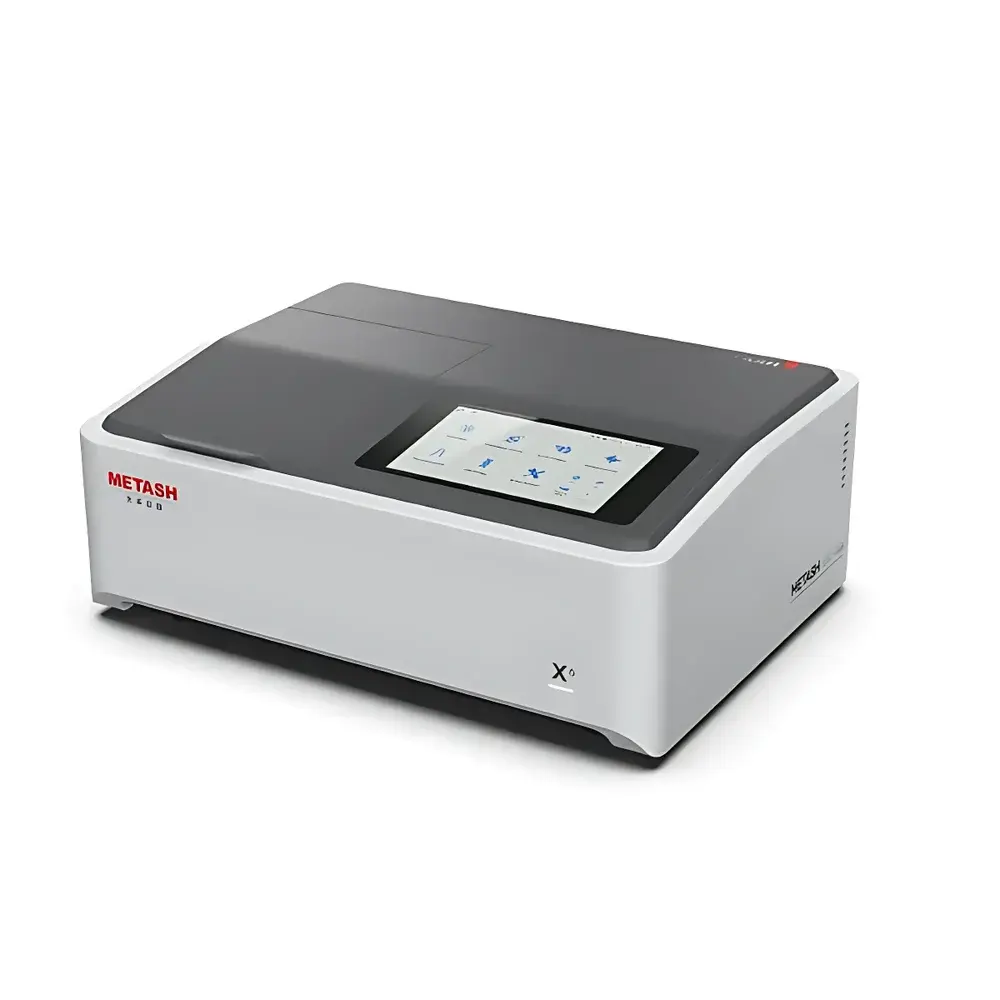
Metash X-6 UV-Vis Spectrophotometer
| Brand | Metash Instruments |
|---|---|
| Origin | Shanghai, China |
| Manufacturer Type | Direct Manufacturer |
| Model | X-6 |
| Optical Design | Pseudo-Double-Beam |
| Detector | Silicon Photodiode |
| Wavelength Range | 190–1100 nm |
| Wavelength Accuracy | ±0.5 nm |
| Wavelength Repeatability | ≤0.2 nm |
| Spectral Bandwidth | 1.8 nm |
| Stray Light | ≤0.05% T |
| Photometric Accuracy | ±0.3% T (0–100% T), ±0.002 A (0–0.5 A), ±0.004 A (0.5–1.0 A) |
| Photometric Repeatability | ≤0.15% T (0–100% T), ≤0.001 A (0–0.5 A), ≤0.002 A (0.5–1.0 A) |
| Baseline Drift | ±0.001 A/h at 500 nm |
| Baseline Flatness | ±0.002 A |
| Noise Level | ≤0.4% T |
| Photometric Range | 0–200% T, –3.0 to +3.0 A, 0–9999 C |
| Data Interfaces | USB port, USB flash drive support, optional Bluetooth module, A4 inkjet printer interface |
| Display | 7-inch high-resolution capacitive touchscreen |
| Light Sources | Imported long-life tungsten lamp and deuterium lamp |
| Dimensions | 505 × 375 × 190 mm |
| Weight | 15.5 kg |
| Power Supply | AC 220 V/50 Hz or 110 V/60 Hz |
Overview
The Metash X-6 UV-Vis Spectrophotometer is a precision optical instrument engineered for quantitative and qualitative analysis across research laboratories, quality control environments, and educational institutions. Based on the pseudo-double-beam optical architecture, it employs real-time reference beam monitoring to dynamically compensate for source intensity fluctuations—ensuring high photometric stability without requiring mechanical chopper synchronization. This design significantly reduces baseline drift and enhances measurement reproducibility over extended operation periods. Operating across a broad spectral range of 190–1100 nm, the X-6 supports routine absorbance, transmittance, and concentration measurements while maintaining compliance with fundamental photometric performance criteria defined in ISO 8579, ASTM E275, and USP . Its 1.8 nm spectral bandwidth enables sufficient resolution for most organic and biochemical applications—including nucleic acid and protein quantification—without compromising signal-to-noise ratio.
Key Features
- Pseudo-double-beam optical system with continuous reference monitoring for enhanced photometric stability and reduced baseline drift (±0.001 A/h at 500 nm)
- 7-inch high-resolution capacitive touchscreen interface enabling intuitive navigation, real-time spectrum visualization, and on-device data processing
- Rigid 10 mm machined aluminum optical baseplate with suspended optical path design—mechanically isolating the spectrometer core from chassis vibration and thermal deformation
- Imported tungsten and deuterium lamps with extended service life; silicon photodiode detector optimized for low-noise signal acquisition (noise level ≤0.4% T)
- Comprehensive onboard functionality: photometric mode, quantitative analysis (single/multi-point calibration), full-spectrum scanning, kinetic assays, DNA/protein A260/A280 ratio calculation, multi-wavelength analysis, and direct A4 printing
- USB host port supporting flash drive data export, firmware updates, and direct connection to inkjet printers for report generation
Sample Compatibility & Compliance
The X-6 accommodates standard 10 mm pathlength cuvettes and integrates seamlessly with optional accessories including an 8-position automated sample changer, micro-volume cell holders (down to 50 µL), temperature-controlled flow cells, integrating sphere reflectance modules, and rotating solid-sample stages. These configurations extend applicability to heterogeneous samples, turbid suspensions, thin films, and reflective surfaces. All hardware and firmware comply with electromagnetic compatibility (EMC) standards IEC 61326-1 and safety requirements per IEC 61010-1. The instrument’s mechanical construction and optical alignment meet GLP/GMP-aligned validation protocols, supporting audit-ready documentation for regulated environments.
Software & Data Management
The optional Metash SpectraScan software provides full PC-based instrument control and advanced post-acquisition processing—including derivative spectroscopy, peak integration, spectral subtraction, and custom calibration curve modeling. Software architecture conforms to FDA 21 CFR Part 11 requirements through role-based user authentication, electronic signature capability, immutable audit trails, and time-stamped data logging. All measurement records—including raw spectra, method parameters, operator ID, and environmental timestamps—are stored in encrypted binary format with traceable metadata. Data export supports CSV, TXT, and JCAMP-DX formats for interoperability with LIMS and third-party analytical platforms.
Applications
- Pharmaceutical QC: Active pharmaceutical ingredient (API) assay, excipient purity screening, dissolution testing, and stability-indicating methods per ICH Q2(R2)
- Biochemistry: Quantification of dsDNA (A260), proteins (A280/A260), and enzyme kinetics using NADH/NADPH absorbance shifts
- Environmental analysis: Nitrate, phosphate, and heavy metal ion determination via colorimetric reaction protocols (e.g., EPA Method 353.2)
- Materials science: Bandgap estimation of semiconductors, thin-film thickness calculation, and pigment concentration profiling
- Food & beverage: Color index evaluation (e.g., AOAC 993.02), antioxidant capacity assays (FRAP, DPPH), and adulterant detection
FAQ
Does the X-6 support regulatory-compliant data integrity practices?
Yes—the optional SpectraScan software implements full 21 CFR Part 11 compliance features including electronic signatures, audit trail review, and secure user access controls. Onboard storage also maintains timestamped method and result logs.
What is the typical warm-up time required before achieving photometric stability?
The instrument reaches thermal and photometric equilibrium within 20 minutes after power-on, as verified by baseline drift testing per ISO 8579 Annex B.
Can the X-6 be integrated into a laboratory network environment?
While the base configuration uses USB and local peripherals, the optional Bluetooth module enables wireless telemetry for remote status monitoring and limited command transmission—not recommended for high-throughput data streaming.
Is calibration verification traceable to national standards?
Yes—factory calibration utilizes NIST-traceable holmium oxide and didymium filters for wavelength accuracy verification, and potassium dichromate solutions for photometric linearity validation.
What maintenance procedures are recommended for long-term optical performance?
Routine cleaning of cuvette compartments and optical windows with lint-free wipes and spectroscopic-grade methanol is advised every 100 operating hours. Lamp replacement intervals are specified at ≥2000 h for deuterium and ≥5000 h for tungsten sources.





