
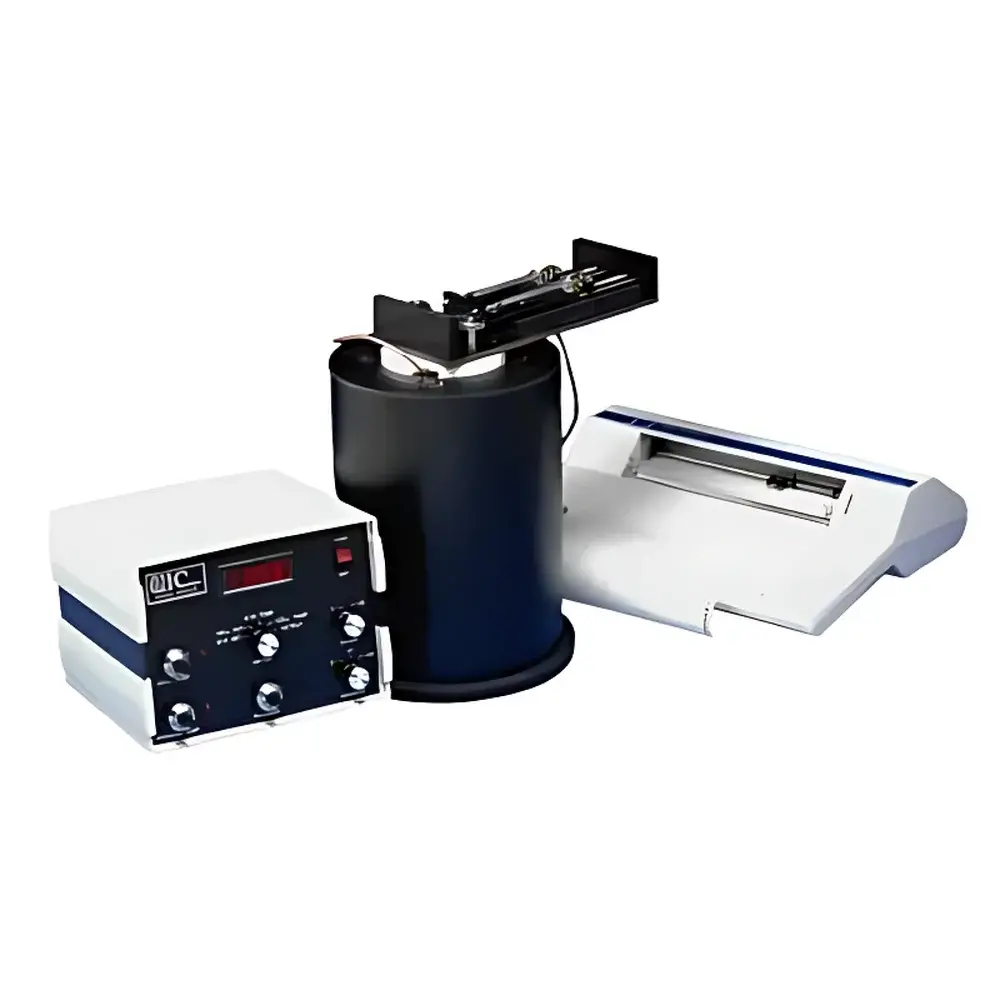
UIC 833 Vapor Pressure Osmometry (VPO) Molecular Weight Analyzer
| Brand | UIC (United Instruments Corporation) |
|---|---|
| Origin | USA |
| Model | 833 |
| Molecular Weight Range | 100–25,000 Da (in toluene), 100–5,000 Da (in water) |
| Minimum Detectable Concentration | 5 × 10⁻⁵ mol/L (toluene), 2.5 × 10⁻⁴ mol/L (water) |
| Temperature Control Range | Ambient to 130 °C (with optional cryo-circulator for sub-ambient operation) |
| Cell Current Settings | 5, 20, 100 µA |
| Equilibration Time | 2–5 min per sample |
| Sample Volume | 0.25 mL |
| Construction | All-metal hermetic cell housing with dual needle-port inlet system |
Overview
The UIC 833 Vapor Pressure Osmometry (VPO) Molecular Weight Analyzer is a precision laboratory instrument engineered for the determination of number-average molecular weight (Mn) of non-volatile solutes in dilute solution. It operates on the fundamental thermodynamic principle of vapor pressure depression—a colligative property directly related to solute concentration and molecular weight. In a closed, saturated vapor environment, two matched thermistors serve as differential thermal sensors: one exposed to pure solvent vapor, the other to solvent vapor above a test solution. The presence of non-volatile solute lowers the solution’s vapor pressure, causing preferential condensation and localized heating on the solution-side thermistor. This temperature differential induces a measurable resistance imbalance in a Wheatstone bridge circuit, quantified as a voltage output proportional to solute molality. Calibration against polymer standards yields a linear relationship between bridge response and m (mol solute / kg solvent), enabling accurate Mn calculation via Mn = w / m, where w is known weight concentration. Designed for reproducibility in academic polymer labs, QC environments, and R&D settings, the 833 delivers traceable, first-principles-based molecular weight data without reliance on column calibration or reference standards beyond initial setup.
Key Features
- All-metal, hermetically sealed measurement cell ensures long-term stability, minimal vapor leakage, and immunity to environmental humidity fluctuations—critical for low-concentration, high-precision VPO operation.
- Dual-needle sampling interface enables rapid, contamination-free injection while maintaining full cavity seal before, during, and after sample introduction—eliminating manual valve actuation and reducing operator-induced variability.
- Three selectable bridge excitation currents (5, 20, 100 µA) allow dynamic optimization of signal-to-noise ratio across diverse solvent systems—from low-conductivity aromatics (e.g., toluene) to polar protic media (e.g., water), extending usable concentration range without hardware modification.
- Integrated temperature control supports operation from ambient up to 130 °C; when paired with an external refrigerated circulator, sub-ambient measurements down to ~5 °C are achievable—enabling studies of thermally sensitive polymers and expanded solvent compatibility.
- Real-time analog output (0–1 V DC) and TTL-compatible digital interface permit direct connection to chart recorders, data acquisition systems, or modern PC-based software platforms for automated run logging and post-processing.
- Stable thermal equilibrium achieved in 2–5 minutes per sample—optimized for routine analysis of synthetic polymers, dendrimers, oligomers, and natural macromolecules including polysaccharides and certain proteins.
Sample Compatibility & Compliance
The UIC 833 accommodates a broad spectrum of non-volatile, thermally stable solutes dissolved in common organic and aqueous solvents—including toluene, chloroform, tetrahydrofuran, dimethylformamide, and buffered aqueous solutions. Its design adheres to core principles outlined in ASTM D2857 (Standard Practice for Dilute Solution Viscosity of Polymers), ISO 16014-3 (Size-exclusion chromatography — Part 3: Determination of molecular weight distributions), and USP <429> (Osmolality and Osmolarity), though VPO itself is recognized as a primary method for Mn validation rather than routine compliance testing. Instrument construction and electrical isolation meet IEC 61010-1 safety requirements for laboratory equipment. While the 833 does not include built-in audit trail or electronic signature functionality, its analog/digital outputs support integration into validated LIMS or ELN environments compliant with FDA 21 CFR Part 11 when paired with qualified third-party acquisition software and procedural controls.
Software & Data Management
The 833 operates as a stand-alone benchtop analyzer with front-panel meter readout and analog output, requiring no proprietary software for basic operation. For enhanced workflow integration, users may connect the device to generic data acquisition platforms (e.g., LabVIEW, MATLAB, or Python-based DAQ scripts) via its 0–1 V DC output and TTL trigger line. Calibration curves (ΔR vs. molality) are typically generated using at least three narrow-distribution polymer standards traceable to NIST SRMs. Raw bridge output values are stored alongside metadata (solvent ID, temperature setpoint, current setting, operator ID) in user-managed spreadsheets or relational databases. Though the instrument lacks onboard storage or network connectivity, its electrical interface architecture facilitates alignment with GLP/GMP documentation practices through externally managed electronic records and version-controlled calibration protocols.
Applications
- Determination of Mn for synthetic polymers (e.g., polystyrene, PMMA, polyacrylates) during process development and batch release testing.
- Verification of molecular weight in controlled-radical polymerization (ATRP, RAFT) where low dispersity (Đ < 1.1) demands absolute Mn accuracy independent of SEC calibration drift.
- Characterization of branched polymers and hyperbranched architectures where hydrodynamic volume deviates significantly from linear analogs—making VPO a preferred orthogonal technique to SEC/MALS.
- Analysis of pharmaceutical excipients (e.g., PEG, poloxamers) and oligonucleotide conjugates where regulatory filings require primary-method molecular weight confirmation.
- Teaching laboratories demonstrating colligative properties, thermodynamic activity, and the physical basis of macromolecular characterization.
FAQ
What molecular weight range is reliably measurable with the UIC 833?
The instrument achieves optimal precision for Mn between 100 and 25,000 Da in low-polarity solvents such as toluene; in water or other high-surface-tension solvents, the practical upper limit reduces to ~5,000 Da due to decreased vapor pressure sensitivity.
Can the 833 measure polydispersity (Đ)?
No—VPO yields only the number-average molecular weight (Mn). Polydispersity index (Đ = Mw/Mn) requires complementary techniques such as SEC-MALS or membrane osmometry.
Is solvent degassing required prior to analysis?
Yes—dissolved gases (especially O2 and N2) can interfere with thermal equilibration and increase noise; vacuum degassing or sparging with inert gas is recommended for all solvents.
How often must the thermistors be recalibrated?
Thermistor matching is factory-set and stable over years of use; periodic verification using a certified standard (e.g., polystyrene in toluene) every 3–6 months is advised for regulated environments.
Does the 833 support automatic sample changers?
Not natively—the system is manually sampled via syringe through the dual-needle port; however, third-party robotic liquid handlers with compatible needle positioning can be integrated using TTL trigger synchronization.






