
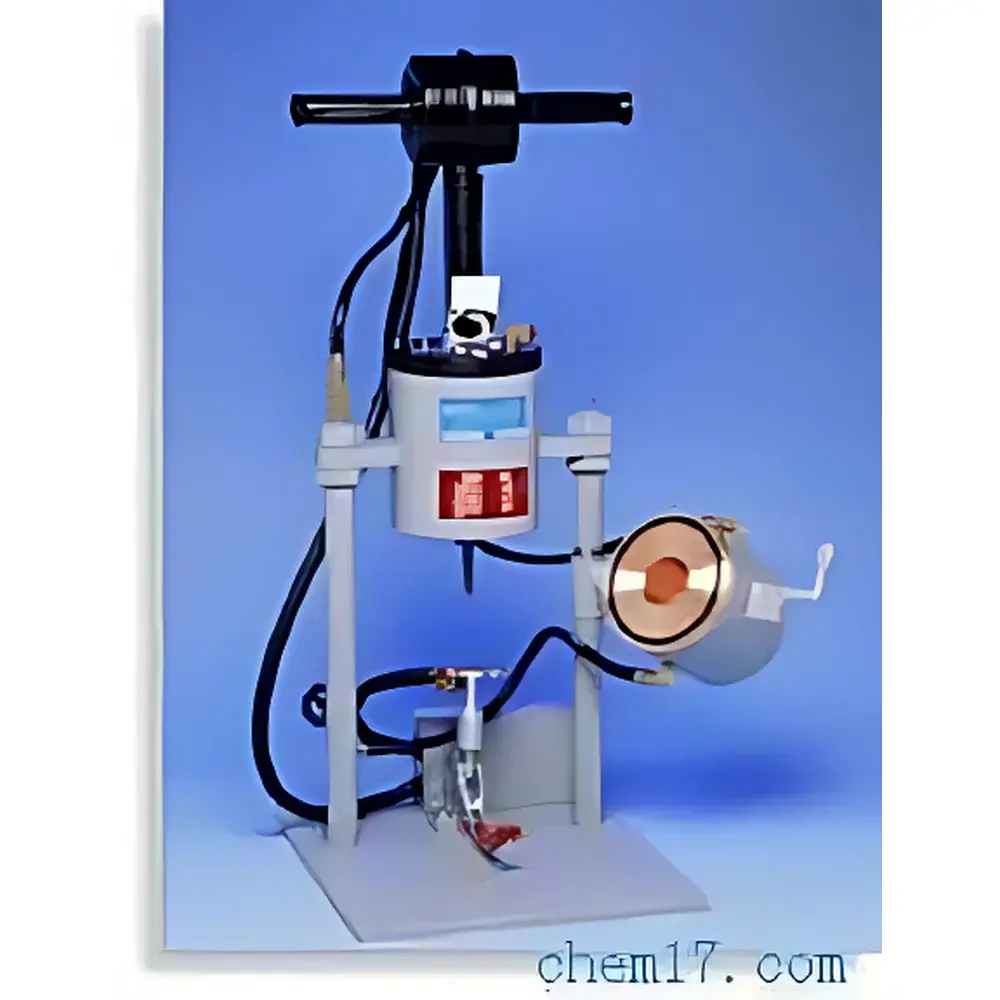
Arcast 2701 DC Arc Melting Furnace
| Origin | USA |
|---|---|
| Manufacturer Type | Authorized Distributor |
| Origin Category | Imported |
| Model | 2701 |
| Pricing | Available Upon Request |
| Max Operating Temperature | 1913 °C |
| Arc Current Range | 400–600 A |
| Argon Gas Flow Requirement | 50 L/min |
| Crucible Material | Water-Cooled Copper |
| Anode Options | Graphite, Carbon, Tungsten |
| Typical Melting Time | ≤60 s |
| Sample Forms Accepted | Powders, Drill Chips, Cut Strips, Slurries |
| Max Sample Mass (Steel) | 50 g (Ø31.8 mm × 6.4 mm) |
Overview
The Arcast 2701 DC Arc Melting Furnace is a laboratory-scale, direct-current arc melting system engineered for high-purity, controlled-atmosphere metallurgical sample preparation—primarily for spectrochemical analysis (e.g., OES, ICP-MS) and fundamental alloy research. It operates on the principle of resistive heating via a stabilized DC arc between a consumable or non-consumable anode and a water-cooled copper crucible acting as the cathode. The intense localized plasma (exceeding 3,500 K at the arc core) enables rapid, bulk melting of refractory and reactive metals under inert gas shielding—most commonly high-purity argon—at pressures near atmospheric. Unlike induction or resistance furnaces, the arc method delivers exceptional thermal efficiency and minimal crucible interaction, preserving trace-element integrity critical for quantitative compositional analysis.
Key Features
- DC power supply delivering stable 400–600 A arc current, optimized for reproducible melt initiation and thermal homogenization.
- Water-jacketed copper crucible with precise tilt mechanism (±15°), enabling controlled solidified ingot ejection without mechanical contact or thermal shock.
- Interchangeable anode holders supporting graphite, carbon, and tungsten electrodes—selected based on sample reactivity and contamination tolerance (e.g., tungsten for ultra-high-purity Ti or Zr melts).
- Integrated argon purge system requiring only 50 L/min flow; compatible with standard lab-grade argon supply and optional gas purifiers for <1 ppm O₂/H₂O residual.
- Compact footprint and modular design facilitate integration into ISO Class 7 cleanrooms or analytical prep labs; no external cooling tower required—standard tap water recirculation suffices.
- Minimal maintenance architecture: no moving parts in the vacuum/gas chamber; electrode wear is visually inspectable and field-replaceable without tools.
Sample Compatibility & Compliance
The 2701 accommodates heterogeneous feedstock forms—including metal powders, machining swarf, drill cuttings, slurries, and pre-alloyed pellets—without prior pressing or binding. A typical 50 g steel sample (Ø31.8 mm × 6.4 mm) achieves full fusion in ≤60 s, minimizing volatilization losses of critical tramp elements (e.g., B, P, S, As). Empirical validation per ASTM E353 and ISO 11576 confirms <0.5% relative loss for boron at 0.003 wt% levels. The system complies with electrical safety standards IEC 61000-6-2/6-4 and supports GLP-compliant operation when paired with calibrated thermocouple monitoring (Type K or S, optional). Argon atmosphere control meets USP inert-gas handling requirements for elemental reference material synthesis.
Software & Data Management
While the 2701 operates via analog front-panel controls for maximum reliability and electromagnetic compatibility in sensitive lab environments, optional digital interfaces (RS-485 or Ethernet) enable integration with LabVantage, Thermo Fisher SampleManager, or custom LIMS platforms. All operational parameters—including arc ignition time, current ramp profile, gas flow verification, and tilt actuation timestamp—are logged to non-volatile memory. Audit trails adhere to FDA 21 CFR Part 11 requirements when configured with user-authenticated access and electronic signature modules. No proprietary software installation is required for basic operation—reducing validation burden in regulated QC/QA settings.
Applications
- Preparation of homogeneous master alloys for calibration standards in spark-OES and GD-MS.
- Rapid prototyping of novel Ni-, Co-, Fe-, and Ti-based superalloys under controlled stoichiometry.
- Trace-element retention studies for volatile analytes (B, Sn, Pb, Bi) in high-temperature metallurgy.
- Production of button ingots for subsequent cold-working, dilution analysis, or microstructural evaluation (SEM/EBSD).
- Research into segregation behavior during solidification under directional cooling conditions (when coupled with optional chill plates).
FAQ
What anode materials are recommended for titanium alloy melting?
Tungsten anodes are strongly recommended for Ti and Zr-based alloys due to their high melting point (3422 °C) and negligible solubility in molten titanium—minimizing W contamination below detection limits of modern MS techniques.
Can the furnace be operated under vacuum instead of argon?
No—the 2701 is designed exclusively for inert-gas-atmosphere operation; vacuum compatibility would require structural reinforcement, high-vacuum seals, and arc stabilization modifications not present in this model.
Is crucible alignment adjustable for asymmetric samples?
Yes—the crucible mount includes fine-threaded leveling screws allowing ±0.5° angular correction to ensure uniform arc impingement across irregularly shaped feedstock.
What electrical service is required for full-power operation?
A dedicated 208–240 V AC, 60 Hz, 100 A three-phase circuit is required; single-phase configurations are available upon request but limit maximum current to 400 A.
Does the system include arc ignition assistance for oxide-containing samples?
Yes—a high-frequency (HF) pilot arc starter is integrated to reliably initiate conduction across surface oxides on stainless steels or aluminum alloys without manual pre-heating.



