
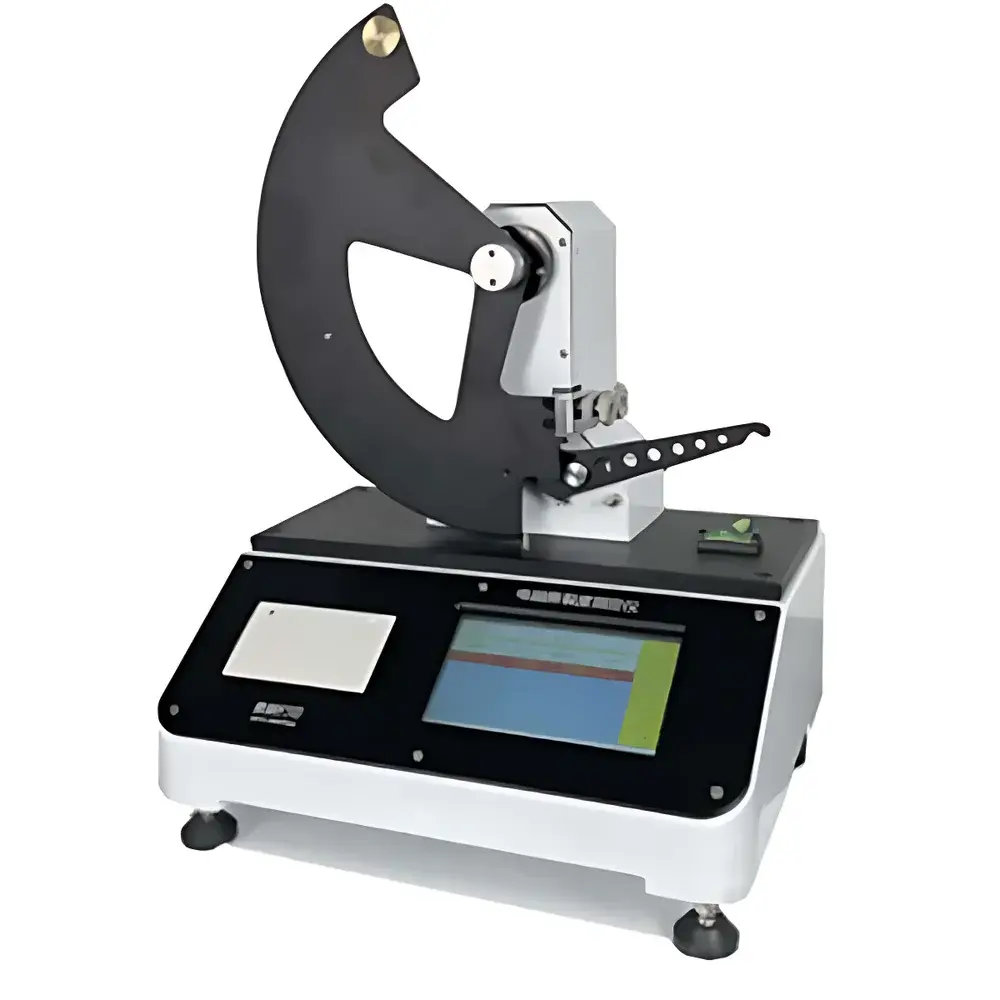
Yuelian PW-6606 Microcomputer Elmontdorf Tear Resistance Tester
| Brand | Yuelian / PW |
|---|---|
| Origin | Guangdong, China |
| Model | PW-6606 |
| Measurement Range | A-range 0–8000 mN, B-range 8000–16000 mN |
| Tear Distance | 43 ± 0.5 mm |
| Initial Tear Angle | 27.5 ± 0.5° |
| Tear Radius (Tear Arm Length) | 104 ± 1 mm |
| Sample Dimensions | (63 ± 0.5) mm × (50 ± 2) mm |
| Clamp Face Size | 25 × 15 mm |
| Maximum Clamping Area | 6.48 cm² |
| Clamp Spacing | 2.8 ± 0.3 mm |
| Clamp Torque Ratio | 2.2 : 0.7 |
| Knife Lever Ratio | 14 : 5.5 |
| Minimum Free Swing Count | ≥20 (min), ≥25 (mid), ≥35 (standard) |
| HMI | 5-inch Touchscreen with English/Chinese Interface |
| Compliance | GB/T 455, GB/T 16578.2, QB/T 1050, ISO 1974, TAPPI T414 |
Overview
The Yuelian PW-6606 Microcomputer Elmontdorf Tear Resistance Tester is a precision mechanical instrument engineered for the quantitative determination of tear resistance in paper, paperboard, and thin flexible sheet materials. It operates on the fundamental principle of the Elmendorf method—defined in ISO 1974 and ASTM D1922—as a pendulum-type energy-loss measurement system. In this method, a pre-notched specimen is clamped between two jaws; a calibrated pendulum, raised to a defined height, is released to tear the sample across a fixed distance. The reduction in pendulum swing amplitude—directly proportional to the energy absorbed during tearing—is converted into tear force (in millinewtons, mN) via calibrated scale factors and geometric constants inherent to the instrument’s lever arm, initial angle, and tear radius. This gravimetric-mechanical approach ensures high reproducibility and traceability without reliance on load cells or dynamic sensors, making it suitable for routine QC laboratories operating under GLP or ISO/IEC 17025 frameworks.
Key Features
- 5-inch capacitive touchscreen HMI supporting real-time bilingual (English/Chinese) operation and intuitive parameter navigation
- Dual-range measurement capability: high-resolution A-range (0–8000 mN) and extended B-range (8000–16000 mN) for broad material coverage—from lightweight tissue to medium-weight corrugated linerboard
- Precision-machined tear arm (104 ± 1 mm) and rigorously controlled initial tear angle (27.5 ± 0.5°) ensure strict adherence to ISO 1974 geometric tolerances
- Optimized clamp geometry: fixed jaw spacing (2.8 ± 0.3 mm), 25 × 15 mm clamping face, and torque ratio (2.2:0.7) minimize slippage and edge deformation during test initiation
- Integrated data acquisition module with non-volatile memory storage—retains up to 1000 test records with timestamp, operator ID, and batch metadata
- Automated statistical reporting: calculates mean, standard deviation, coefficient of variation (CV%), and pass/fail status against user-defined specification limits
- Optional USB-RS232 interface enables direct connection to laboratory PCs for real-time curve plotting, SPC charting, and export to CSV or Excel formats
Sample Compatibility & Compliance
The PW-6606 is validated for use with planar, fibrous sheet materials exhibiting isotropic or mildly anisotropic tear behavior. It accommodates standard test specimens per ISO 1974 and GB/T 455: (63 ± 0.5) mm × (50 ± 2) mm, pre-cut with a 20 mm notch. While optimized for paper and paperboard, it may be applied to select nonwovens, thin films, and metallized laminates—provided tensile modulus and elongation at break fall within the instrument’s kinematic envelope. All mechanical dimensions—including tear distance (43 ± 0.5 mm), knife lever ratio (14:5.5), and free-swing repeatability (≥35 cycles at standard calibration)—are verified against national and international reference standards. The instrument meets essential requirements of ISO/IEC 17025:2017 for test equipment verification and supports audit-ready documentation when paired with version-controlled firmware and calibration certificates traceable to NIM (National Institute of Metrology, China).
Software & Data Management
Firmware v3.2 embeds embedded Linux-based control logic with deterministic real-time response. Test sequences follow predefined SOP templates compliant with ISO 1974 Annex B (test sequence validation). Data logs include raw swing decay values, calculated tear force, environmental temperature/humidity tags (when external sensor input is enabled), and operator authentication. Exported datasets comply with ASTM E1447-22 for analytical data interchange and are compatible with LIMS platforms supporting HL7 or ASTM E1384. Optional PC software provides 21 CFR Part 11-compliant user access controls, electronic signatures, and full audit trail functionality—including modification history, calibration event logging, and failed-test flagging. All stored results retain cryptographic hash integrity checks to prevent tampering.
Applications
- Quality assurance in pulp & paper mills: monitoring consistency of refining, beating, and sizing processes
- Package development labs: evaluating tear propagation resistance in folding cartons, labels, and flexible packaging substrates
- Regulatory testing for food-contact paper compliance (e.g., FDA 21 CFR 176.170)
- Academic research on fiber network mechanics, including effects of filler loading, nanocellulose reinforcement, and wet-strength resin dosing
- Third-party certification bodies conducting accredited tear tests per ISO/IEC 17025 scope
- Supplier qualification programs requiring documented tear performance across lot-to-lot production batches
FAQ
What standards does the PW-6606 fully support?
It complies with ISO 1974, GB/T 455, GB/T 16578.2, QB/T 1050, and TAPPI T414 for tear resistance measurement using the Elmendorf pendulum method.
Is calibration traceable to national metrology institutes?
Yes—calibration weights and angular encoders are certified traceable to NIM (China) or equivalent signatory NMIs under the CIPM MRA.
Can the instrument be integrated into a networked QA system?
With optional RS232/USB interface and companion software, it supports automated data transfer to MES, LIMS, and SPC platforms.
Does it require periodic recalibration?
Annual verification is recommended; however, daily verification using certified reference specimens (e.g., ISO 5636-5 reference papers) is required per ISO/IEC 17025 clause 6.5.
What maintenance is required to ensure long-term accuracy?
Routine cleaning of the pendulum bearing, inspection of knife sharpness, and verification of clamp alignment every 500 tests—or as specified in the maintenance logbook included with shipment.





