
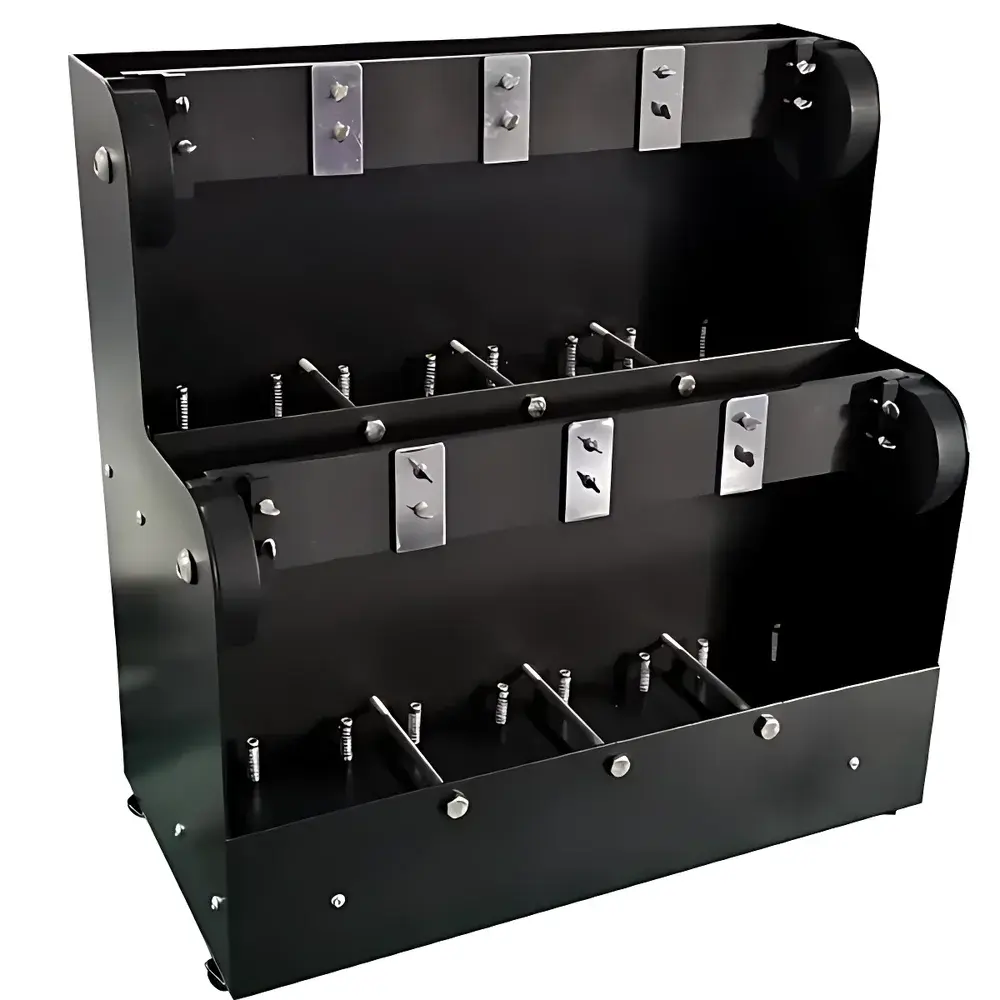
Multi-Angle Room-Temperature Holding Power Tester PW-SS8C
| Brand | PW (Yuelian) |
|---|---|
| Origin | Guangdong, China |
| Model | PW-SS8C |
| Testing Stations | 8 |
| Test Angles | Adjustable 90° and 180° |
| Timer Resolution | 0.1 min, Max Duration: 999999.9 min (LCD Display with Battery Backup) |
| Standard Weight | 1 kg per station (optional weights available) |
| Substrate | Stainless Steel Plates (8 pcs) |
| Fixture | 8 Connection Strips |
| Structural Frame | Powder-Coated Steel Sheet |
| Vibration Damping | Integrated Spring Isolation System with Safety Guardrails |
| Dimensions (W×D×H) | 45 × 22 × 52 cm |
| Net Weight | 25 kg |
| Compliance | GB/T 2792, GB/T 4851, PSTC-7, CNS 11888 |
Overview
The PW-SS8C Multi-Angle Room-Temperature Holding Power Tester is an engineered solution for quantifying the static shear resistance of pressure-sensitive adhesives (PSAs) under controlled ambient conditions. Based on the principle of constant-load creep testing, it subjects adhesive-bonded specimens to a vertically applied gravitational force—via calibrated stainless steel weights—and measures either the time-to-failure (hold time) or the cumulative displacement over defined intervals. Unlike dynamic peel or tack testers, this instrument evaluates long-term structural integrity under sustained stress, directly reflecting real-world performance in applications such as protective films, masking tapes, medical transdermal patches, and automotive trim bonding. Its dual-angle configuration (90° and 180°) enables comparative assessment of interfacial failure modes—cohesive vs. adhesive—according to standardized test geometries specified in ISO 29862, ASTM D3654, and related national standards.
Key Features
- Eight independent test stations allow parallel evaluation of replicate samples or multi-condition screening—significantly improving throughput for QC laboratories and R&D validation protocols.
- Precision-machined stainless steel substrate plates (8 pcs) and connection strips ensure dimensional consistency, surface flatness (<0.02 mm), and corrosion resistance across repeated cycles.
- Adjustable mounting mechanism supports rapid reconfiguration between 90° (T-peel geometry) and 180° (lap-shear geometry), facilitating compliance with both GB/T 4851 (180° peel hold) and GB/T 2792 (90° peel hold) requirements.
- Electronically controlled timer with LCD interface offers 0.1-minute resolution and non-volatile memory retention—even during power interruption—ensuring data continuity and audit readiness.
- Integrated spring-damped support structure minimizes environmental vibration transmission, while perimeter safety guardrails prevent accidental weight dislodgement during extended tests (>72 h).
- Modular weight system accepts standard 1 kg masses (ASTM E4-compliant); optional calibration sets (0.5 kg, 2 kg, 5 kg) enable method development for low- or high-cohesion formulations.
Sample Compatibility & Compliance
The PW-SS8C accommodates standard specimen dimensions per PSTC-7 (25 mm × 100 mm) and GB/T 4851 (25 mm × 150 mm), with adjustable clamping force to prevent slippage without inducing edge deformation. Substrate compatibility includes stainless steel (default), aluminum, polycarbonate, and PET—each requiring documented surface energy verification prior to testing. The system meets mechanical and procedural requirements of ISO 29862:2021 (adhesive holding power at room temperature), ASTM D3654/D3654M (peel adhesion holding power), and CNS 11888 (Chinese National Standard for adhesive tape shear strength). All hardware components are traceably manufactured; calibration certificates for weights and timers are provided upon request to support GLP/GMP documentation workflows.
Software & Data Management
While the PW-SS8C operates as a standalone analog-electronic tester, its timer output supports RS-232 or USB-to-serial interfaces (optional accessory) for integration into LIMS or ELN platforms. Time-stamped hold duration data can be exported in CSV format for statistical process control (SPC) analysis—including mean time-to-failure, standard deviation, and Weibull distribution modeling. Audit trails—including operator ID, test date/time, angle setting, weight mass, and substrate lot number—are manually recorded per internal SOPs aligned with FDA 21 CFR Part 11 principles for electronic records where digital capture is implemented.
Applications
- Quality control of acrylic, rubber-based, and silicone PSAs used in electronics manufacturing (e.g., display module lamination, camera lens protection films).
- Regulatory submission support for medical device adhesives, including ISO 10993-5 cytotoxicity correlation studies where prolonged skin contact is required.
- Formulation optimization in R&D labs—comparing polymer architecture, crosslink density, and tackifier loading via systematic hold-time profiling.
- Supplier qualification against tier-1 automotive OEM specifications (e.g., GMW14872, Ford FLTM BO 116-01) for interior trim bonding durability.
- Stability assessment of aging effects—samples conditioned at 40°C/75% RH for 168 h prior to room-temperature hold testing per ASTM D1879.
FAQ
What is the maximum recommended test duration for reliable data interpretation?
For statistically robust results, tests exceeding 168 hours (7 days) should include periodic visual inspection intervals to confirm absence of substrate creep or fixture relaxation—particularly when evaluating ultra-high-hold formulations.
Can the PW-SS8C be used for elevated-temperature testing?
No—the system is designed exclusively for room-temperature (23 ± 2°C) operation per GB/T 4851 and PSTC-7. For thermal hold testing, a climate-controlled chamber with compatible load-bearing fixtures is required.
Is third-party calibration certification available?
Yes—PW-certified calibration services include NIST-traceable weight verification and timer accuracy validation (±0.05% full scale), with documentation compliant with ISO/IEC 17025 requirements.
How is specimen alignment verified before initiating a test?
Each station incorporates precision-ground alignment grooves and a reference edge stop; users must confirm ≤0.5 mm lateral offset using a calibrated feeler gauge prior to weight application.
Does the system comply with FDA 21 CFR Part 11 for electronic records?
The base unit does not generate electronic records; however, when paired with optional serial-data logging hardware and validated software, full Part 11 compliance—including electronic signatures and audit trail generation—is achievable within a qualified IT environment.



