
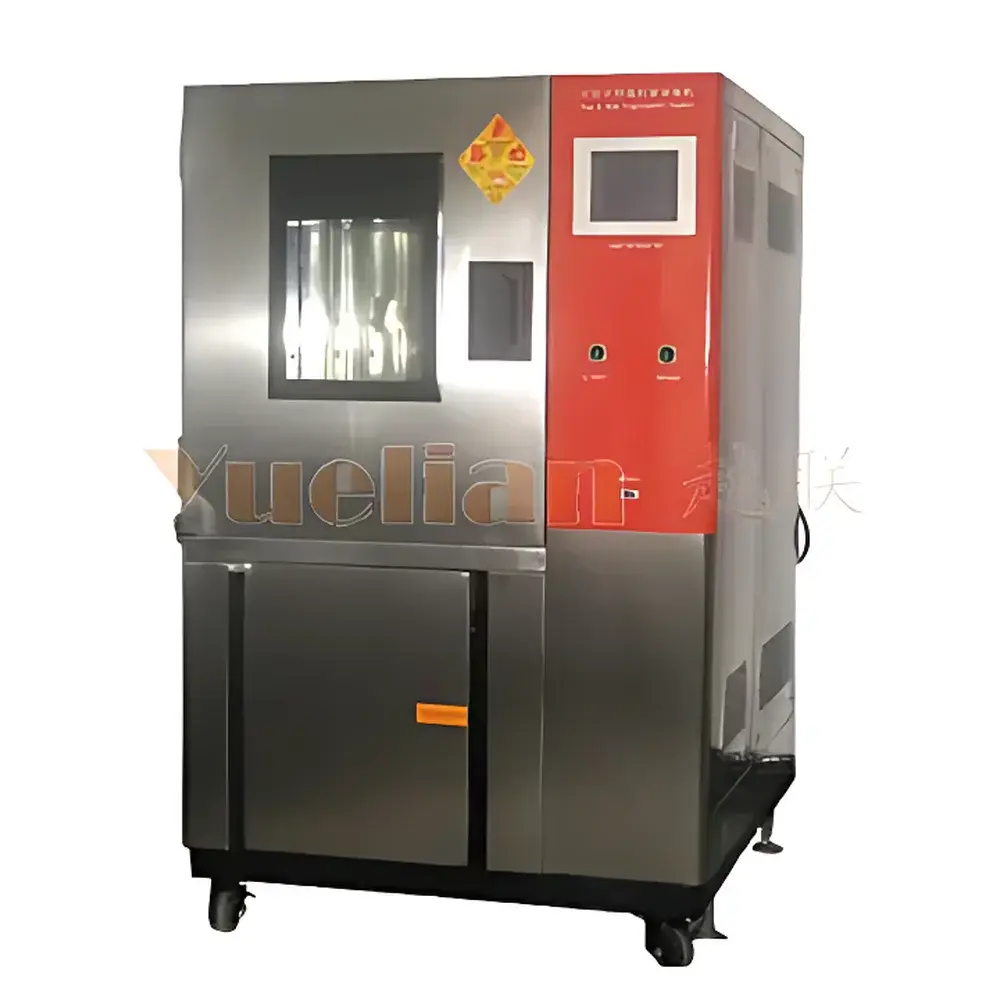
Yuelian YL-2236 Programmable Temperature and Humidity Cycling Chamber
| Brand | Yuelian |
|---|---|
| Origin | Guangdong, China |
| Model | YL-2236 |
| Temperature Range | −60 °C to +150 °C (standard: −40 °C to +100 °C) |
| Humidity Range | 20–98 % RH |
| Temp. Accuracy | ±0.3 °C |
| Humidity Accuracy | ±2.5 % RH |
| Temp. Uniformity | ±1.0 °C |
| Humidity Uniformity | ±5 % RH |
| Heating Rate | −40 °C → +100 °C in ≈45 min |
| Cooling Rate | +20 °C → −40 °C in ≈90 min |
| Internal Dimensions | 100 × 80 × 100 cm (W×H×D) |
| External Dimensions | 160 × 187 × 132 cm (W×H×D) |
| Internal Material | Mirror-finish stainless steel (SUS304) |
| External Material | Brushed stainless steel |
| Insulation | Rigid polyurethane foam (glass wool for >100 °C options) |
| Refrigeration System | Air-cooled, single-stage, hermetic compressor |
| Power Supply | 3-phase, AC 220 V ±10 %, 60 Hz or AC 380/415 V ±10 %, 50 Hz |
| Weight | ≈530 kg |
Overview
The Yuelian YL-2236 Programmable Temperature and Humidity Cycling Chamber is an engineered environmental test system designed to replicate dynamic climatic conditions for reliability validation of materials and finished products across industrial and R&D laboratories. It operates on a dual-control principle—simultaneous and independent regulation of temperature and relative humidity—enabling precise execution of standardized thermal-hygric stress profiles, including cyclic, ramp-and-soak, and steady-state protocols. The chamber conforms to the functional architecture of IEC 60068-2 series, ASTM D4332, ISO 4892-2, and JIS Z 8701-2, supporting qualification testing under accelerated aging, storage stability, and transport simulation requirements. Its robust thermal management architecture—featuring high-efficiency air circulation, optimized duct design, and PID-controlled heating/cooling loops—ensures reproducible condition transitions with minimal overshoot and stable dwell performance over extended test durations.
Key Features
- Programmable multi-segment test cycles with up to 999 steps per program and 999 repeat loops, supporting complex environmental profiles defined per MIL-STD-810G Method 502.5 and GB/T 2423.3–2016 (IEC 60068-2-78)
- Dual-sensor feedback loop: High-stability platinum RTD (Pt100) for temperature control and capacitive polymer humidity sensor with automatic drift compensation
- Uniform airflow distribution via centrifugal blower and perforated internal wall panels, validated to meet ±1.0 °C temperature uniformity and ±5 % RH spatial consistency across the full working volume
- Hermetically sealed refrigeration circuit using R404A/R23 cascade configuration (optional) for rapid cooling to −60 °C; electric heating elements with overheat cut-off redundancy
- Comprehensive safety architecture: Dual-stage overtemperature protection (mechanical and electronic), refrigerant high-pressure switch, condensate level monitoring, phase failure detection, and audible/visual alarm interface
- Standard ergonomic accessories: Double-layer tempered glass observation window with anti-fog heater, two adjustable stainless steel shelves, one Ø50 mm cable port with silicone gasket, and interior LED lighting compliant with Class I, Division 2 electrical safety standards
Sample Compatibility & Compliance
The YL-2236 accommodates diverse sample geometries and thermal masses—including PCB assemblies, automotive ECUs, polymer packaging, pharmaceutical blister packs, and coated metal substrates—within its 800 L internal workspace. Its stainless-steel construction (SUS304 interior, brushed exterior) ensures corrosion resistance during prolonged high-humidity exposure and eliminates outgassing contamination risks. All operational parameters comply with GLP documentation requirements: real-time data logging with timestamped audit trails, user-access-level permissions (admin/operator), and non-volatile memory retention during power interruption. Optional calibration certificates traceable to NIM (National Institute of Metrology, China) or UKAS-accredited labs are available upon request. The system supports IQ/OQ documentation packages aligned with ISO/IEC 17025 and FDA 21 CFR Part 11 readiness when paired with validated software modules.
Software & Data Management
Control and monitoring are executed via a 7-inch TFT-LCD touchscreen HMI with intuitive icon-based navigation and multilingual UI (English, Chinese, Spanish). The embedded controller stores ≥10,000 hours of time-stamped temperature/humidity data at 1-second resolution, exportable via USB to CSV or Excel-compatible formats. Optional PC-based software (YL-Link v3.2) enables remote supervision, real-time graphing, statistical process analysis (X̄/R charts), deviation alerts via email/SMS, and automated report generation per ISO/IEC 17025 Annex A.5. All firmware updates are digitally signed and installed via secure USB handshake to prevent unauthorized modification—meeting integrity requirements for GMP-regulated environments.
Applications
- Electronics: Thermal cycling validation of solder joints, conformal coating integrity, and connector reliability per IPC-9701 and JEDEC JESD22-A104
- Automotive: Climate endurance testing of infotainment modules, battery management systems, and interior trim per ISO 16750-4 and GMW15022
- Pharmaceuticals: Stability chamber qualification (ICH Q1A–Q1E), excipient hygroscopicity screening, and packaging permeability assessment
- Materials Science: Polymer crystallinity shift analysis, adhesive bond degradation kinetics, and composite moisture diffusion coefficient determination
- Quality Assurance: In-process verification of environmental conditioning prior to mechanical or electrical testing per ASTM E145 and ISO 291
FAQ
What standards does the YL-2236 support for validation and routine operation?
The chamber meets core requirements of IEC 60068-3-5 (environmental test methods), ISO 16750-4 (road vehicles), and GB/T 2423.3–2016 (damp heat testing). Full IQ/OQ documentation and third-party calibration services are available.
Can the YL-2236 perform rapid temperature transitions below −40 °C?
Yes—when equipped with the optional cascade refrigeration system (R404A/R23), it achieves −60 °C with a typical cooling rate of 1.5 °C/min from ambient, verified per IEC 60068-3-10.
Is humidity control maintained during extreme low-temperature ramps?
Humidity is actively suppressed below 0 °C per standard operation; dehumidification is suspended during sub-zero segments to prevent condensation and ice formation on sensors and chamber walls.
How is data integrity ensured for regulatory submissions?
All logged data include immutable timestamps, operator ID, and event flags (e.g., door open, alarm trigger). Optional software provides electronic signatures, change history, and 21 CFR Part 11-compliant audit trails.
What maintenance intervals are recommended for long-term reliability?
Compressor oil and refrigerant levels should be verified annually; humidity sensor recalibration every 6 months; air filter replacement every 3 months under continuous operation. Preventive maintenance logs are auto-generated by the HMI.



