
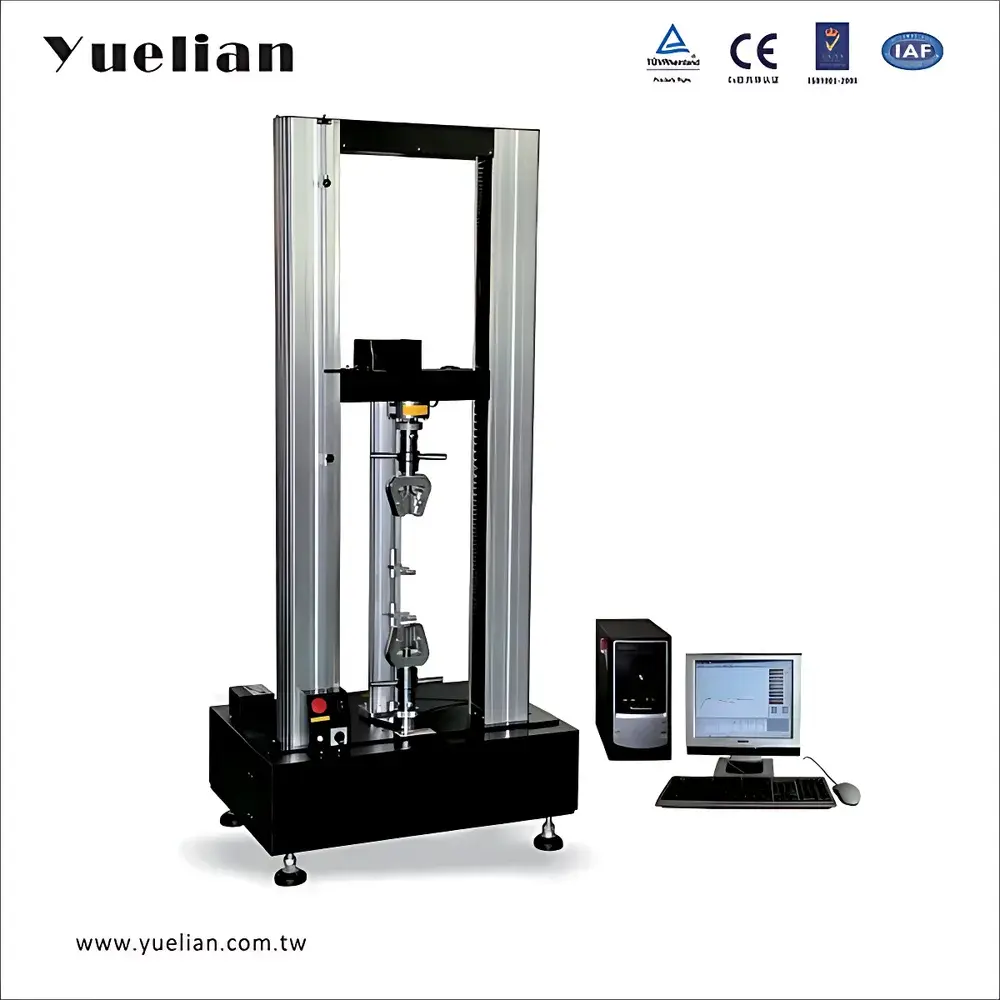
Yuelian YL-1125 Electronic Tensile Testing Machine
| Brand | Yuelian |
|---|---|
| Origin | Guangdong, China |
| Manufacturer Type | Authorized Distributor |
| Country of Origin | China |
| Model | YL-1125 |
| Instrument Type | Electronic Universal Testing Machine |
| Load Capacity Options | 10 N to 50 kN (dual-range configuration available) |
| Force Resolution | 1/500,000 full scale |
| Force Accuracy | ±0.3% of reading |
| Displacement Resolution | 1/500,000 full scale |
| Crosshead Travel | 1200 mm |
| Test Width | 420 mm |
| Speed Range | 0.01–1000 mm/min (programmable) |
| Control System | PC-based closed-loop servo control |
| Drive System | Servo motor + precision ball screw + synchronous timing belt |
| Power Supply | 220 V, 50/60 Hz, 10 A |
| Power Consumption | 750 W |
| Dimensions (W×D×H) | 92 × 62 × 199 cm |
| Weight | ~422 kg |
| Compliant Standards | ISO 7500-1, ASTM E4, JJG 475-88, DIN 51221, JIS B7721/B7733, EN 10002-1, EN 10002-2, BS 1610, GB/T 228.1–2021, GB/T 1449–2005, GB/T 9341–2008, ASTM D6109–2010 |
Overview
The Yuelian YL-1125 Electronic Tensile Testing Machine is a microprocessor-controlled universal testing system engineered for high-reproducibility mechanical characterization of metallic, polymeric, ceramic, composite, and elastomeric materials. Based on the principle of controlled displacement actuation via a precision servo-driven ball screw mechanism, the system applies uniaxial tensile, compressive, flexural (three-point and four-point), shear, tear, and peel loads under programmable rate conditions. Its architecture adheres to metrological traceability requirements defined in ISO 7500-1 (static calibration of force-proving instruments) and ASTM E4 (practices for force verification of testing machines), ensuring compliance with international laboratory accreditation frameworks including ISO/IEC 17025. Designed for routine QC/QA labs and R&D environments, the YL-1125 supports standardized test execution across global regulatory domains—particularly where mechanical property reporting must align with GB/T, ASTM, ISO, JIS, DIN, and EN material specifications.
Key Features
- High-resolution dual-circuit load measurement: 1/500,000 full-scale resolution with ±0.3% force accuracy over the entire calibrated range (10 N – 50 kN; optional dual-capacity sensor configuration enables extended dynamic range without manual transducer swapping)
- Programmable crosshead speed from 0.01 to 1000 mm/min, with real-time velocity feedback and closed-loop PID control for consistent strain-rate application per ASTM D638 or ISO 527 protocols
- 1200 mm vertical travel with 420 mm test width accommodates standard and custom specimen geometries—including ASTM D6109-compliant beam fixtures for four-point bending and GB/T 9341-compliant fixtures for three-point flexure
- Integrated safety interlocks: overload cutoff, emergency stop, automatic rupture termination, user-defined upper/lower displacement limits, and auto-return-to-initial-position post-test
- Modular fixture interface compliant with ISO 26203-1 mounting standards, supporting interchangeable grips for tension (pneumatic, wedge, vise), compression platens, bend supports, peel jigs, and shear adapters
- 750 W brushless servo motor drive ensures low thermal drift, minimal maintenance, and long-term repeatability under continuous operation cycles
Sample Compatibility & Compliance
The YL-1125 accommodates specimens ranging from thin polymer films (≥0.05 mm thickness) to structural metal coupons (up to 25 mm thick), provided within the 420 mm test width and 1200 mm stroke envelope. It is validated for use with ASTM D6109 (flexural properties of unreinforced and reinforced plastics in four-point bending), ASTM D790 (flexural properties of plastics), GB/T 1449–2005 (flexural properties of fiber-reinforced plastic composites), and GB/T 9341–2008 (plastics—determination of flexural properties). Compression testing complies with ISO 604 and ASTM D695; tensile testing meets ISO 527-2, ASTM D638, and GB/T 228.1–2021. All calibrations are documented per ISO/IEC 17025 requirements, and force verification reports include uncertainty budgets traceable to national metrology institutes.
Software & Data Management
The embedded Windows-based test software provides full GLP-compliant data acquisition and analysis. It supports multi-channel synchronized sampling (load, displacement, extensometer input), real-time stress–strain curve generation, and automated parameter extraction—including ultimate tensile strength, yield strength (0.2% offset), Young’s modulus, fracture elongation, flexural strength, flexural modulus, and secant modulus. Data export formats include CSV, XML, and PDF reports with embedded digital signatures. The system integrates natively with MS Access databases for audit-trail-enabled storage, supports 21 CFR Part 11–compliant electronic signatures (when deployed with validated Windows domain authentication), and maintains full revision history for test methods, calibration records, and operator logs.
Applications
- Mechanical validation of thermoplastics and thermosets per ISO 527 and ASTM D638
- Bending stiffness and failure mode analysis of fiber-reinforced composites using three- and four-point configurations
- Quality conformance testing of rubber compounds, adhesives, and flexible packaging films
- Raw material qualification for automotive interior trim, medical device components, and consumer electronics housings
- Process development support for extrusion, injection molding, and thermoforming operations
- Regulatory submission testing for CE marking, FDA 510(k), and IEC 60601-1 mechanical safety assessments
FAQ
Does the YL-1125 support extensometer integration?
Yes—it features analog and digital inputs compatible with clip-on, video, and laser extensometers meeting ISO 9513 Class 1 accuracy requirements.
Is the system suitable for high-cycle fatigue testing?
No—the YL-1125 is designed for quasi-static monotonic loading only; it does not support dynamic or cyclic loading waveforms.
Can test methods be password-protected and version-controlled?
Yes—software allows role-based access control, method locking, and timestamped revision archiving with change logs.
What documentation is supplied for ISO/IEC 17025 compliance?
Factory calibration certificates (traceable to CNAS-accredited labs), uncertainty statements, installation qualification (IQ) templates, and operational qualification (OQ) checklists are included.
Is remote diagnostics supported?
Yes—via secure TLS-encrypted VNC tunneling; service engineers can remotely verify firmware, sensor linearity, and controller responsiveness with customer consent.



