
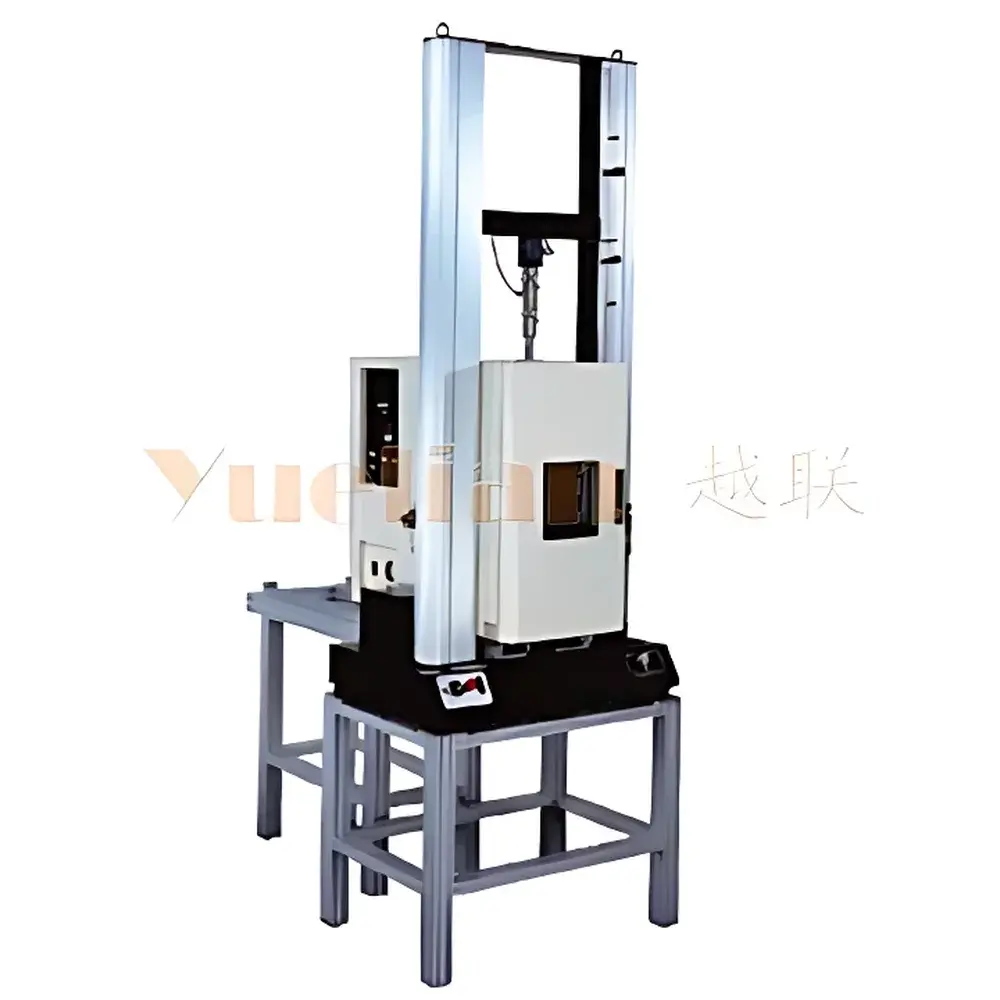
Yuelian YL-1162 High-Low Temperature Universal Testing Machine
| Brand | Yuelian |
|---|---|
| Origin | Guangdong, China |
| Manufacturer Type | Authorized Distributor |
| Country of Origin | China |
| Model | YL-1162 |
| Quotation | Available Upon Request |
| Load Capacity Options | 10N–10kN (dual-range configurable) |
| Temperature Range | –70 °C to +150 °C |
| Force Resolution | 1/250,000 full scale |
| Force Accuracy | ≤ ±0.5% FS |
| Displacement Resolution | 0.005 mm |
| Temperature Control Method | PID auto-tuning |
| Temperature Uniformity | ±1 °C |
| Temperature Display Resolution | 0.1 °C |
| Test Speed Range | 0.5–500 mm/min (PC-programmable) |
| Effective Test Stroke | 1300 mm |
| Test Width | 720 mm |
| Environmental Chamber Internal Dimensions | 500 × 480 × 650 mm (W×D×H) |
| Drive System | Servo motor + precision ball screw + timing belt |
| Power Consumption | 400 W |
| Input Voltage | 220 V, 50/60 Hz, 30 A |
| Net Weight | ~420 kg |
| Frame Material | SUS#304 stainless steel |
| Safety Protections | Overload cutoff, emergency stop, specimen rupture detection, upper/lower limit auto-stop, thermal overload protection for heater/compressor, temperature limiter |
Overview
The Yuelian YL-1162 High-Low Temperature Universal Testing Machine is an electromechanical materials testing system engineered for precise mechanical property evaluation under controlled thermal conditions. It integrates a high-stiffness universal testing frame with a fully enclosed, forced-air-circulated environmental chamber—enabling standardized tensile, compression, flexural, shear, tear, peel, and adhesion testing across a wide temperature spectrum from –70 °C to +150 °C. Unlike ambient-only testers, the YL-1162 supports thermomechanical characterization per ASTM D638, ISO 527, ASTM D790, ISO 178, ASTM D882, ISO 1184, and ASTM D3330, where temperature-dependent modulus, yield behavior, elongation at break, and interfacial strength must be quantified in compliance with quality assurance protocols. The modular chamber design allows physical removal for standalone room-temperature testing—optimizing lab floor space and operational flexibility without hardware reconfiguration.
Key Features
- Modular thermal chamber with independent PID-controlled heating (SUS304 finned resistive heaters) and refrigeration (high-efficiency compressor + eco-friendly refrigerant), ensuring stable thermal gradients and minimal overshoot.
- Servo-driven actuation system featuring precision-ground ball screws and synchronous timing belts—delivering repeatable displacement control and low-noise, low-backlash motion across the full 1300 mm stroke.
- High-resolution force measurement with ≤ ±0.5% full-scale accuracy and 1/250,000 internal resolution, compliant with ISO 7500-1 Class 0.5 and ASTM E4 verification requirements.
- Multi-range load cell support (10 N to 10 kN), including optional dual-capacity configurations for enhanced dynamic range without manual sensor swapping.
- Full PC-based operation via Windows-compatible software: real-time data acquisition, multi-curve overlay, automatic peak detection, and calculation of mechanical parameters—including ultimate tensile strength, yield stress (0.2% offset), Young’s modulus, elongation, and energy absorption.
- Comprehensive safety architecture: dual-channel overload cutoff, hardware emergency stop, specimen rupture-triggered halt, programmable upper/lower displacement limits, and redundant thermal limiters for heater and compressor subsystems.
Sample Compatibility & Compliance
The YL-1162 accommodates standard test specimens per ISO, ASTM, and GB geometries—including dog-bone, dumbbell, rectangular strips, and laminated composites—within its 720 mm test width and 500 × 480 × 650 mm chamber volume. Its structural rigidity and thermal isolation minimize frame-induced drift during sub-zero or elevated-temperature tests. The system meets essential regulatory expectations for laboratory instrumentation: mechanical calibration traceability to national standards (e.g., NIST or CNAS-accredited labs), electrical safety per IEC 61000-6-2/6-4, and thermal stability validated per ISO 16750-4 for automotive-grade material qualification. While not pre-certified for FDA 21 CFR Part 11, the software architecture supports audit trail implementation, electronic signature integration, and user-access-level configuration—enabling GxP-aligned deployment when paired with validated SOPs and IT infrastructure.
Software & Data Management
The embedded test control software operates natively on Windows OS (Windows 10/11 64-bit) and interfaces via USB 2.0. It provides graphical setup wizards for common test methods, customizable test sequences with conditional branching (e.g., “hold at 80 °C for 5 min → ramp to 100 °C at 2 °C/min → apply 5 mm/min tensile rate”), and synchronized thermal–mechanical data logging at up to 100 Hz. All raw data—including force, displacement, time, temperature, and calculated metrics—are stored in encrypted MS Access database files (.accdb) with timestamped metadata, supporting version-controlled archiving and export to CSV, Excel, or PDF report formats. Optional API access enables integration with LIMS or MES platforms for automated result ingestion and statistical process control (SPC) charting.
Applications
- Thermoplastic and thermoset polymer characterization: glass transition effects on tensile modulus, cold-embrittlement thresholds, heat-deflection behavior.
- Adhesive and sealant performance: peel strength vs. temperature, cohesive failure mode shifts, low-temperature tack retention.
- Automotive component validation: rubber bushings, gaskets, and composite brackets under simulated under-hood or winter-climate conditions.
- Medical device materials: biodegradable sutures, hydrogel films, and silicone tubing tested per ISO 10993-12 extractables protocols requiring defined thermal preconditioning.
- Electronics packaging: solder joint reliability simulation, flexible PCB bending fatigue at operational temperature extremes.
- Quality control laboratories performing incoming inspection per ISO/IEC 17025—where documented repeatability, equipment calibration records, and environmental condition logging are mandatory.
FAQ
Can the environmental chamber be operated independently of the testing frame?
No—the chamber is mechanically and thermally integrated with the load frame; it cannot function as a standalone climatic chamber.
Is the system compatible with third-party load cells or extensometers?
Yes, provided they output analog ±10 V or digital RS-422/USB signals and are configured within the software’s sensor calibration module.
What is the typical warm-up and stabilization time for –40 °C testing?
Approximately 45–60 minutes from ambient to –40 °C with chamber door closed and no specimen loaded; add 10–15 minutes for thermal equilibration after specimen insertion.
Does the software support GLP-compliant audit trails?
The base software logs user actions, parameter changes, and test events; full GLP compliance requires supplemental validation documentation and IT governance controls applied by the end user.
Are calibration certificates included with shipment?
A factory calibration report is supplied; formal ISO/IEC 17025-accredited calibration must be arranged separately through an accredited metrology provider.



