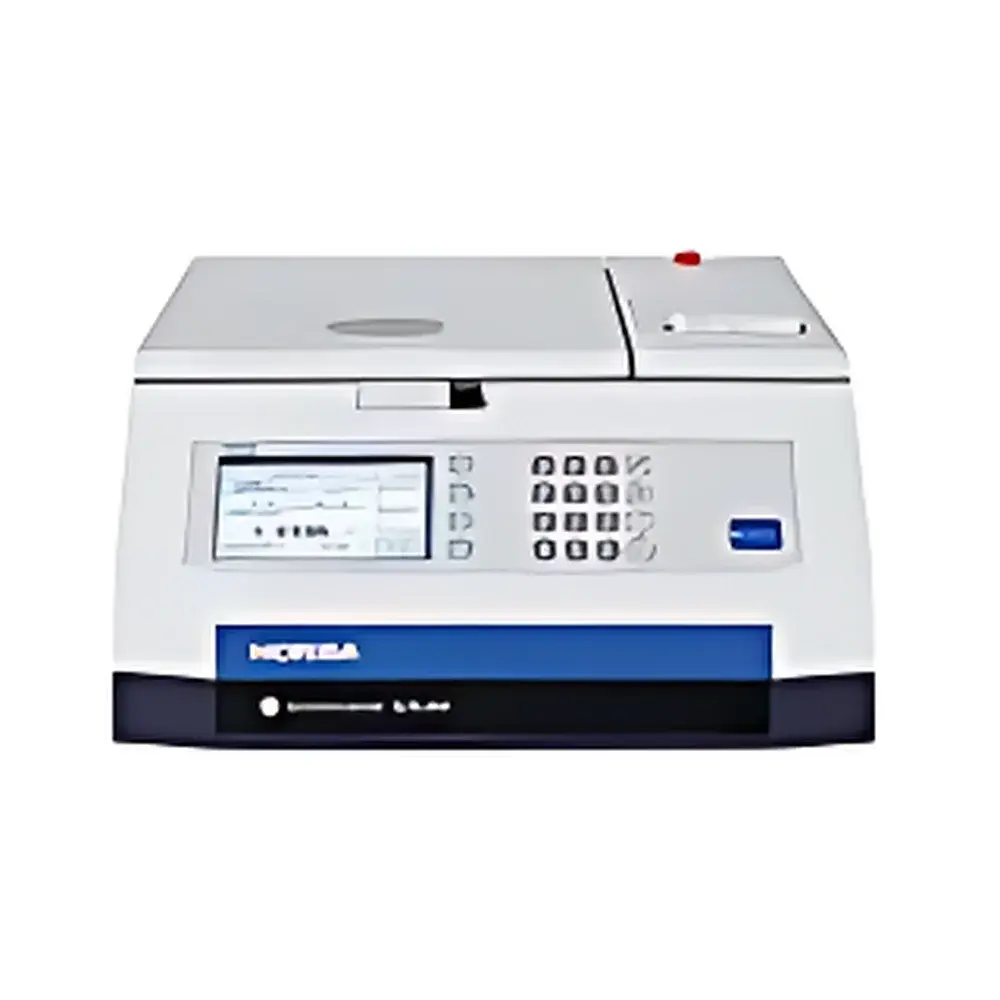
HORIBA SLFA-2100/2800 Wavelength-Dispersive X-ray Fluorescence (WDXRF) Sulfur Analyzer
| Brand | HORIBA |
|---|---|
| Origin | Japan |
| Model | SLFA-2100/2800 |
| Detection Principle | Wavelength-Dispersive X-ray Fluorescence (WDXRF) |
| Analyte | Total Sulfur in Petroleum Products |
| Detection Range | ≤5 ppm (at 1% sample mass loading) / ≤1.6 ppm (at 0% baseline) |
| C/H Correction Error | ±50 ppm per 1% C/H ratio (at 1% sample loading) |
| Detection Limit | <5 ppm |
| Calibration Curves | Up to 5 stored |
| Calibration Points | 2–20 points using certified reference materials |
| Sample Volume | 4–10 mL |
| Measurement Time | 10–600 s (user-selectable) |
| Sample Capacity | 1 position (SLFA-2100) / 8-position automated turntable (SLFA-2800) |
| Operating Temperature | 5–35 °C |
| Relative Humidity | 30–85 % RH |
| Energy Range | 0–10 keV |
| Output Interface | RS-232C |
| Power Supply | AC 100–240 V ±10%, 50/60 Hz |
| Power Consumption | 150 VA |
| Dimensions (W×D×H) | 430 × 500 × 230 mm |
| Weight | ~21 kg (SLFA-2100) / ~24 kg (SLFA-2800) |
Overview
The HORIBA SLFA-2100 and SLFA-2800 are benchtop wavelength-dispersive X-ray fluorescence (WDXRF) analyzers engineered for precise, interference-free quantification of total sulfur in liquid petroleum products—including diesel fuel, gasoline, kerosene, light and heavy fuel oils, crude oil, and marine distillates. Designed in compliance with ASTM D2622, ISO 8754, and IP 336 standards, these instruments deliver regulatory-grade accuracy without requiring vacuum or helium purge environments—enabling robust operation in routine QC laboratories, refinery process control labs, and third-party testing facilities. The core measurement principle relies on monochromatic excitation of sulfur Kα radiation (2.307 keV) via a high-stability, low-power X-ray tube, followed by high-resolution spectral separation using a crystal analyzer (e.g., LiF or PET) and proportional counter detection. This WDXRF architecture ensures superior peak-to-background ratio and minimal matrix-induced spectral overlap compared to energy-dispersive (EDXRF) alternatives—critical for achieving sub-5 ppm detection limits in complex hydrocarbon matrices.
Key Features
- High-precision WDXRF optics with fixed-channel configuration optimized exclusively for sulfur K-line detection, eliminating need for full-spectrum scanning and improving counting statistics.
- Dual-platform design: SLFA-2100 supports single-sample manual loading; SLFA-2800 integrates an 8-position motorized turntable with priority-interrupt capability for unattended sequential analysis and urgent sample override.
- Auto-C/H correction algorithm compensates for variable carbon/hydrogen absorption effects across diverse fuel types (e.g., paraffinic vs. naphthenic vs. aromatic base stocks), ensuring consistent accuracy independent of feedstock origin.
- Dynamic spectral monitoring mode enables real-time assessment of X-ray tube aging, detector gain drift, and crystal alignment stability—supporting predictive maintenance and GLP-compliant instrument qualification.
- Intuitive 7-inch backlit LCD interface with smartphone-style key layout, alphanumeric sample ID entry (up to 10 characters), and dual-unit display (ppm/%) with automatic range scaling across 0–9.999%.
- Integrated thermal and atmospheric pressure compensation eliminates external environmental stabilization requirements—maintaining <1.6 ppm repeatability even under ambient fluctuations (5–35 °C, 30–85% RH).
- Double-interlock safety system: X-ray emission is physically inhibited unless both the sample chamber door and primary beam shutter are fully closed—meeting IEC 61010-1 and JIS Z 4901 requirements without designated controlled areas.
Sample Compatibility & Compliance
The SLFA series accommodates homogenous liquid samples in standardized 4–10 mL volumes using disposable polypropylene or quartz cuvettes—compatible with viscous fuels up to 500 cSt after optional pre-heating (external bath). No digestion, dilution, or chemical derivatization is required. Instruments comply with EPA Method 8080B (sulfur in fuels), ASTM D7042 (diesel sulfur by WDXRF), and ISO 20884 (automotive gasoline sulfur). Data integrity meets FDA 21 CFR Part 11 requirements when paired with HORIBA’s optional audit-trail-enabled software package, including electronic signatures, version-controlled calibration records, and immutable raw spectrum archiving.
Software & Data Management
HORIBA’s proprietary SLFA Control Software provides full method development, calibration management, and report generation. It supports up to five independent calibration curves—each configurable as first- or second-order polynomial—with auto-selection based on expected concentration range. All measurements log timestamp, integration time, repetition count, sample ID, mean value, standard deviation, curve ID, and full spectral snapshot. Data export via RS-232C includes ASCII-formatted results compatible with LIMS integration, statistical process control (SPC) platforms, and Excel-based trending. Optional PDF report generation includes embedded spectra, calibration plots, and pass/fail flags against user-defined specification limits.
Applications
- Refinery final product release testing for ultra-low-sulfur diesel (ULSD, ≤15 ppm) and marine gas oil (MGO, ≤0.1% wt).
- Crude assay sulfur profiling to optimize desulfurization unit feed blending.
- QC verification of additive-treated fuels where sulfur interference may affect oxidation stability tests.
- Contract laboratory certification for ISO/IEC 17025-accredited sulfur testing services.
- Research applications involving sulfur speciation correlation studies (when coupled with complementary techniques such as XANES).
FAQ
Does the SLFA require helium purging or vacuum operation?
No. The instrument operates in ambient air using optimized collimation and crystal dispersion—eliminating consumable gases and associated infrastructure costs.
Can it analyze solid or slurry samples?
Not directly. Only homogeneous liquids are supported. Solids must be dissolved in suitable organic solvents (e.g., xylene) prior to analysis, following validated dissolution protocols.
What reference materials are recommended for calibration?
Certified sulfur standards traceable to NIST SRM 2721 (diesel), SRM 1634c (fuel oil), or equivalent CRM-grade materials from AccuStandard or SpectraPure.
Is remote diagnostics supported?
Yes—via optional Ethernet module and HORIBA Remote Support Protocol (HRSP), enabling secure firmware updates and troubleshooting under ITAR-compliant data handling policies.
How often does the X-ray tube require replacement?
Typical service life exceeds 20,000 hours under standard operating conditions (10–30 kV, 0.5–1.0 mA), with built-in tube health monitoring via spectral resolution tracking.