
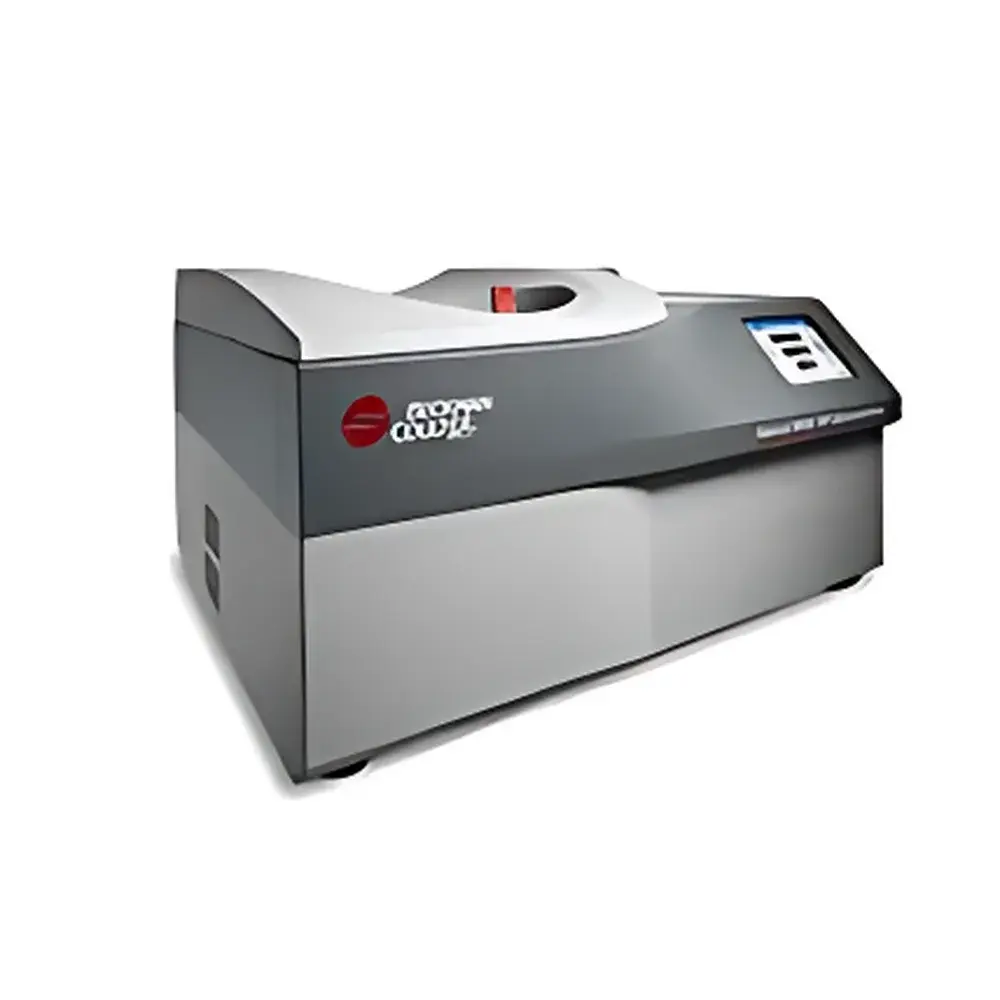
Beckman Coulter Optima MAX-XP Desktop Ultracentrifuge
| Brand | Beckman Coulter |
|---|---|
| Origin | USA |
| Model | Optima MAX-XP |
| Centrifuge Type | Benchtop Ultracentrifuge |
| Maximum Speed | 150,000 rpm |
| Maximum RCF | 1,019,000 × g |
| Maximum Capacity | 6 × 32.4 mL |
| Dimensions (W × H × D) | 58.4 × 73.7 × 40.9 cm |
| Sample Volume Range | 0.175–194 mL |
| Operating Temperature Range | 0–40 °C |
| Noise Level | <55 dBA (typical at 150,000 rpm) |
| Interface Language | English / Chinese selectable |
| Security Compliance | User authentication, electronic audit trail, FDA 21 CFR Part 11–ready software architecture |
Overview
The Beckman Coulter Optima MAX-XP is a high-performance benchtop ultracentrifuge engineered for precision separation of macromolecules, subcellular organelles, viruses, nanoparticles, and nucleic acids under extreme gravitational forces. Operating on the principle of sedimentation velocity and equilibrium centrifugation, the Optima MAX-XP delivers reproducible, high-resolution separations at rotational speeds up to 150,000 rpm and relative centrifugal forces (RCF) exceeding 1,019,000 × g. Its compact footprint integrates industrial-grade rotor dynamics, vacuum-sealed drive technology, and active magnetic bearing suspension—enabling stable, low-vibration operation critical for sensitive biological samples. Designed for regulated laboratory environments, the system meets stringent mechanical safety standards (IEC 61010-2-020) and supports GLP/GMP workflows through traceable user access, time-stamped run logs, and configurable electronic records.
Key Features
- Ultra-high-speed capability: Certified performance up to 150,000 rpm with RCF >1,019,000 × g—validated per ISO 15197 and ASTM F2119 protocols.
- Intelligent touchscreen interface: 10.4-inch full-color capacitive display with intuitive icon-based navigation; supports bilingual (English/Chinese) language switching without firmware reload.
- Multi-level safety architecture: Integrated rotor recognition, real-time imbalance detection, lid interlock verification, and automatic deceleration upon anomaly detection.
- Acoustically optimized enclosure: Sound-dampened chamber and balanced drive assembly reduce operational noise to <55 dBA—ideal for shared lab spaces and continuous overnight runs.
- Programmable multi-step protocols: Up to five sequential steps per method (e.g., acceleration → hold → deceleration → brake), with delay start, repeat cycles, and auto-restart after power interruption.
- HEPA-filtered aerosol containment option: Optional integrated HEPA filtration module compliant with BSL-2/BSL-3 biosafety requirements per NIH Guidelines and CDC/NIH Biosafety in Microbiological and Biomedical Laboratories (BMBL).
Sample Compatibility & Compliance
The Optima MAX-XP accommodates a broad spectrum of sample formats—from 175 µL microvolume tubes to 32.4 mL high-capacity bottles—across Beckman Coulter’s proprietary rotor portfolio, including fixed-angle (e.g., Type 70 Ti, Type 90 Ti), vertical (e.g., Vti 65.2), near-vertical (e.g., NVT 65), and swinging-bucket configurations. All rotors undergo full ASME BPVC Section VIII Div. 1 certification and are individually serialized for lifetime traceability. Tube compatibility includes patented g-Max high-RCF tubes, conical-bottom concentrator tubes, quick-seal polyallomer vials, and fingertip-seal polycarbonate tubes—each validated for pressure integrity, thermal stability (−20 to +40 °C), and chemical resistance to common solvents and buffers. System-level compliance extends to ISO/IEC 17025 calibration traceability, USP analytical instrument qualification (AIQ) framework, and alignment with FDA 21 CFR Part 11 requirements for electronic records and signatures when paired with Beckman Coulter’s CentriLog™ software.
Software & Data Management
CentriLog™ software provides comprehensive instrument control, method development, and data governance. It enables role-based user authentication (administrator/operator/reviewer), encrypted audit trails capturing operator ID, timestamp, parameter changes, and run outcomes—fully exportable as PDF or CSV for regulatory submission. Electronic signatures support dual-approval workflows for SOP adherence. Method libraries allow version-controlled storage of validated protocols, with automated alerts for rotor lifetime expiration, maintenance due dates, and calibration status. Integration with LIMS via HL7 or RESTful API ensures seamless data flow into enterprise quality management systems (QMS). All software modules comply with ICH GCP and ALCOA+ principles for data integrity.
Applications
The Optima MAX-XP serves as a core platform in advanced life science research and bioprocessing QC. Key use cases include: isolation of extracellular vesicles (exosomes) from plasma or cell culture supernatants; purification of recombinant AAV vectors for gene therapy development; density gradient separation of ribosomal subunits and protein complexes; preparative isolation of lipid nanoparticles (LNPs); subcellular fractionation of mitochondria, lysosomes, and nuclei; and high-resolution analysis of synthetic nanomaterials (e.g., quantum dots, polymeric micelles). Its capacity for both rapid pelleting and isopycnic banding makes it indispensable in structural biology, virology, and mRNA vaccine process development laboratories operating under cGMP conditions.
FAQ
What is the maximum certified RCF for the Optima MAX-XP?
The system achieves a verified maximum RCF of 1,019,000 × g using the Type 70 Ti rotor at 150,000 rpm.
Does the Optima MAX-XP support remote monitoring or network connectivity?
Yes—via Ethernet-enabled CentriLog™ software, supporting secure remote diagnostics, method push/pull, and real-time run status viewing across local networks.
Is FRIP (Rotor Field Inspection Program) available globally?
FRIP services are offered in North America, EMEA, and APAC regions through authorized Beckman Coulter service centers, providing non-destructive rotor integrity assessment per manufacturer specifications.
Can the instrument be installed inside a biosafety cabinet?
Yes—the Optima MAX-XP meets dimensional and exhaust compatibility requirements for Class II BSC integration, and optional HEPA filtration ensures aerosol containment during high-speed viral pellet recovery.
How is rotor lifetime managed and tracked?
Each rotor contains an embedded RFID tag storing manufacturing date, material lot, and cumulative run history; CentriLog™ enforces hard-stop alerts when operational limits (hours/cycles) are reached.



