
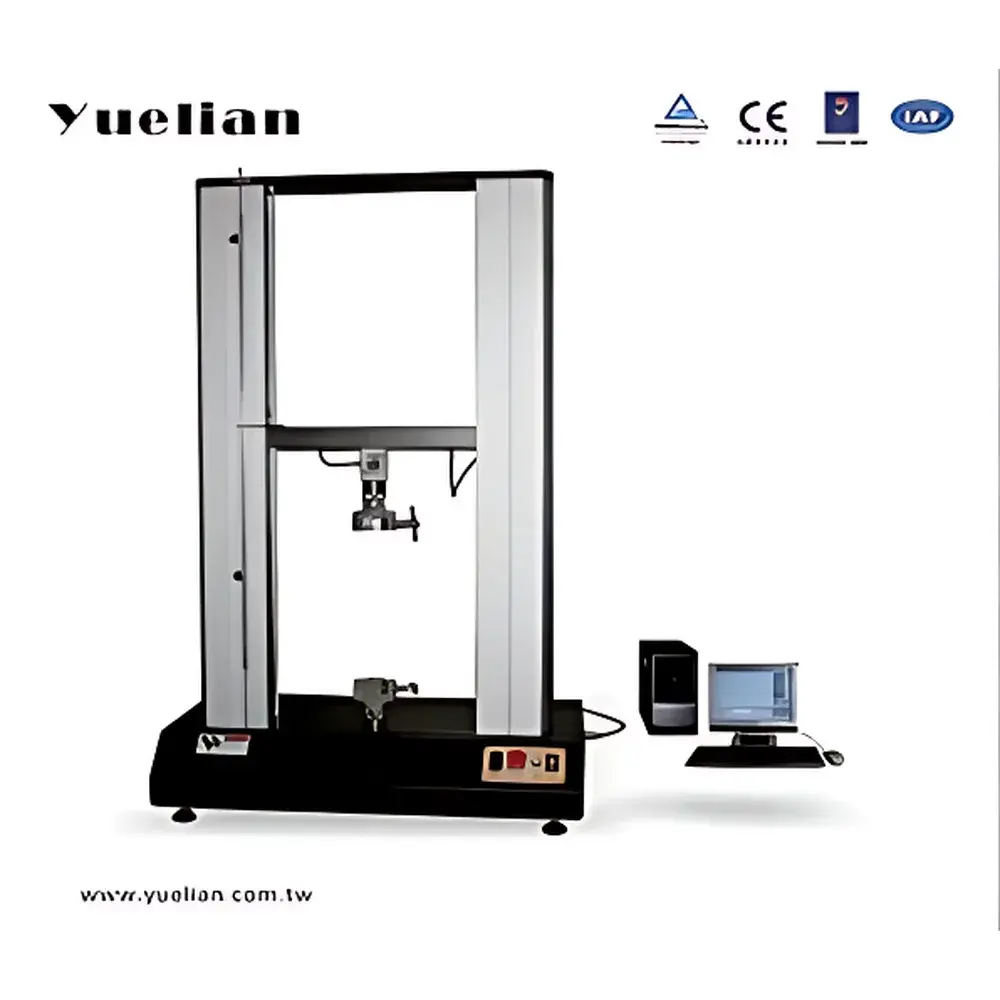
Yuelian YL-1123 Servo-Controlled Tensile Testing Machine (20 kN Capacity)
| Brand | Yuelian |
|---|---|
| Origin | Guangdong, China |
| Manufacturer Type | Authorized Distributor |
| Country of Origin | China |
| Model | YL-1123 |
| Instrument Type | Electromechanical Universal Testing Machine |
| Load Capacity Options | 10 N to 20 kN (dual-range configuration available) |
| Force Resolution | 1/500,000 full scale |
| Force Accuracy | ±0.3% of reading |
| Crosshead Travel Resolution | 1/500,000 |
| Test Speed Range | 0.01–1000 mm/min (programmable) |
| Maximum Travel | 700 mm |
| Test Width | 420 mm |
| Drive System | Servo motor with precision ball screw and synchronous belt transmission |
| Power Supply | 220 V, 50/60 Hz, 10 A |
| Rated Power | 400 W |
| Dimensions (W×D×H) | 720 × 520 × 1300 mm |
| Weight | ~115 kg |
| Compliance Standards | ISO 7500-1, ASTM E4, EN 10002-1, GB/T 228.1, GB/T 2792, ASTM D3330, JIS B7721/B7733, DIN 51221, JJG 475 |
Overview
The Yuelian YL-1123 Servo-Controlled Tensile Testing Machine is a high-precision electromechanical universal testing system engineered for static mechanical property evaluation of solid materials under uniaxial loading conditions. Based on closed-loop servo control architecture, it applies controlled displacement or load rates to specimens while continuously acquiring force and displacement data in real time. The system operates according to fundamental principles of uniaxial tensile mechanics—measuring stress–strain response, yield behavior, ultimate strength, elongation at break, modulus of elasticity, and fracture characteristics. Designed for routine quality assurance, incoming material inspection, R&D validation, and standardized compliance testing, the YL-1123 meets the metrological requirements defined in ISO 7500-1 (Class 0.5 accuracy), ASTM E4 (verification of force-measuring systems), and GB/T 228.1 (metallic materials – tensile testing). Its modular mechanical design supports interchangeable load cells and fixture sets, enabling adaptation across diverse specimen geometries and test modes—including tension, compression, flexure, peel, shear, tear, and adhesion.
Key Features
- Servo motor-driven crosshead with precision ground ball screw and synchronous belt transmission ensures smooth, low-backlash motion and high positional repeatability over full stroke (700 mm).
- Force measurement system calibrated to ±0.3% of reading with resolution up to 1 part in 500,000 full scale—enabling reliable detection of subtle mechanical transitions in low-force applications (e.g., thin films, adhesives, biomedical polymers).
- Programmable speed range from 0.01 to 1000 mm/min accommodates both quasi-static structural testing and high-speed dynamic characterization within regulatory-compliant boundaries.
- Dual-capacity load cell configuration option allows seamless switching between high-sensitivity and high-load ranges without hardware reconfiguration—ideal for labs handling heterogeneous material portfolios.
- Integrated emergency stop circuitry, overload cutoff, specimen rupture auto-stop, and programmable upper/lower travel limits ensure operator safety and equipment protection per IEC 61000-6-2 and GB/T 2611 standards.
- Robust frame construction (720 × 520 × 1300 mm, ~115 kg) minimizes vibration-induced noise and maintains alignment stability during extended test cycles or high-cycle fatigue pre-conditioning.
Sample Compatibility & Compliance
The YL-1123 accommodates a broad spectrum of specimen types and geometries across industrial sectors. Standard test widths of 420 mm support flat specimens up to 400 mm wide, including metallic sheets, polymer films, composite laminates, rubber strips, textile fabrics, paperboard, adhesive tapes, and elastomeric seals. Optional fixtures extend functionality to ASTM D3330 (peel adhesion), GB/T 2792 (180° peel strength), ISO 8510-2 (flexural strength of sandwich panels), and EN 1002-2 (compression testing of concrete cores). All test procedures are traceable to internationally recognized reference standards, and raw data acquisition complies with audit requirements for GLP and GMP environments—supporting 21 CFR Part 11–compliant electronic signatures when paired with validated software configurations.
Software & Data Management
The embedded PC-based control and analysis platform provides comprehensive test orchestration and post-processing capabilities. Using a USB-connected interface board, the system acquires synchronized force and displacement signals at configurable sampling rates. Software modules compute key mechanical parameters—including maximum load, yield strength (offset method), Young’s modulus, elongation at break, average peel force, and energy absorption—and generate standardized stress–strain curves. Data export formats include CSV, XLSX, and PDF reports compatible with LIMS integration. The application supports multi-sensor input channels, real-time graphical overlay of multiple tests, curve smoothing and derivative analysis, and database storage via Microsoft Access for long-term trend monitoring. Calibration certificates, user-defined test templates, and version-controlled firmware updates are managed through an auditable administrative interface.
Applications
- Quality control laboratories verifying conformance of raw materials (e.g., steel strips, aluminum extrusions, PET films) against GB/T 228.1, ASTM E8, or ISO 6892-1 specifications.
- Packaging R&D teams evaluating seal integrity, tape adhesion (GB/T 2792, ASTM D3330), and pouch burst strength under variable humidity and temperature preconditioning.
- Automotive component suppliers conducting tensile and compressive validation of gaskets, hoses, and interior trim per SAE J211 or VW TL 226.
- Academic research groups studying viscoelastic deformation mechanisms in thermoplastics, hydrogels, or fiber-reinforced composites using controlled strain-rate protocols.
- Electronics manufacturers assessing solder joint reliability, flexible PCB tensile endurance, and conformal coating adhesion per IPC-TM-650 2.4.1.
FAQ
What standards does the YL-1123 officially comply with for force calibration and system verification?
The system conforms to ISO 7500-1 (Class 0.5), ASTM E4, EN 10002-1, and JJG 475-2008 for static force calibration and verification of universal testing machines.
Is the software compliant with FDA 21 CFR Part 11 requirements for electronic records and signatures?
Yes—when deployed with validated user access controls, audit trail logging, and electronic signature workflows, the software meets core elements of 21 CFR Part 11 for regulated environments.
Can the machine perform cyclic or fatigue testing?
The YL-1123 is optimized for static and quasi-static tests; for true low-cycle or high-cycle fatigue applications, a dedicated servo-hydraulic or electrodynamic fatigue system is recommended.
What is included in the standard delivery package?
Standard configuration includes one set of wedge-action tensile grips, Windows-compatible control and analysis software, USB communication cable, calibration certificate, and operation manual.
Does the system support third-party transducers or extensometers?
Yes—the analog input interface accepts industry-standard ±10 V or 4–20 mA signals, allowing integration with clip-on extensometers, environmental chambers, or digital image correlation (DIC) systems.



