
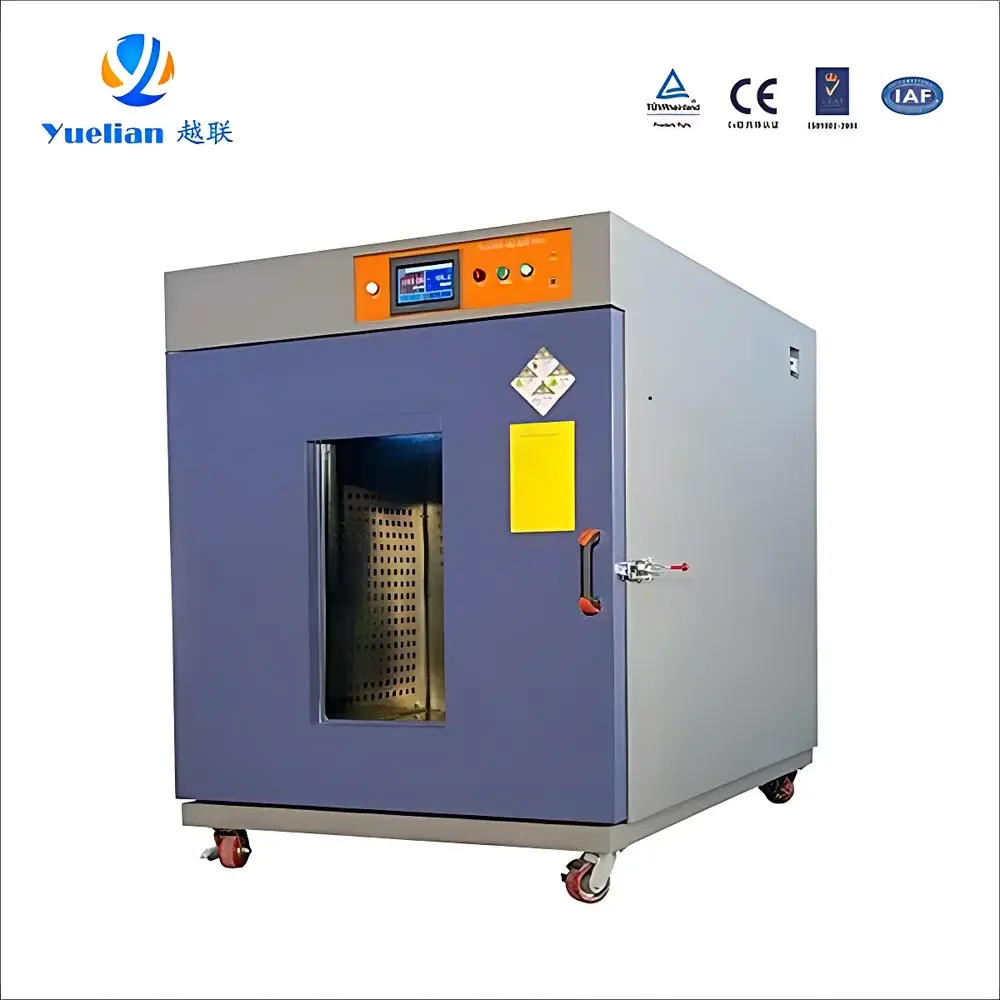
Yuelian YL-8808-9 SAFT Shear Adhesion Failure Temperature Tester
| Brand | Yuelian |
|---|---|
| Origin | Guangdong, China |
| Manufacturer Type | Authorized Distributor |
| Country of Origin | China |
| Model | YL-8808-9 |
| Price | Upon Request |
| Temperature Resolution | 0.1 °C |
| Specimen Width | 24 mm |
| Bonded Area | 24 mm × 24 mm |
| Test Plate Dimensions | 72 mm × 50 mm |
| Load Options | Nine independent weights (0.5 kg or 1 kg each) |
| Starting Temperature | 40 °C |
| Temperature Range | Ambient +5 °C to 300 °C |
| Temperature Uniformity | ±1 °C |
| Temperature Ramp Control | Programmable multi-segment ramp via touchscreen interface |
| Timing Resolution | 0.5 min per test station |
| Test Stations | 9 independent channels with staggered start capability |
| Chamber Interior | 304 stainless steel |
| Chamber Exterior | Powder-coated steel |
| Power Supply | 220 V AC, 2 kW |
Overview
The Yuelian YL-8808-9 SAFT Shear Adhesion Failure Temperature Tester is an engineered solution for quantifying the thermal stability of pressure-sensitive adhesive (PSA) tapes under sustained shear load—a critical performance parameter in automotive, electronics, medical device, and industrial bonding applications. Designed in strict accordance with GB/T 36794–2018, this instrument determines the Shear Adhesion Failure Temperature (SAFT): the maximum temperature at which a standardized PSA tape specimen maintains structural integrity under constant shear stress before interfacial or cohesive failure occurs. The measurement principle relies on controlled thermal ramping within a calibrated forced-air convection chamber while applying defined mechanical loads (0.5 kg or 1 kg) across nine independent test stations. Failure is detected visually or via time-stamped observation of slippage or delamination; SAFT is then calculated using the recorded failure time and the programmed heating rate (e.g., 1 °C/min), per ISO 29337 and ASTM D4498–17 guidelines for thermal shear resistance testing.
Key Features
- Nine independent test positions with staggered initiation capability—enabling parallel evaluation of multiple specimens under identical thermal profiles while minimizing operator intervention.
- Precision temperature control system featuring a programmable multi-segment ramp function via intuitive 7-inch capacitive touchscreen interface, supporting up to 10 user-defined temperature/time profiles.
- High-uniformity forced-air convection chamber (±1 °C uniformity across working volume) constructed with 304 stainless steel interior and electrostatically powder-coated exterior for corrosion resistance and long-term thermal stability.
- Standardized test geometry: 24 mm × 24 mm bonded area on 72 mm × 50 mm stainless steel test plates, compliant with GB/T 36794–2018 dimensional requirements.
- Thermal resolution of 0.1 °C and timing resolution of 0.5 min per station—ensuring reproducible data acquisition aligned with GLP-compliant laboratory practices.
- Modular accessory compatibility: Optional manual or motorized roller applicators (sold separately) support consistent wetting and contact pressure during specimen preparation.
Sample Compatibility & Compliance
The YL-8808-9 accommodates standard PSA tape formats—including acrylic, rubber-based, silicone, and hybrid formulations—on rigid substrates such as stainless steel, aluminum, or anodized plates. Specimens are cut using the included 24-mm-width precision die, ensuring dimensional repeatability. All operational parameters—including temperature ramp rate, dwell time, load magnitude, and failure criteria—are fully configurable to meet method-specific validation requirements. The system supports documentation traceability per ISO/IEC 17025:2017 and aligns with regulatory expectations for adhesion performance verification in GMP environments (e.g., ISO 13485 for medical adhesives). While not inherently 21 CFR Part 11–compliant, its timestamped event logging and profile audit trail facilitate integration into validated QA workflows when paired with secure networked data capture systems.
Software & Data Management
The integrated touchscreen controller stores all test profiles, runtime logs, and failure timestamps locally with automatic date/time stamping. Each of the nine test channels maintains an independent chronology, including start time, temperature at failure, elapsed time to failure, and active ramp segment. Export functionality supports USB-based CSV file transfer for post-processing in Excel, MATLAB, or LIMS platforms. Optional firmware upgrades may introduce Ethernet connectivity and remote monitoring capabilities—subject to regional regulatory approval. All temperature calibration points (including offset and linearity verification) are accessible through service mode for metrological traceability to NIST-traceable reference standards.
Applications
- Quality control of PSA tapes used in battery module assembly (e.g., cell-to-module bonding where thermal cycling resistance is critical).
- Development and screening of high-temperature masking tapes for aerospace paint-bake processes (150–200 °C).
- Comparative evaluation of cohesive strength degradation kinetics across adhesive chemistries under accelerated thermal stress.
- Supporting ISO 10360-based uncertainty analysis for SAFT measurement uncertainty budgets in accredited laboratories.
- Validation of adhesive performance specifications for automotive interior trim bonding under under-hood thermal exposure conditions.
FAQ
What standards does the YL-8808-9 comply with?
It is designed and verified for full conformance with GB/T 36794–2018 and technically compatible with ASTM D4498–17 and ISO 29337 methodologies.
Can the instrument perform isothermal hold tests?
Yes—the programmable temperature profile supports both linear ramp and static isothermal segments, allowing for dwell-time studies at fixed temperatures.
Is calibration certification included?
Factory calibration data is provided; users are responsible for periodic verification using NIST-traceable thermocouples and certified weights per internal SOPs or ISO/IEC 17025 requirements.
How is specimen failure determined?
Failure is defined as measurable slippage (>0.5 mm) or complete debonding under load, observed visually or via optional digital displacement monitoring (not included but integrable via analog output port).
What maintenance is required?
Routine cleaning of chamber interior, inspection of door gasket integrity, and annual verification of temperature uniformity and ramp accuracy are recommended per manufacturer’s technical manual.



