
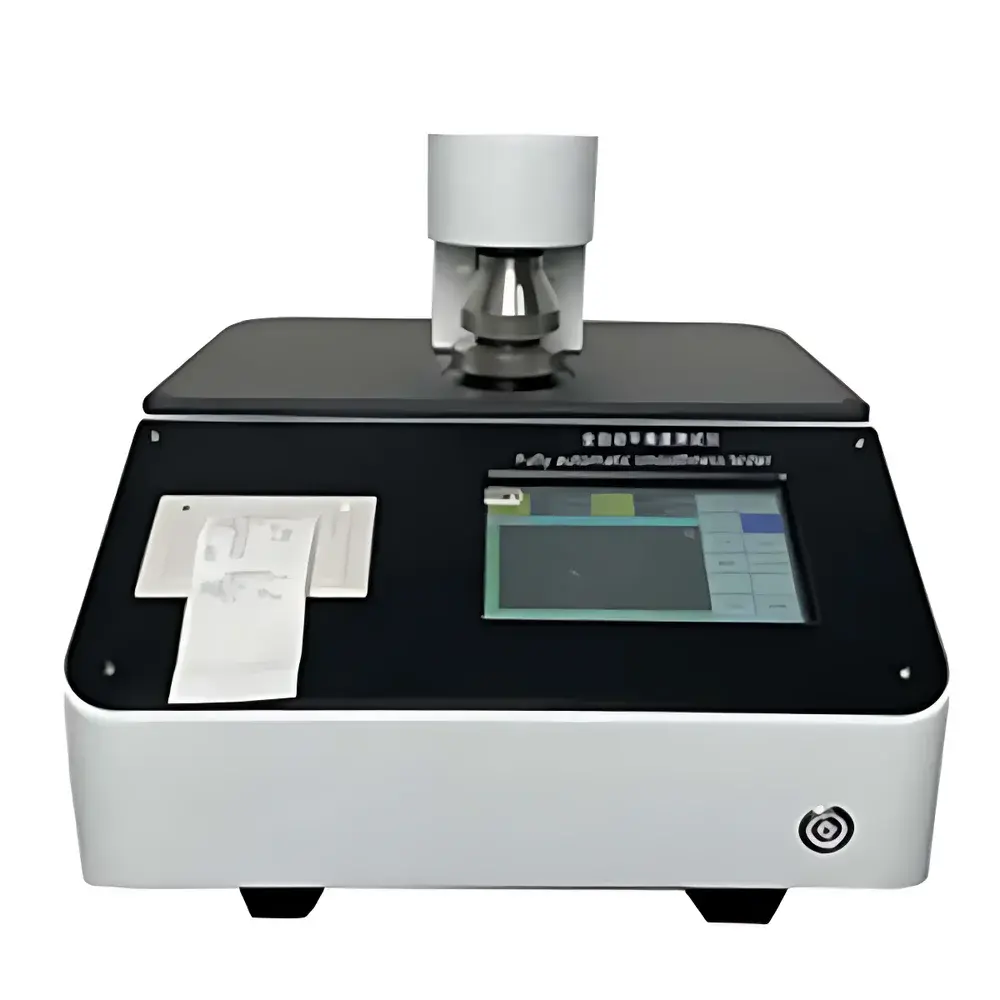
Brookfield PW-6607 Automated Bekk Smoothness Tester for Paperboard and Packaging Materials
| Brand | PW |
|---|---|
| Origin | Guangdong, China |
| Model | PW-6607 |
| Compliance | ISO 5627, GB/T 456 |
| Test Area | 10 ± 0.05 cm² |
| Pressure | 100 ± 2 kPa |
| Vacuum Range | 50.66–29.33 kPa (3档) |
| Timing Range | 1–9999 s (Auto mode ≤200 s) |
| Timing Accuracy | ≤1 s @ 1000 s |
| Display | 7-inch color touchscreen (Chinese/English UI) |
| Power | AC 220 V ±10%, 50 Hz (110 V/60 Hz optional) |
| Dimensions | 370 × 330 × 390 mm |
| Weight | ~29 kg |
| Interface | RS232 |
| Printer | Built-in thermal printer |
| Data Storage | Onboard flash memory with statistical calculation and dual-side differential analysis |
Overview
The Brookfield PW-6607 Automated Bekk Smoothness Tester is a precision instrument engineered for the quantitative assessment of surface smoothness in paper, paperboard, corrugated board, and packaging substrates. It operates on the internationally standardized Bekk method—defined in ISO 5627 and GB/T 456—which measures the time required for a fixed volume of air to flow between a flat glass anvil and the test specimen under controlled vacuum and contact pressure. Unlike traditional lever-and-weight Bekk instruments, the PW-6607 replaces mechanical loading with a motor-driven, closed-loop pressure actuation system. This eliminates operator-dependent force application, ensures consistent 100 ± 2 kPa contact pressure across all tests, and enhances long-term repeatability and inter-laboratory comparability. The instrument’s core architecture integrates a high-stability, oil-free vacuum pump, a calibrated pressure transducer, and a microprocessor-controlled timing circuit—all synchronized via embedded firmware compliant with GLP data integrity principles.
Key Features
- Motor-driven pressure application ensures precise, repeatable 100 ± 2 kPa contact force without manual intervention or mechanical drift.
- Three-vacuum-range configuration (I: 50.66–48.00 kPa; II: same as I; III: 50.66–29.33 kPa) enables optimized sensitivity for low-, medium-, and high-smoothness materials—including coated board and metallized films.
- Auto-mode algorithm dynamically selects optimal vacuum level and timing range (≤200 s), reducing average test duration by up to 40% for specimens with Bekk values >300 s.
- 7-inch full-color capacitive touchscreen with dual-language UI (English/Chinese), intuitive icon-based navigation, and real-time graphical feedback during vacuum ramp-up and airflow decay.
- Dual-side differential analysis function automatically computes and displays the absolute difference (ΔSmoothness) between front and back surface measurements—critical for evaluating calendering uniformity and coating symmetry.
- Onboard thermal printer supports immediate hard-copy output with timestamp, sample ID, test parameters, and statistical summary (mean, SD, CV%) per batch.
- RS232 serial interface enables bidirectional communication with LIMS or QC databases; supports ASTM E1382-compliant ASCII data export with metadata tagging (operator ID, calibration date, environmental conditions).
Sample Compatibility & Compliance
The PW-6607 accommodates standard sheet sizes (≥100 × 100 mm) and accepts specimens up to 5 mm thickness—covering uncoated kraft, clay-coated board, folding boxboard, laminated cartons, and synthetic packaging films. Its 10 ± 0.05 cm² test area conforms strictly to ISO 5627 Annex A and GB/T 456 Clause 6.2. All critical subsystems—including vacuum regulation, pressure sensing, and timing circuitry—are factory-calibrated traceable to NIM (National Institute of Metrology, China) standards. The instrument satisfies functional requirements for ISO/IEC 17025-accredited testing laboratories and supports audit-ready documentation: automatic timestamped logs, sensor linearity correction records, and power-failure-resilient data retention (retains last 500 test results even after unexpected shutdown).
Software & Data Management
Firmware v3.2 embeds a deterministic real-time operating system (RTOS) with non-volatile flash memory allocation for raw data, statistical aggregates, and user-defined test protocols. Each measurement stores: vacuum setpoint, actual applied pressure, elapsed time, temperature/humidity stamp (via optional external probe), and pass/fail flag against configurable limits. Batch reports include coefficient of variation (CV%), confidence interval at 95%, and outlier detection using Grubbs’ test. Data export formats include CSV (tab-delimited) and PDF (print-image). While native PC software is not bundled, the RS232 protocol adheres to Modbus RTU register mapping—enabling integration with LabVIEW, MATLAB, or custom MES platforms. All stored data comply with FDA 21 CFR Part 11 foundational requirements for electronic records (user authentication, audit trail, data integrity safeguards).
Applications
- Quality control of linerboard and corrugating medium in packaging mills—monitoring calender roll wear and nip pressure consistency.
- R&D evaluation of coating formulations (e.g., PVOH vs. starch-based barriers) where surface pore structure directly influences print gloss and ink holdout.
- Regulatory submission testing for pharmaceutical blister packaging—verifying smoothness thresholds that affect heat-seal integrity and peel strength.
- Supplier qualification audits for flexible laminates, where Bekk smoothness correlates with adhesive spread uniformity and delamination resistance.
- Academic research on fiber orientation effects: comparative smoothness profiling across machine direction (MD) and cross direction (CD) cuts.
FAQ
Does the PW-6607 require annual recalibration?
Yes—recommended annually or after 5000 test cycles. Calibration includes vacuum transducer verification, pressure sensor linearity check, and timer accuracy validation against NIST-traceable stopwatch.
Can it test samples with embossed or textured surfaces?
It can measure them, but results must be interpreted with caution. ISO 5627 explicitly excludes heavily textured or perforated materials; such specimens should be reported with a “non-standard surface” annotation.
Is the thermal printer replaceable with a networked laser printer?
No—the built-in thermal unit is mechanically integrated into the chassis. However, RS232 output allows routing print commands to external Windows/Linux systems with shared network printers via virtual COM port emulation.
What environmental conditions are required for ISO-compliant testing?
Standard conditioning per ISO 187: (23 ± 1)°C and (50 ± 2)% RH for ≥24 h prior to testing. The instrument itself operates within 10–35°C and ≤85% RH (non-condensing).
How is sensor nonlinearity corrected during operation?
The firmware applies a 5-point polynomial correction curve, pre-loaded during factory calibration. Users may initiate a field verification routine using certified reference discs (sold separately) to confirm residual error remains <±0.8% FS.
Related Products





