
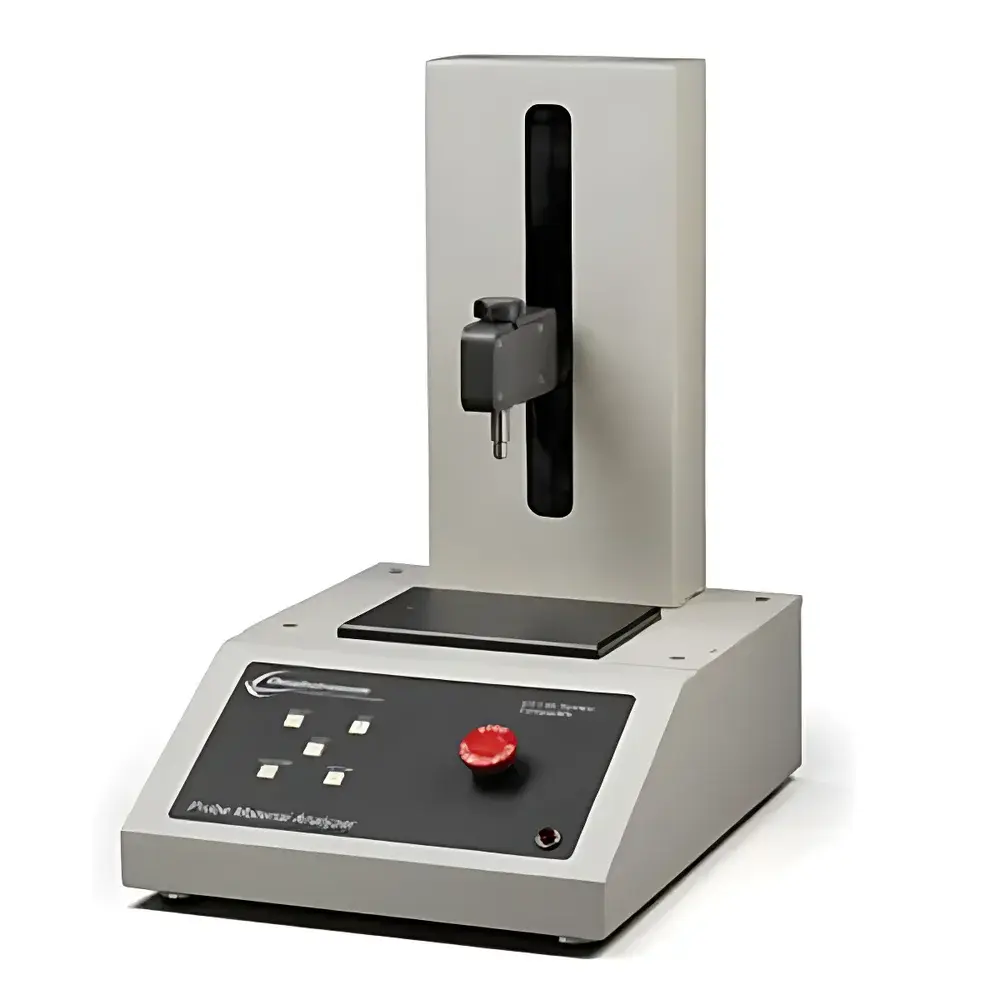
ChemInstruments PMA-1000 Probe Material Analyzer
| Origin | USA |
|---|---|
| Manufacturer Type | Authorized Distributor |
| Origin Category | Imported |
| Model | PMA-1000 |
| Pricing | Available Upon Request |
| Test Speed Range | 0.02–40 in/min (0.5–1016 mm/min) |
| Effective Probe Travel | 9 in (229 mm) |
| Force Sensor Standard | 10 lbf (44.5 N) |
| Force Units | g, kg, oz, lb, N |
| Temperature Operating Range | 0–70 °C |
| Dimensions (H×W×D) | 22 in × 14 in × 18 in (56 × 36 × 45.7 cm) |
| Weight | 55 lb (25 kg) |
| Software | EZ-Lab v3.x (Standalone, Windows-compatible) |
| Compliance | ASTM D1445, ASTM D2990, ISO 179-1, ISO 6892-1 (tensile/compression mode), GLP-ready audit trail logging |
Overview
The ChemInstruments PMA-1000 Probe Material Analyzer is a precision-engineered mechanical testing platform designed for controlled probe-based characterization of soft solids and viscoelastic materials. It operates on the fundamental principle of uniaxial quasi-static indentation and withdrawal—applying calibrated axial force while monitoring displacement, time, and load response during three distinct phases: probe insertion, dwell (static hold), and retraction. This methodology enables quantitative evaluation of material resistance to penetration, recovery behavior, adhesion hysteresis, and energy dissipation—critical parameters for quality control and formulation development in polymer science, adhesive R&D, pharmaceutical excipient screening, and food texture analysis. Unlike conventional universal testers, the PMA-1000 integrates purpose-built probe kinematics with real-time force-displacement synchronization, delivering high reproducibility under standardized test protocols aligned with ASTM and ISO guidelines for soft-material mechanical profiling.
Key Features
- Programmable dual-speed actuation: Independent control of insertion and retraction velocities (0.02–40 in/min), enabling asymmetric loading/unloading profiles essential for hysteresis analysis.
- Precise dwell-phase timing: Adjustable static hold duration (0.1–999.9 s) with force stabilization monitoring, supporting creep compliance and stress relaxation studies.
- Multi-parameter acquisition: Simultaneous recording of load (±0.1% FS), displacement (±0.001 in), and time (±1 ms resolution), synchronized at 100 Hz sampling rate.
- Modular probe interface: Standardized 1/4″-20 threaded mount compatible with interchangeable stainless-steel probes (cylindrical, conical, spherical) and custom fixtures for geometry-specific testing.
- Integrated overload protection: Hardware-limited force cutoff with automatic motor stop and audible alert, safeguarding both sensor integrity and sample integrity.
- Auto-return functionality: Programmable post-test retraction to home position, reducing operator intervention and improving throughput in batch testing environments.
- Calibration traceability: NIST-traceable force calibration certificate included; optional annual recalibration service available with ISO/IEC 17025 documentation.
Sample Compatibility & Compliance
The PMA-1000 accommodates a broad spectrum of compliant and semi-solid matrices—including thermoplastic elastomers, pressure-sensitive adhesives (PSAs), hydrogels, pastes, creams, gels, chewing gum bases, and composite fillers. Sample containers range from standard Petri dishes (minimum Ø 35 mm) to custom molds (up to 6 in diameter). The system complies with key regulatory and industry standards: ASTM D1445 (penetration hardness of greases), ASTM D2990 (creep and stress relaxation of plastics), ISO 179-1 (Charpy impact—when adapted with pendulum fixture), and ISO 6892-1 (tensile testing of metallic foils or thin films using compression-to-tension transition). All data logs generated via EZ-Lab software support 21 CFR Part 11 compliance when deployed on validated Windows workstations, including electronic signatures, audit trails, and user access controls required for GMP/GLP environments.
Software & Data Management
EZ-Lab software (v3.x) serves as the native control and analysis suite for the PMA-1000. It provides intuitive test method creation via drag-and-drop sequence builder—allowing users to define multi-step protocols (e.g., pre-load → ramp → dwell → retract → hold → unload) without scripting. Real-time graphical overlays display live force-displacement curves, with on-the-fly calculation of derived metrics: penetration depth, maximum load, adhesion work (area under retraction curve), elastic recovery ratio (%), and tangent modulus at specified strain points. Export options include CSV, Excel (.xlsx), and PDF reports with embedded metadata (operator ID, timestamp, calibration status, environmental conditions). Data archives are structured in hierarchical project folders with version-controlled method templates, facilitating cross-laboratory method transfer and FDA inspection readiness.
Applications
- Adhesive performance validation: Quantifying peel initiation force, tack energy, and cohesive failure thresholds in PSA formulations.
- Pharmaceutical solid dosage development: Assessing tablet friability, capsule shell elasticity, and gelatin bloom strength.
- Food texture profiling: Measuring firmness, cohesiveness, and springiness of dairy products, confectionery, and plant-based analogs per TPAs (Texture Profile Analysis) conventions.
- Biopolymer rheomechanics: Characterizing shear-thinning onset and yield behavior in injectable hydrogels and tissue scaffolds.
- Quality assurance in elastomer manufacturing: Monitoring batch-to-batch consistency in silicone rubber durometer correlation and compression set prediction.
FAQ
Is the PMA-1000 suitable for testing liquids or low-viscosity suspensions?
No—the instrument is optimized for materials with measurable yield stress and structural integrity under static probe contact. Liquids require rotational or capillary rheometry instead.
Can I integrate third-party sensors (e.g., temperature or humidity) into the test sequence?
Yes—EZ-Lab supports analog input channels (0–10 V) for synchronized external sensor data acquisition when configured with optional DAQ modules.
What maintenance is required for long-term accuracy?
Annual force sensor recalibration and lead-screw lubrication per manufacturer schedule; no routine alignment or optical recalibration needed due to purely mechanical transduction architecture.
Does the system support automated pass/fail decision logic based on specification limits?
Yes—EZ-Lab allows definition of upper/lower specification limits per parameter; tests auto-flag deviations and generate non-conformance reports with timestamped screenshots.
Are validation documents (IQ/OQ/PQ) available for regulated laboratories?
Full qualification packages—including installation qualification protocols, operational qualification test scripts, and performance qualification acceptance criteria—are provided upon request and supported by ChemInstruments’ global validation services team.



