
ZEISS COMET5 1.4M Optical 3D Scanning System
| Brand | ZEISS |
|---|---|
| Origin | Germany |
| Manufacturer Type | Authorized Distributor |
| Import Status | Imported |
| Model | COMET5 1.4M |
| Effective Resolution | 1360 × 1024 pixels |
| Pixel Size | 1360 × 1024 |
| Measurement Volume Ranges (mm³) | 46×34×50 / 110×82×70 / 220×164×140 / 444×330×250 / 890×660×500 |
| 3D Point Spacing | 50 / 100 / 200 / 400 / 800 µm |
| Minimum Acquisition Time | 0.6 s |
| Interface | CAN bus + Gigabit Ethernet |
| Software Platform | COMETplus v8.x (64-bit Windows OS compatible) |
Overview
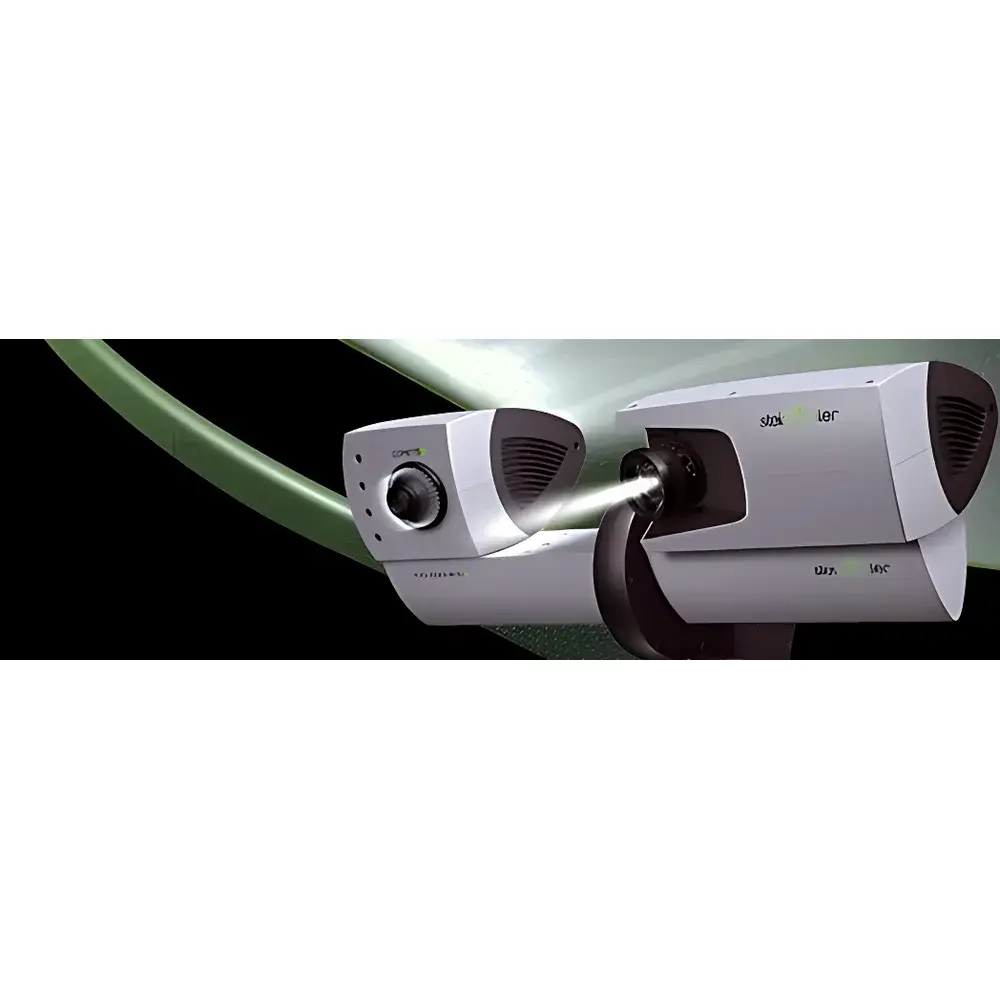
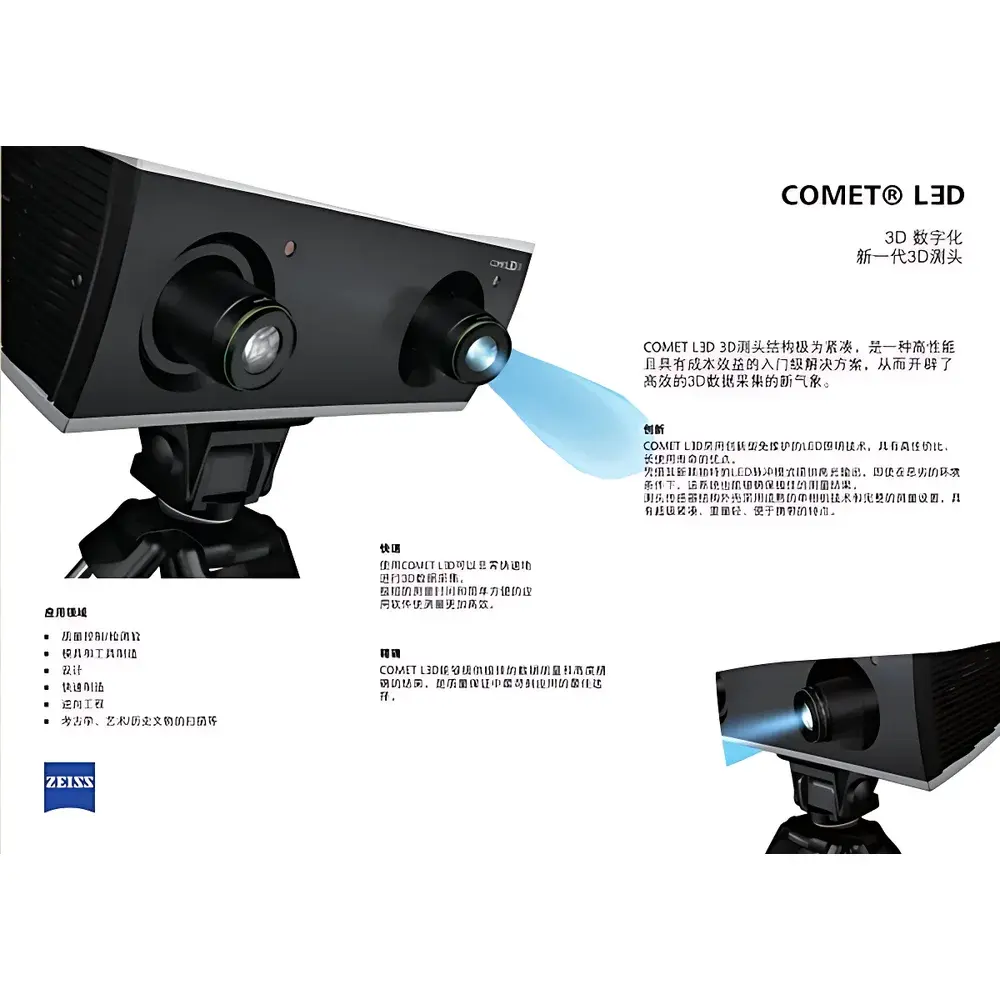
The ZEISS COMET5 1.4M Optical 3D Scanning System is a high-precision, non-contact photogrammetric measurement platform engineered for industrial metrology applications requiring traceable, repeatable, and geometrically robust surface digitization. Developed by Steinbichler Optotechnik — now part of the ZEISS Industrial Quality Solutions division — the COMET series represents one of the earliest and most mature implementations of structured-light triangulation in industrial 3D metrology. Its core principle relies on local triangulation using projected fringe patterns: a calibrated white-light source projects digitally modulated sinusoidal or binary grating patterns onto the object surface; a single high-resolution CCD sensor (1360 × 1024 effective pixels) captures sequential deformed fringes from a fixed optical axis. Each pattern is uniquely encoded, enabling pixel-wise correspondence between projection and imaging planes. Using baseline distance *b* and angular parameters α and β derived from epipolar geometry, the system computes precise 3D coordinates for each surface point with sub-pixel interpolation capability. This monocular architecture eliminates stereo-matching ambiguity, ensures intrinsic alignment stability, and delivers exceptional data fidelity across complex topographies — including concave, convex, bridged, and under-cut geometries — without shadow-induced artifacts or registration drift.
Key Features
- Monocular structured-light design with patented single-lens optical path — eliminates parallax error and guarantees intrinsic geometric consistency across overlapping scans.
- Digital fringe projection technology enabling full-field acquisition in as little as 0.6 seconds per frame — optimized for dynamic environments and vibration-prone production floors.
- Five scalable working volumes (from 46 × 34 × 50 mm to 890 × 660 × 500 mm), configured via interchangeable lens/projector modules — no hardware re-calibration required between ranges.
- FEM-optimized mechanical chassis with thermally stable aluminum alloy frame and fiber-optic-coupled mercury arc lamp — minimizes thermal drift and maintains long-term repeatability (Rrep ≤ 1.5 µm at 50 mm range).
- Gigabit Ethernet + CAN bus dual-interface architecture — ensures deterministic data transfer and real-time synchronization in industrial automation networks.
- VDI/VDE 2634 Part 2 Class 1 certification — compliant with German national standards for optical 3D coordinate measuring systems, supporting ISO/IEC 17025-accredited calibration workflows.
Sample Compatibility & Compliance
The COMET5 1.4M accommodates a broad spectrum of industrial parts: machined metal components, injection-molded plastics, composite tooling, turbine blades, automotive body panels, and reverse-engineered legacy prototypes. Matte, semi-gloss, and low-reflectivity surfaces yield optimal results; highly specular or transparent materials require standardized matting sprays (e.g., ZEISS OptiScan Spray). The system supports ISO 10360-8 verification protocols and integrates into GLP/GMP-compliant quality management systems via audit-trail-enabled software logging. All firmware and calibration certificates adhere to ZEISS’s ISO 9001:2015–certified manufacturing and service processes. Optional robot-mounting kits and rotary stage interfaces enable automated multi-angle scanning per ASTM E2924-22 guidelines for dimensional stability assessment.
Software & Data Management
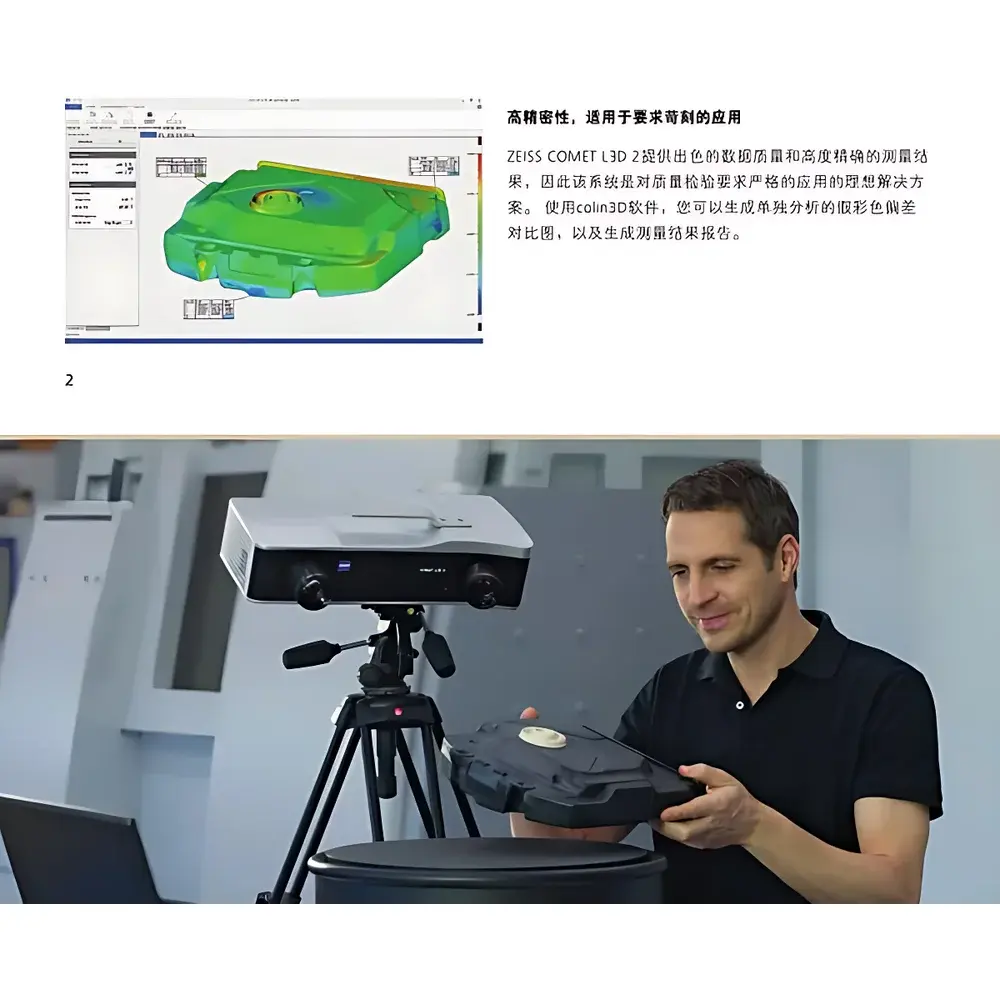
COMETplus v8.x serves as the unified control, evaluation, and reporting environment — fully native on 64-bit Windows 10/11 platforms with support for up to 24 GB RAM and Intel Xeon Quad-Core processors. It provides automated mesh generation (STL export with adaptive tessellation preserving sharp edges and curvature discontinuities), intelligent point-cloud decimation without feature loss, and multi-scan alignment via three proprietary methods: turntable-based auto-registration, marker-based alignment (minimum two fiducials), and feature-driven registration (ideal for bilateral scanning of symmetric parts). Raw data files are stored in vendor-neutral HDF5 format with embedded metadata (timestamp, calibration ID, environmental conditions). Export modules include GD&T analysis (per ASME Y14.5–2018), deviation color mapping, cross-section extraction, and direct integration with PolyWorks, Geomagic Control X, and Siemens Teamcenter via API connectors. Remote operation is supported via WLAN-connected tablet PCs with role-based access control.
Applications
- First-article inspection and FAI report generation for aerospace castings and forgings.
- In-process dimensional verification of CNC-machined components on shop-floor metrology stations.
- Tool wear monitoring through periodic scanning of mold cavity surfaces.
- Reverse engineering of legacy parts lacking CAD documentation — generating watertight NURBS surfaces for CAM re-manufacturing.
- Deformation analysis of thermal or mechanical load tests using time-series scan comparison.
- GD&T validation of position, profile, flatness, and concentricity tolerances against nominal models.
FAQ
What standards does the COMET5 1.4M comply with for metrological traceability?
It conforms to VDI/VDE 2634 Part 2 (Class 1), and its calibration procedures align with ISO/IEC 17025 requirements when performed by ZEISS-certified service centers.
Can the system operate in ambient factory lighting conditions?
Yes — the narrow-band optical filtering and synchronized projection capture suppress ambient light interference; no darkroom is required.
Is robotic integration supported out-of-the-box?
Standard mounting interfaces and EtherCAT-compatible motion control APIs are provided; ZEISS offers validated integration packages for KUKA, ABB, and Universal Robots platforms.
How is measurement uncertainty quantified and documented?
Uncertainty budgets are generated per VDI/VDE 2634 Annex C, incorporating contributions from camera noise, projector linearity, lens distortion, and environmental temperature gradients — all traceable to PTB (Physikalisch-Technische Bundesanstalt) reference standards.
Does COMETplus support automated report generation for quality audits?
Yes — customizable PDF/HTML reports include measurement certificates, GD&T tables, color deviation maps, and digital signatures compliant with FDA 21 CFR Part 11 when paired with ZEISS Authentis authentication module.




