
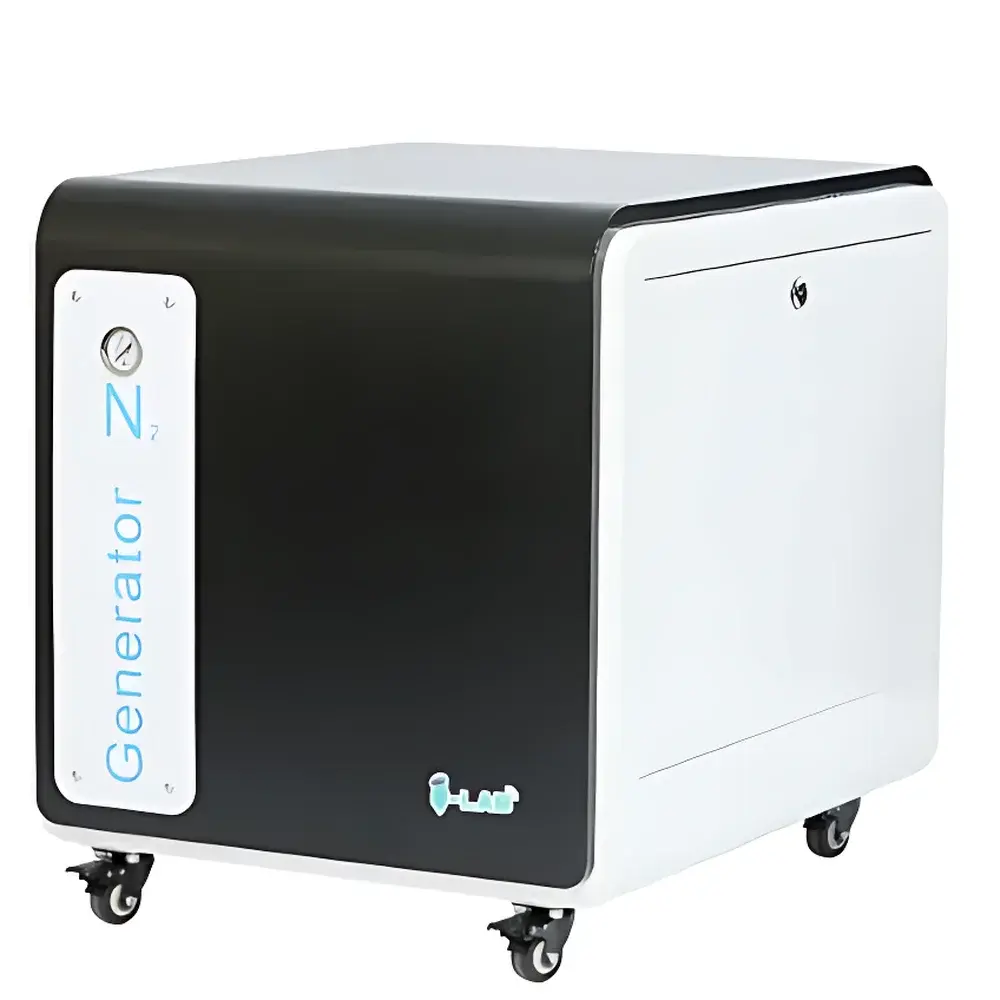
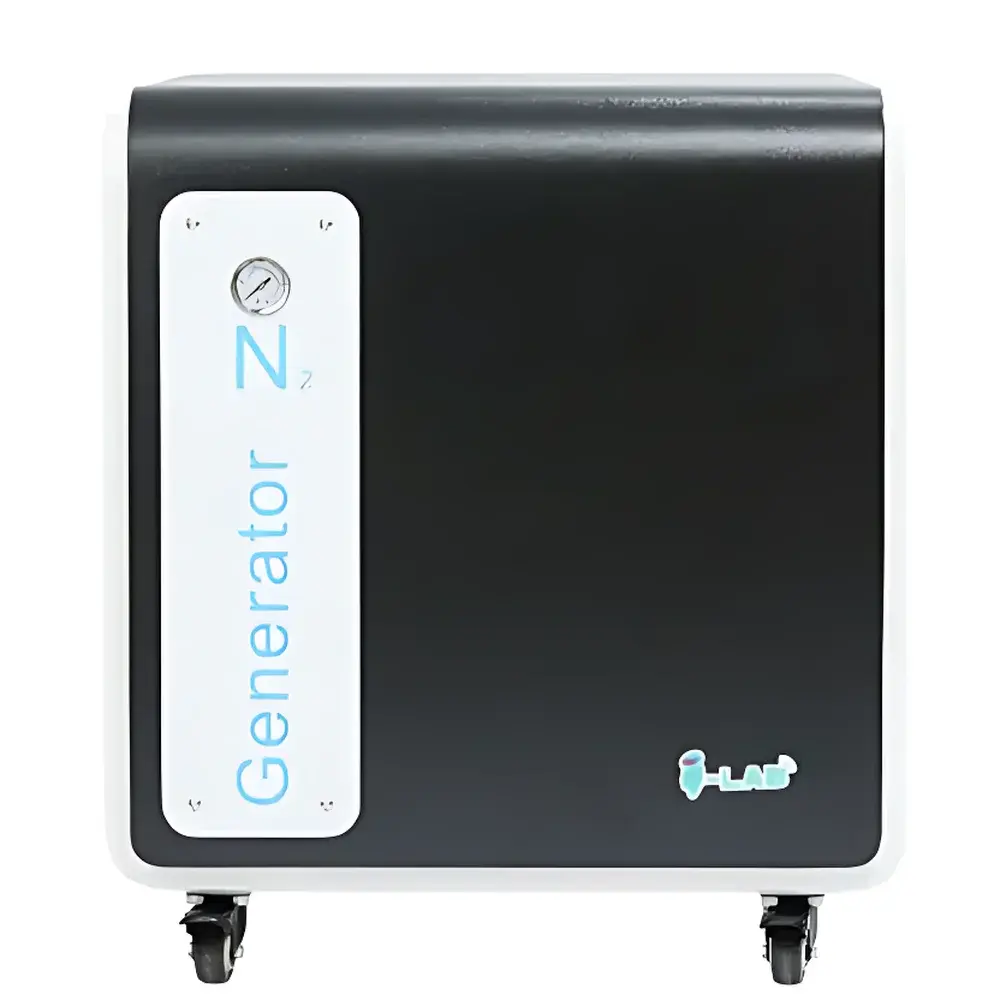
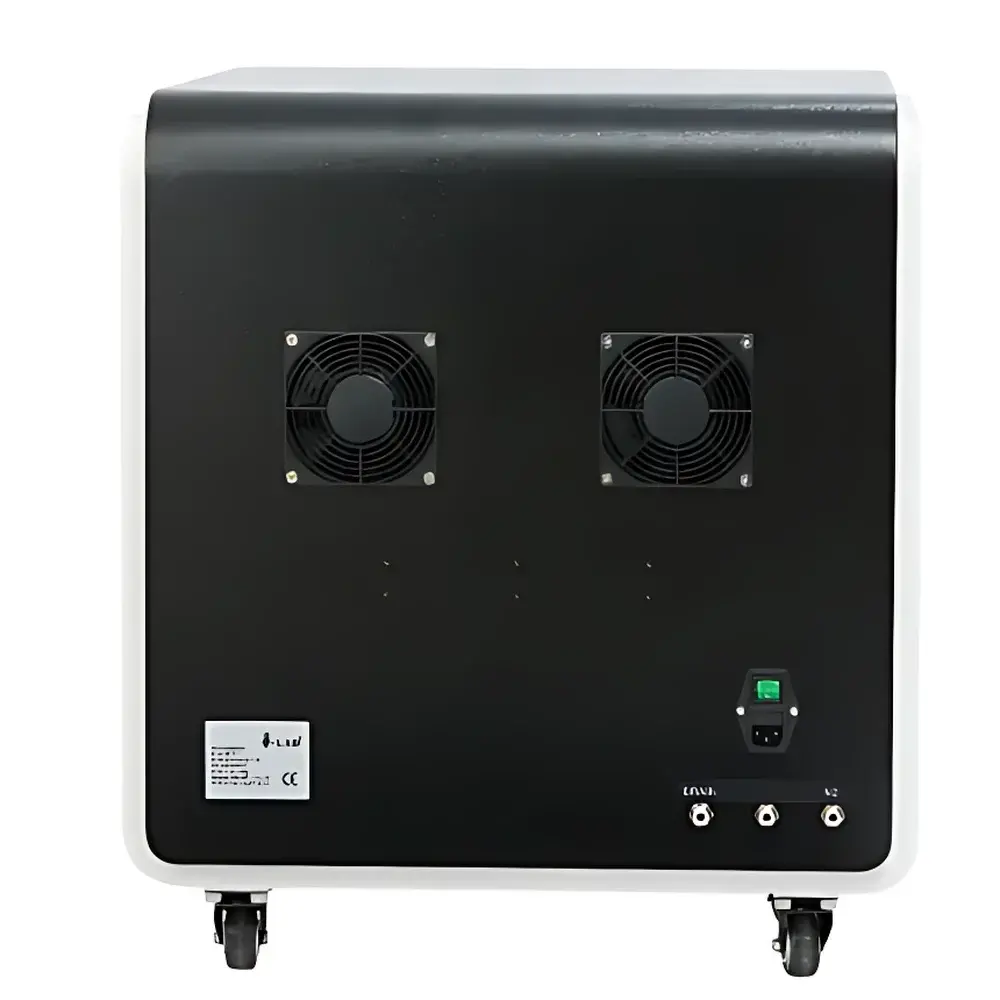
i-Lab KL35-1S Nitrogen & Zero-Air Generator for Shimadzu LCMS
| Brand | i-Lab |
|---|---|
| Origin | Shanghai, China |
| Manufacturer Type | Direct Manufacturer |
| Instrument Type | Nitrogen & Zero-Air Generator |
| Nitrogen Generation Principle | Hollow Fiber Membrane Separation |
| Nitrogen Output Flow | 25 L/min @ 99.9% purity |
| Zero-Air Output Flow | 2 × independently adjustable streams, total 20 L/min |
| Total Gas Output | 45 L/min (25 L/min N₂ + 20 L/min zero-air) |
| Output Pressure Range | 0–7 bar |
| Noise Level | <60 dB(A) |
| Startup Time | ≤5 min |
| Filtration Stages | 3-stage integrated purification (coalescing, hydrocarbon adsorption, sub-micron particulate) |
| Safety Features | Low-water-level alarm, overpressure cutoff, leak-triggered shutdown |
| Power Supply | 220 V AC, 50 Hz |
Overview
The i-Lab KL35-1S is an integrated dual-output gas generator engineered specifically for Shimadzu liquid chromatography–mass spectrometry (LC-MS) systems equipped with atmospheric pressure ionization (API) sources—including ESI, APCI, and DUO sources. It employs hollow fiber membrane separation technology to produce high-purity nitrogen (99.9%) at a stable flow rate of 25 L/min, while simultaneously delivering two independent, pressure-regulated streams of zero-grade air (totaling 20 L/min) for nebulization, drying, and curtain gas applications. Unlike conventional cylinder-based supply or generic nitrogen generators, the KL35-1S integrates source-specific pressure regulation, real-time flow balancing, and multi-stage purification into a single compact chassis—eliminating cross-contamination risks and minimizing pressure transients that compromise ionization efficiency and signal stability in high-sensitivity LC-MS workflows.
Key Features
- Dual-output architecture: Dedicated nitrogen and zero-air channels with independent flow control, each calibrated to Shimadzu LC-MS API source specifications (e.g., LCMS-8040, LCMS-8050, LCMS-8060).
- Hollow fiber membrane nitrogen generation: Delivers consistent 99.9% N₂ purity without consumables or catalyst replacement; membrane stack designed for >15,000 hours MTBF under continuous operation.
- Integrated 3-stage purification: Coalescing pre-filter (removes bulk moisture and oil aerosols), activated carbon hydrocarbon trap (≤0.1 ppm THC), and 0.01 µm final particulate filter—meeting ISO 8573-1 Class 1:2:1 for compressed gases used in analytical instrumentation.
- Intelligent pressure stabilization: Built-in buffer tank and closed-loop pressure regulation maintain output pressure variation within ±0.3 bar across full flow range, critical for maintaining optimal desolvation and ion transmission in API interfaces.
- Low-noise operation: Acoustically isolated enclosure with suspended mounting reduces operational noise to <60 dB(A) at 1 m distance—suitable for shared laboratory environments without dedicated utility rooms.
- Energy-optimized design: Oil-free scroll compressor with adaptive duty cycling; enters low-power standby mode during instrument idle periods, reducing annual energy consumption by >70% versus conventional fixed-speed compressors.
Sample Compatibility & Compliance
The KL35-1S is validated for direct integration with Shimadzu LC-MS platforms requiring dual-gas support, including but not limited to LCMS-8040, LCMS-8050, LCMS-8060, and LCMS-9030 systems. Its gas quality profile complies with ASTM D6352–22 (Standard Guide for Gas Purity Requirements in Mass Spectrometry) and aligns with USP Analytical Instrument Qualification criteria for gas supply systems. The zero-air output meets EPA Method TO-15 and TO-17 requirements for VOC analysis when used as carrier or makeup gas. All internal wetted materials are electropolished stainless steel or FDA-compliant fluoropolymers; no copper, zinc, or elastomeric components contact process gas streams.
Software & Data Management
The generator includes embedded microcontroller-based monitoring with RS-232 and optional Ethernet connectivity. Real-time parameters—including nitrogen purity estimate (via O₂ sensor feedback), outlet pressure, cumulative runtime, and filter service intervals—are accessible via local LCD interface or remote terminal. Audit-trail-capable logging (optional firmware upgrade) supports 21 CFR Part 11 compliance for regulated laboratories, recording all operator actions, alarm events, and calibration timestamps with user authentication. Maintenance alerts are triggered based on actual usage hours and pressure differential thresholds—not calendar-based timers—ensuring predictive servicing aligned with actual system wear.
Applications
- Primary application: Continuous, on-demand nitrogen and zero-air supply for Shimadzu API sources in quantitative bioanalysis, metabolomics, and environmental residue testing.
- Secondary use cases: Carrier gas for GC-FID/TCD, purge gas for headspace samplers, blank gas for TO-15/TO-17 canister analysis, and inert atmosphere maintenance in sample preparation workstations.
- Field-deployable operation: Stable performance across ambient temperatures from 15–30°C and relative humidity up to 80% non-condensing—validated for mobile labs and satellite QC facilities.
FAQ
Is the KL35-1S compatible with non-Shimadzu LC-MS systems?
Yes—provided the target instrument accepts external nitrogen and zero-air inputs within 0–7 bar pressure range and requires ≤25 L/min N₂ at ≥99.9% purity. Integration may require custom pressure regulators or flow restrictors depending on OEM gas inlet specifications.
Does the unit require external cooling or ventilation?
No. The KL35-1S operates passively cooled via convection; no external exhaust ducting or chilled water connection is needed. Minimum clearance of 10 cm on all sides ensures adequate thermal dissipation.
What maintenance intervals are recommended?
Pre-filters: Every 6 months or 2,000 operating hours (whichever occurs first). Hydrocarbon trap: Every 12 months or 4,000 hours. Membrane module: Replacement recommended after 15,000 hours or if purity drops below 99.5% under nominal load.
Can the zero-air outputs be used independently of nitrogen production?
Yes. Each zero-air stream can be activated or deactivated individually via front-panel controls or remote command, allowing flexible allocation for auxiliary instruments such as GC detectors or ozone analyzers.
Is GLP/GMP documentation available?
Yes. Factory IQ/OQ protocols, material traceability certificates, and calibration reports per ISO/IEC 17025 are provided upon request. Full validation support packages—including risk assessments and URS alignment—are available for regulated pharmaceutical and clinical labs.



