
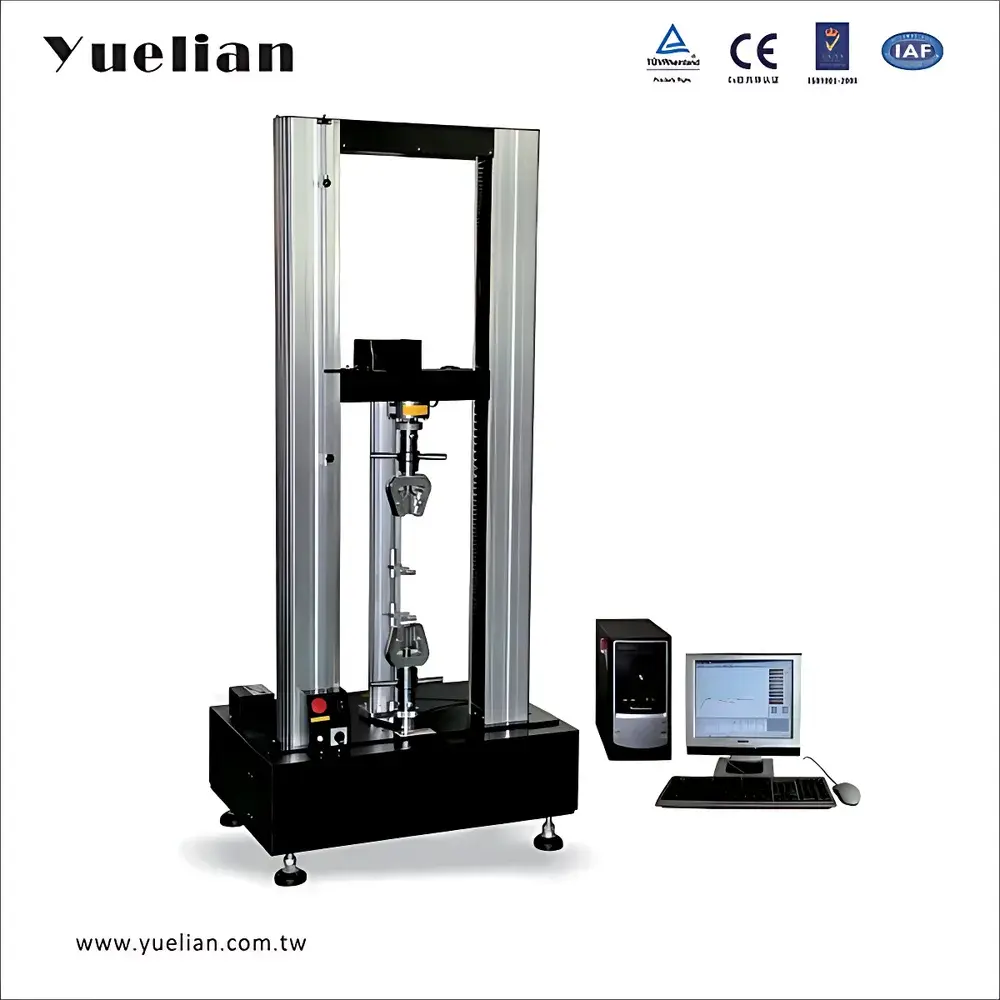
Yuelian YL-1125 Universal Tensile Testing Machine
| Brand | Yuelian |
|---|---|
| Origin | Guangdong, China |
| Model | YL-1125 |
| Instrument Type | Electromechanical Universal Testing Machine |
| Load Capacity Options | 10 N to 50 kN (dual-range configuration available) |
| Force Resolution | 1/500,000 full scale |
| Force Accuracy | ±0.3% of reading |
| Crosshead Travel | 1200 mm |
| Test Width | 420 mm |
| Speed Range | 0.01–1000 mm/min (programmable) |
| Position Resolution | 1/500,000 full stroke |
| Control Interface | PC-based with USB connectivity |
| Compliant Standards | ISO 7500-1, ASTM E4, ASTM D6109, ASTM D3330, GB/T 228.1, GB/T 9341, GB/T 1449, JJG 475, EN 10002-1, JIS B7721/B7733, DIN 5122, BS 1610 |
| Data Management | MS-ACCESS database support, real-time curve plotting, multi-sensor calibration, GLP-compliant audit trail (software-configurable) |
| Power Supply | 220 V, 50/60 Hz, 10 A |
| Motor Drive | Servo motor with precision ball screw and timing belt transmission |
| Dimensions (W×D×H) | 92 × 62 × 199 cm |
| Weight | 422 kg |
| Standard Accessories | One set of universal grips, test software, USB interface cable |
Overview
The Yuelian YL-1125 Universal Tensile Testing Machine is an electromechanical materials testing system engineered for precision mechanical property characterization across a broad spectrum of metallic, polymeric, composite, and elastomeric materials. It operates on the principle of controlled uniaxial force application via servo-driven crosshead displacement, enabling standardized tensile, compression, flexural (3-point and 4-point), shear, peel, tear, and puncture testing per internationally recognized mechanical testing protocols. Designed for laboratory-grade repeatability and traceable metrology, the system conforms to ISO 7500-1 Class 0.5 accuracy requirements and supports full compliance with ASTM, ISO, EN, JIS, DIN, and GB series standards—including ASTM D6109 for flexural testing of wood-based composites, ASTM D3330 for peel adhesion, and GB/T 228.1 for metallic tensile behavior. Its rigid C-frame architecture, high-resolution load cell (1/500,000 internal resolution), and closed-loop position control ensure consistent strain-rate fidelity and minimal frame compliance—critical for reliable modulus determination and yield point detection in R&D and QC environments.
Key Features
- High-fidelity dual-range load sensing architecture supporting capacities from 10 N to 50 kN, with optional dual-capacity configurations for enhanced low-load sensitivity and high-force robustness
- Precision servo motor drive coupled with ground ball screw and synchronous timing belt transmission—delivering smooth, backlash-free motion and long-term mechanical stability
- Programmable speed range from 0.01 to 1000 mm/min, fully adjustable in real time via PC interface to meet ASTM E8/E21 strain-rate requirements or ISO 527 creep protocols
- Integrated safety logic including overload cutoff, emergency stop circuitry, specimen rupture auto-stop, and user-defined upper/lower travel limits with automatic return-to-start functionality
- Real-time data acquisition at up to 1 kHz sampling rate, synchronized with load, displacement, and extensometer (optional) channels for multi-parameter correlation
- Comprehensive unit conversion engine supporting SI (N, MPa), imperial (lbf, psi), and legacy units (kgf, tonf, gf)—automatically applied during report generation and curve annotation
Sample Compatibility & Compliance
The YL-1125 accommodates specimens ranging from thin polymer films (≥0.05 mm thickness) to structural metal coupons (up to 40 mm width × 12 mm thickness), textile yarns, adhesive tapes, rubber strips, and composite laminates. Standard wedge-action and pneumatic grips ensure secure clamping without slippage or premature failure at jaw interfaces. For flexural testing, interchangeable support rollers and loading noses comply with GB/T 9341 (plastics), GB/T 1449 (fiber-reinforced plastics), and ASTM D6109 (wood composites). All test methods are preconfigured in software with parameter validation rules aligned with standard clause requirements—e.g., span-to-depth ratios, support spacing tolerances, and strain rate verification checks. The system meets mechanical calibration traceability requirements under JJG 475-2018 and supports third-party certification per ISO/IEC 17025 accredited laboratories.
Software & Data Management
The embedded PC-based control and analysis suite provides full GLP/GMP-aligned data integrity features: electronic signatures, role-based access control, audit trail logging (user actions, parameter changes, calibration events), and 21 CFR Part 11–compliant electronic records when configured with digital certificate authentication. Test sequences are defined using intuitive step-based templates—tensile ramp-hold, cyclic compression, multi-stage peel, or custom profile loading. Raw data streams are stored in encrypted MS-ACCESS databases with relational schema for batch tracking, material lot association, and instrument calibration history linkage. Post-test analysis includes automatic calculation of tensile strength, yield offset (0.2%), Young’s modulus (secant/tangent), elongation at break, bending strength/modulus, peel average force, and tear propagation energy. Export formats include CSV, PDF reports (with embedded stress–strain curves), and XML for LIMS integration.
Applications
- Quality assurance of insulated wires and cables—measuring jacket tensile strength, conductor pull-out resistance, and insulation elongation per UL 1581, IEC 60811, and GB/T 2951
- Mechanical screening of thermoplastic and thermoset compounds during formulation development and incoming raw material inspection
- Adhesion performance evaluation of pressure-sensitive tapes, laminated packaging films, and automotive interior bonding systems
- Structural validation of fiber-reinforced polymer (FRP) profiles used in aerospace secondary structures and civil infrastructure retrofitting
- Regulatory submission support for medical device packaging (ASTM F88 seal strength, ASTM F1140 burst testing) and orthopedic implant polymers (ISO 5834)
- Academic research in viscoelastic modeling, fracture mechanics, and time-dependent deformation behavior under controlled environmental conditions (when integrated with environmental chamber)
FAQ
What standards does the YL-1125 directly support out-of-the-box?
The system includes preloaded test method templates for ASTM D6109 (flexure), ASTM D3330 (peel), GB/T 228.1 (tensile metals), GB/T 9341 (plastics flexure), ISO 179 (impact-flexure), and EN 10002-1 (metallic tensile), with automatic parameter validation and reporting alignment.
Can the system be upgraded for high-temperature or humidity-controlled testing?
Yes—the machine frame and load train are compatible with commercially available environmental chambers (−70 °C to +300 °C, RH 10–95%). Integration requires optional extensometer signal conditioning and chamber communication interface modules.
Is third-party calibration and ISO/IEC 17025 certification available?
Yuelian provides factory calibration certificates traceable to NIM (China National Institute of Metrology). Authorized service partners offer on-site recalibration and ISO/IEC 17025 accreditation services upon request.
What extensometer options are supported?
The system accepts analog and digital clip-on, video, and non-contact laser extensometers with LVDT or encoder outputs. Software automatically detects input type and applies correct gauge length scaling and filtering algorithms.
Does the software support automated pass/fail decision logic based on specification limits?
Yes—users can define acceptance criteria per test parameter (e.g., “Tensile Strength ≥ 25 MPa”, “Elongation ≥ 300%”) and generate binary compliance flags alongside statistical summaries (mean, SD, CPK) for SPC reporting.



