
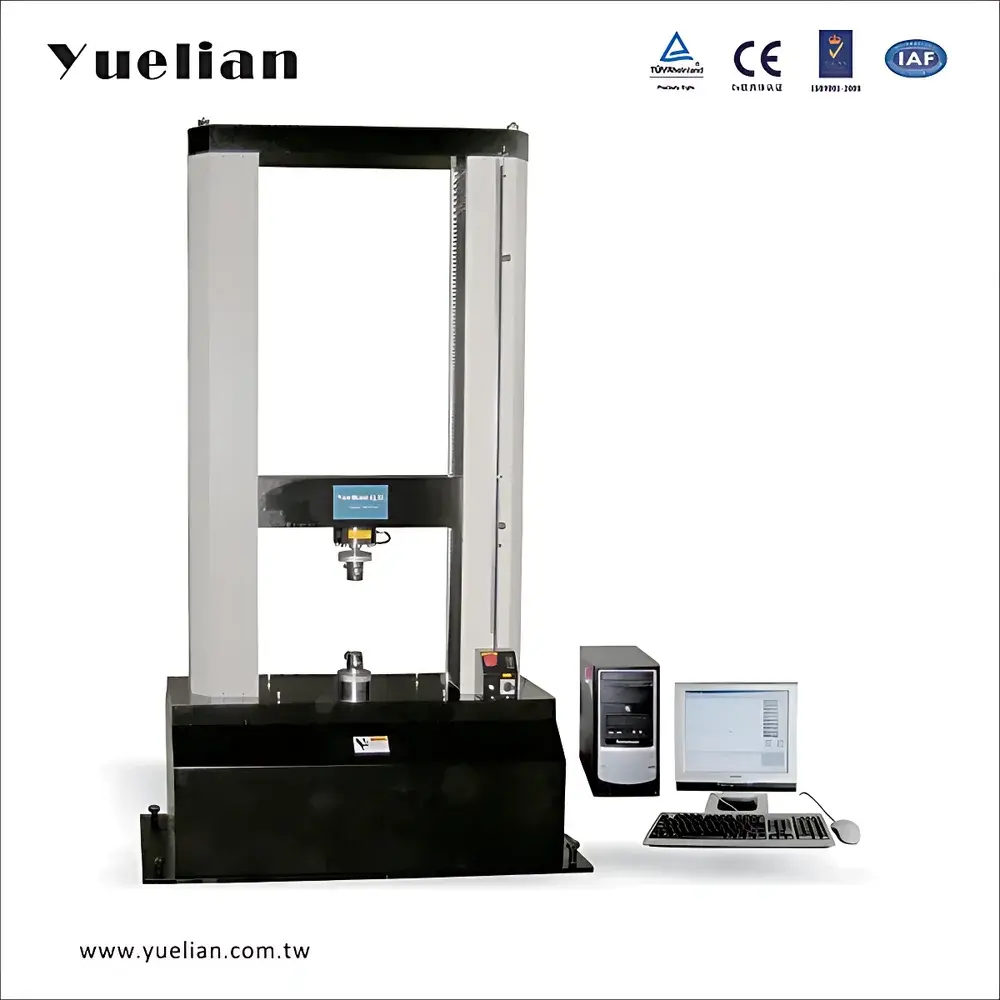
Yuelian YL-1152 Universal Testing Machine
| Brand | Yuelian |
|---|---|
| Origin | Guangdong, China |
| Manufacturer Type | Authorized Distributor |
| Country of Origin | China |
| Model | YL-1152 |
| Instrument Type | Electromechanical Universal Testing Machine |
| Load Capacity Options | 1 kN, 2 kN, 5 kN, 10 kN, 20 kN, 50 kN, 100 kN, 200 kN (dual-range configuration available) |
| Force Resolution | 1/500,000 full scale |
| Force Accuracy | ±0.3% of reading |
| Crosshead Travel Resolution | 1/500,000 |
| Test Speed Range | 0.5–500 mm/min (software-controlled) |
| Maximum Travel | 1000 mm |
| Test Width | 420 mm |
| Drive System | Servo motor with precision ball screw and timing belt transmission |
| Power Supply | 220 V, 50/60 Hz, 10 A |
| Rated Power | 2500 W |
| Dimensions (W×D×H) | 108 × 85 × 205 cm |
| Weight | ~950 kg |
| Standard Accessories | One set of universal grips, proprietary test software, USB interface cable |
| Optional | Customer-supplied PC |
| Compliance Standards | ISO 7500-1, ASTM E4, EN 10002-1, EN 10002-2, DIN 51221, JIS B7721/B7733, GB/T 228.1, GB/T 2792, GB/T 15598, GB/T 7753, GB/T 7754, GB/T 7124 (1986 & 2008), HG/T 2-163, ASTM D3330 |
Overview
The Yuelian YL-1152 Universal Testing Machine is an electromechanical force-testing system engineered for high-reproducibility tensile, compressive, flexural, shear, peel, tear, and adhesion measurements across a broad spectrum of engineering and industrial materials. Based on closed-loop servo-controlled actuation and high-fidelity load cell transduction, the system implements standardized mechanical testing principles per ISO 7500-1 (static calibration of force-proving instruments) and ASTM E4 (practices for verification of force-measuring systems). Its rigid C-frame architecture, precision-ground ball screw transmission, and low-backlash timing belt drive ensure minimal deflection under load and consistent crosshead positioning—critical for accurate modulus, yield point, and elongation-at-break determination in both R&D and QA/QC environments.
Key Features
- Electromechanical actuation with 2.5 kW AC servo motor, delivering smooth, programmable motion profiles from 0.5 to 500 mm/min
- High-resolution force measurement: 1/500,000 full-scale resolution and ±0.3% accuracy traceable to national metrological standards
- Configurable load capacity range: selectable single or dual-range configurations from 1 kN up to 200 kN to accommodate diverse material stiffness and strength profiles
- Integrated displacement sensing with 1/500,000 travel resolution over 1000 mm stroke and 420 mm test width clearance
- Full PC-based control and data acquisition via USB interface; real-time curve plotting, multi-channel synchronization, and automated event triggering (e.g., specimen rupture, upper/lower limit breach)
- Dual-mode operation: manual jog controls for rapid fixture alignment plus fully automated test sequencing with pre-defined method templates
- Comprehensive safety architecture: hardware interlocks, emergency stop circuitry, overload cutoff, automatic return-to-start, and programmable travel limits
Sample Compatibility & Compliance
The YL-1152 supports standardized mechanical characterization of metals, polymers, elastomers, composites, textiles, paperboard, adhesives, thin films, and coated substrates. Its modular grip system accommodates wedge-action, pneumatic, hydraulic, and custom fixtures for flat, round, or irregular specimens. The system complies with international testing standards including ISO 7500-1 (force calibration), EN 10002-1/-2 (tensile testing of metallic materials), ASTM D3330 (peel adhesion), ASTM E4 (force verification), GB/T 228.1 (metal tensile testing), GB/T 2792 (peel strength of pressure-sensitive tapes), and JIS B7721 (universal testing machines). All calibration records, test logs, and audit trails adhere to GLP/GMP documentation requirements, with optional 21 CFR Part 11-compliant electronic signature support when paired with validated software configurations.
Software & Data Management
The embedded test control software runs natively on Windows platforms and provides ISO/IEC 17025-aligned data handling workflows. It enables calculation of key mechanical parameters—including ultimate tensile strength, yield strength (0.2% offset), Young’s modulus, elongation at break, peel force averages, and tear propagation resistance—as well as advanced post-processing such as stress-strain curve smoothing, tangent modulus derivation, and hysteresis loop analysis. Data export supports CSV, XML, and native MS Access database formats. Graphical user interface features real-time dual-axis plotting (load vs. displacement, stress vs. strain), multi-curve overlay, annotation tools, and customizable report templates compliant with internal QA protocols and external accreditation bodies.
Applications
- Mechanical validation of structural steel, aluminum alloys, and stainless-steel wire ropes per ISO 12076 and ASTM A931
- Quality assurance of polymer extrusions, injection-molded parts, and thermoplastic elastomers per ISO 527 and ASTM D638
- Adhesion performance testing of pressure-sensitive tapes, laminates, and medical device bonding layers per ASTM D3330 and PSTC-107
- Flexural property evaluation of composite panels and packaging substrates per ISO 178 and ASTM D790
- Peel and tear resistance assessment of flexible packaging films, labels, and textile laminates per ASTM D903 and ISO 11339
- Material development support for automotive NVH components, aerospace fasteners, and biomedical implant coatings
FAQ
What load frame configurations are supported?
The YL-1152 is supplied as a single-column or dual-column C-frame depending on selected capacity; models above 50 kN utilize reinforced dual-column construction with enhanced lateral rigidity.
Is the system compatible with third-party grips or extensometers?
Yes—standard M6 and 1/4″-20 threaded mounting interfaces allow integration of ASTM-compliant extensometers, video extensometers, and vendor-agnostic mechanical grips.
Can test methods be saved and reused across laboratories?
All test definitions—including speed profiles, trigger conditions, calculation algorithms, and reporting layouts—are stored as portable .xml method files for cross-platform consistency and audit readiness.
Does the software support multi-user access control and audit trails?
When deployed with validated Windows domain authentication and SQL Server backend, the system supports role-based permissions, electronic signatures, and immutable audit logs meeting FDA 21 CFR Part 11 and ISO 17025 requirements.
What maintenance is required to maintain calibration integrity?
Annual verification against certified reference loads per ISO 7500-1 is recommended; routine checks include ball screw lubrication, grip jaw inspection, and encoder alignment verification every 6 months.



