
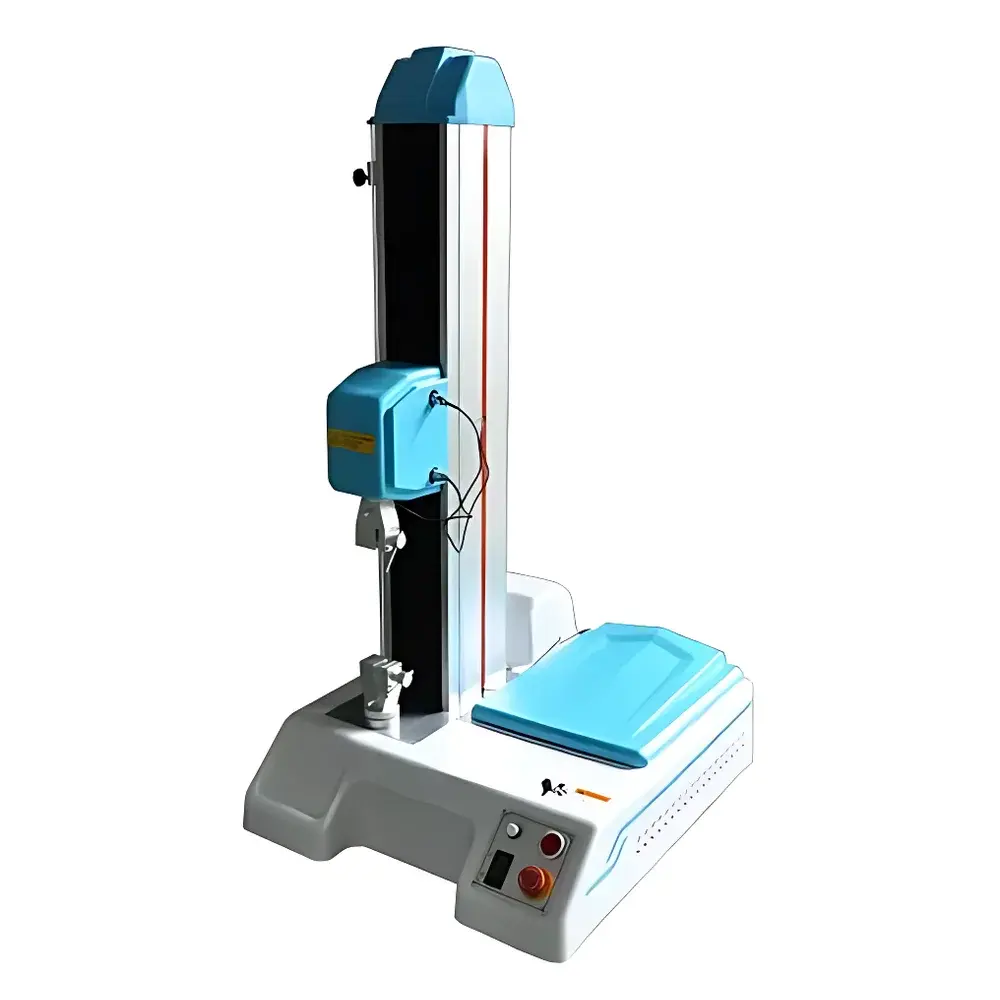
Yuelian YL-S70 Servo-Powered Peel & Tensile Testing Machine (Compliant with GB/T 2792)
| Brand | Yuelian |
|---|---|
| Origin | Guangdong, China |
| Model | YL-S70 Servo Peel Tester |
| Instrument Type | Electromechanical Universal Testing Machine |
| Force Capacity Options | 10 N, 20 N, 50 N, 100 N, 200 N, 500 N, 1 kN, 2 kN, 5 kN (dual-range configuration available) |
| Force Resolution | 1/500,000 full scale |
| Force Accuracy | ±0.1% of reading |
| Displacement Resolution | 1/500,000 mm |
| Displacement Accuracy | ±0.1% of reading |
| Data Acquisition Rate | 2000 Hz |
| Effective Stroke | 450 mm (customizable) |
| Speed Range | 0.001–500 mm/min (customizable) |
| Test Space Diameter | Ø140 mm |
| Control Mode | Full PC-based closed-loop servo control |
| Power Supply | 220 V AC, 50–60 Hz |
| Rated Power | 400 W |
| Net Weight | 66 kg |
| Dimensions (W×D×H) | 650 × 260 × 2625 mm |
Overview
The Yuelian YL-S70 Servo-Powered Peel & Tensile Testing Machine is a precision electromechanical universal testing system engineered for high-fidelity mechanical characterization of soft and semi-rigid materials under controlled quasi-static loading conditions. Designed in strict compliance with GB/T 2792 (Chinese national standard for peel strength testing of adhesives), ASTM D903, ISO 8510-2, and related international specifications for adhesive bond integrity, film delamination, and flexible packaging evaluation, the YL-S70 implements a closed-loop servo-controlled architecture to deliver repeatable force-displacement response across a broad operational envelope. Its core measurement principle relies on high-resolution load cell transduction coupled with optical encoder-based displacement feedback, enabling simultaneous acquisition of force, displacement, time, and derived parameters—including stress, strain, modulus, and energy absorption—within a single test cycle. The machine supports both static and dynamic cyclic protocols, making it suitable for R&D validation, QC release testing, and long-term durability assessment in regulated manufacturing environments.
Key Features
- High-precision dual-range load cell options (10 N to 5 kN), supporting rapid interchange without recalibration via quick-release couplings
- AC servo motor drive with precision ground ball screw transmission, delivering smooth motion control and minimal backlash (<0.01 mm)
- Real-time multi-curve display: simultaneous visualization of force vs. displacement, force vs. time, displacement vs. time, and stress vs. strain
- Advanced data acquisition at 2000 Hz sampling rate, ensuring fidelity in transient event capture (e.g., peak peel initiation, sudden failure)
- Full software configurability: user-defined test methods including constant-rate, constant-force, constant-strain, ramp-hold, and multi-step nested cycles
- Integrated safety logic: overload cutoff, emergency stop, specimen rupture detection, upper/lower limit enforcement, over-travel and over-capacity protection
- Modular fixture interface compatible with standardized grips (pneumatic, wedge, pin, peel arm, puncture, bending jigs) per ISO 527, ASTM D638, and GB/T 1040 series
- Aluminum extrusion guard housing with sandblasted anodized finish; ABS polymer enclosure with electrostatic powder coating for chemical resistance and ESD mitigation
Sample Compatibility & Compliance
The YL-S70 accommodates a wide range of low-to-medium stiffness specimens—including pressure-sensitive adhesives (PSAs), laminated films, medical tapes, labels, flexible electronics substrates, nonwovens, thin elastomers, and composite laminates. Its Ø140 mm test chamber and 450 mm vertical stroke support both standard 180° and 90° peel configurations per GB/T 2792, as well as tensile testing of dog-bone and strip geometries. The system meets essential regulatory expectations for documented traceability: force calibration certificates are NIST-traceable (or equivalent national metrology institute), and all test sequences can be timestamped, user-logged, and exported in CSV/PDF formats compliant with GLP and internal QA documentation requirements. While not pre-certified for FDA 21 CFR Part 11, the software architecture supports audit trail implementation, electronic signature integration, and role-based access control when deployed on validated IT infrastructure.
Software & Data Management
Bundled PC-based control software provides comprehensive test definition, execution, and post-processing capabilities. Users may configure up to seven independent test intervals per method, assign up to 40 manual cursor points and 120 auto-sampled points per curve, and apply statistical functions—including mean, median, standard deviation, CpK, and trimmed mean (excluding outliers). Raw data is stored in binary format with metadata embedding (operator ID, date/time, environmental notes, calibration ID). Export options include ASCII CSV (for LIMS integration), PNG/SVG vector graphics, and PDF reports with embedded pass/fail thresholds. Software supports multi-language UI (English, Simplified Chinese, Spanish), automatic unit conversion (N/kN/lbf/kgf/mm/inch/MPa/psi), and cross-test comparative overlay of historical datasets—enabling longitudinal trend analysis across material lots or process changes.
Applications
- Peel strength quantification of PSA tapes, labels, and medical dressings per GB/T 2792 and ASTM D3330
- Tensile property determination (UTS, elongation at break, Young’s modulus) of polymer films, foams, and elastomeric sheets
- Compression testing of corrugated cardboard (box crush test), foam cushions, and gasket materials
- Bending rigidity assessment of paperboard and thin composites using three-point or four-point flexure fixtures
- Puncture resistance evaluation of protective fabrics, blister packaging, and footwear components
- Cyclic fatigue testing of springs, elastic bands, and sealing components under programmable load/displacement envelopes
- Shear and tear resistance characterization of textiles, membranes, and laminated structures
FAQ
Is the YL-S70 compliant with ISO/IEC 17025 requirements for accredited testing laboratories?
The hardware and software meet foundational metrological criteria (traceable calibration, documented uncertainty budgets, environmental monitoring compatibility), but formal accreditation requires laboratory-specific procedural validation, staff training records, and inter-laboratory comparison participation.
Can the system perform ASTM D1876 (T-peel) and ASTM D3167 (floating roller peel) tests?
Yes—when equipped with the optional T-peel fixture or floating roller assembly, and configured with appropriate speed profiles and data filtering settings per standard clauses.
Does the software support automated report generation with company branding and digital signatures?
Report templates are fully customizable; digital signature fields and corporate header/footer insertion are supported, though cryptographic signing requires integration with external PKI infrastructure.
What is the recommended maintenance interval for the servo drive and load cell?
Annual verification of load cell linearity and zero stability is advised; servo motor and ball screw lubrication is specified at 2000 operating hours or biannually—whichever occurs first.
Is remote diagnostics or firmware update capability available?
Firmware updates are delivered via secure USB media; remote desktop-assisted troubleshooting is supported under signed service agreement, but no cloud-connected telemetry is implemented for data security reasons.



