
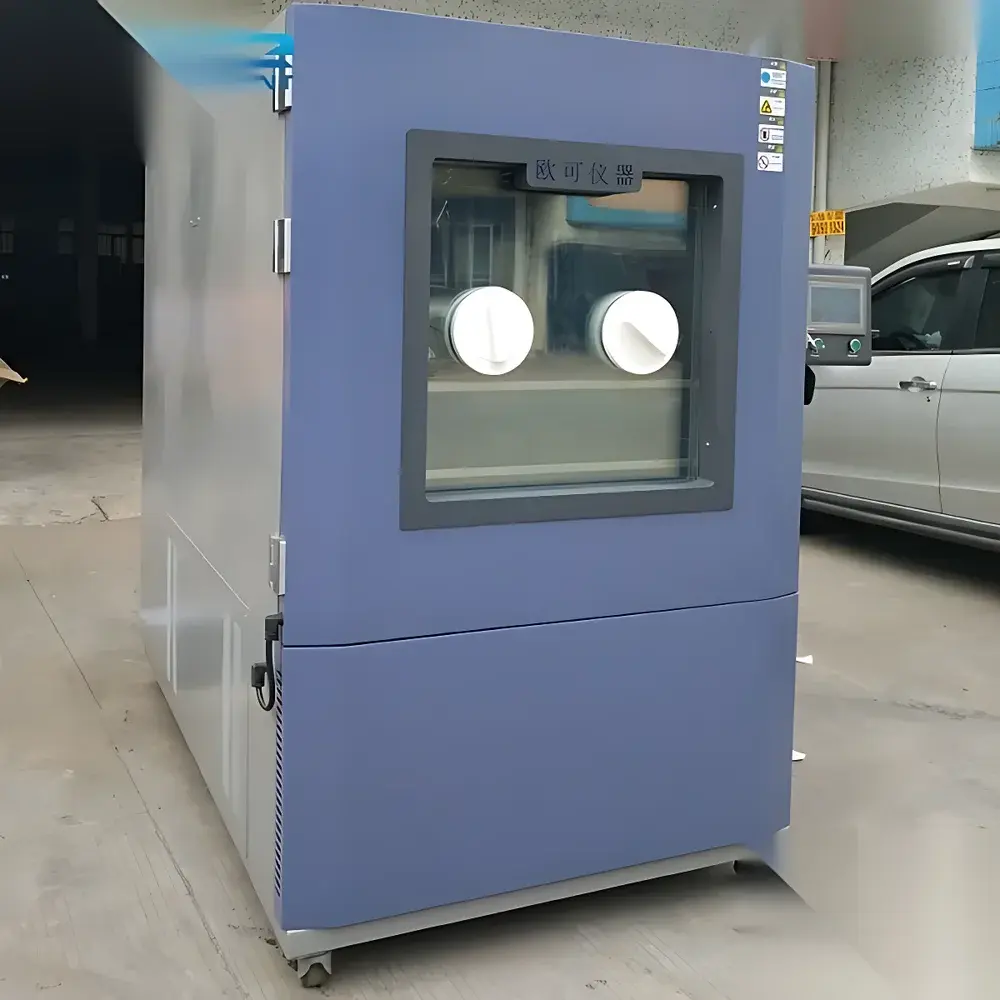
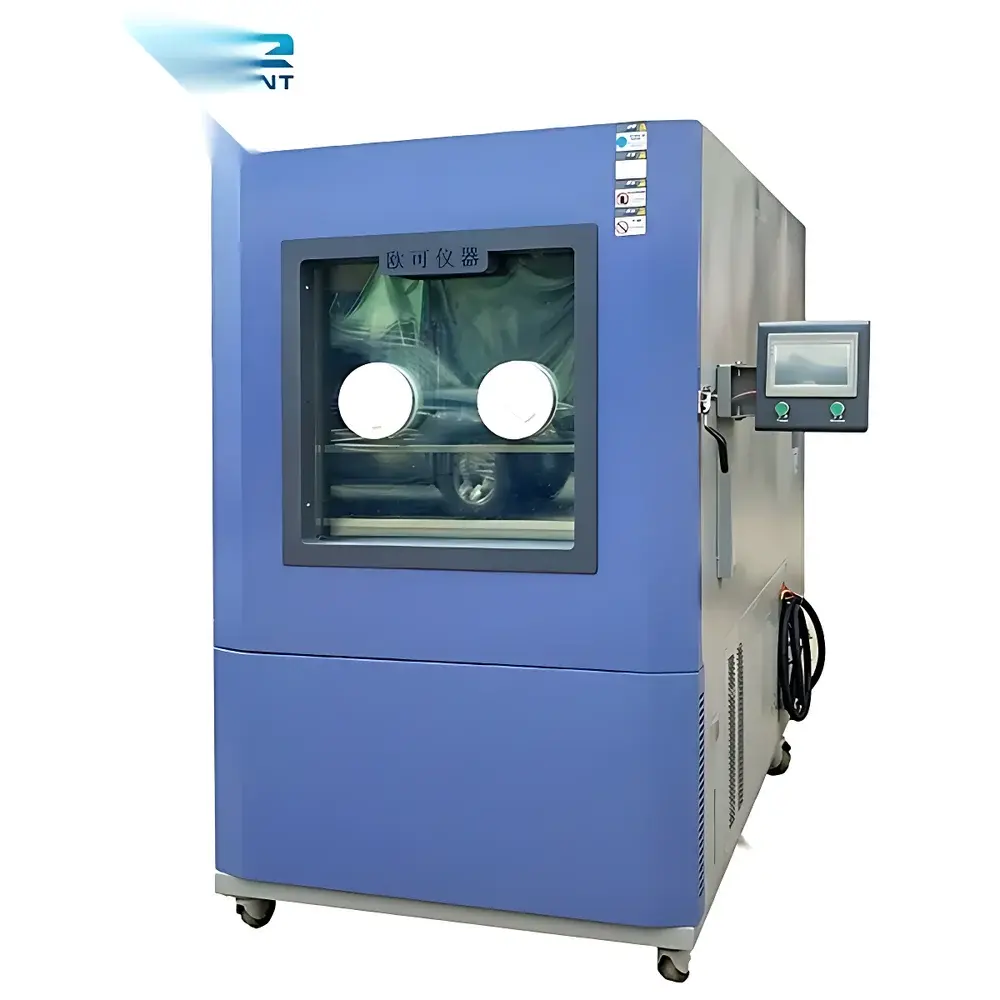
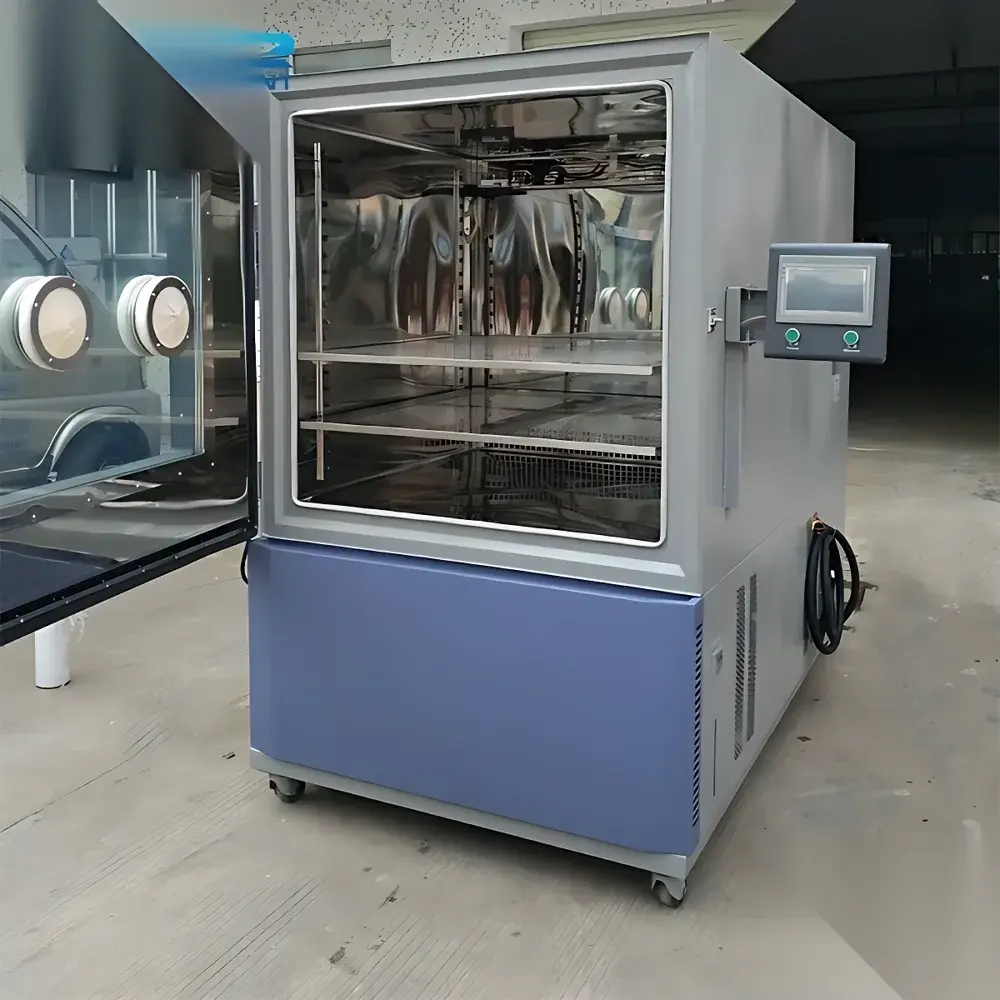
English Product Name
| Temperature Range | –40 °C to +150 °C (standard) |
|---|---|
| Humidity Range | 30–98 % RH (standard) |
| Temperature Resolution | 0.01 °C |
| Temperature Uniformity | ±0.5 °C |
| Temperature Deviation | ≤ ±2 °C |
| Humidity Resolution | 0.1 % RH |
| Humidity Deviation | ≤ ±2.5 % RH |
| Cooling Rate | 0.7–1.0 °C/min |
| Heating Rate | 2.0–3.0 °C/min |
| Control System | TEMI880 color LCD touchscreen programmable controller |
| Power Supply | 380 V ±5 %, 50 Hz, 3P+N+G (customizable to 220 V) |
| Interior Material | SUS304 stainless steel |
| Exterior Material | SUS304 stainless steel or A3 steel with electrostatic powder coating |
Overview
The Cement-Specific Temperature and Humidity Controlled Environmental Test Chamber is a precision-engineered environmental simulation system designed to meet the stringent conditioning requirements of cementitious materials during standardized strength development, hydration kinetics, and durability assessment. It operates on the principle of forced-air convection with dual independent PID-controlled refrigeration and humidification subsystems, enabling stable, reproducible maintenance of temperature and relative humidity across defined test cycles. Unlike general-purpose climate chambers, this unit incorporates structural and control adaptations—such as enhanced condensate management, low-thermal-mass chamber geometry, and extended dwell stability protocols—specifically aligned with ASTM C192/C192M (Standard Practice for Making and Curing Concrete Test Specimens in the Laboratory), ISO 1920-2 (Testing of concrete — Part 2: Making and curing of test specimens), and GB/T 17671-1999 (Method of testing cement — Determination of strength). Its thermal and hygric performance is validated under no-load conditions at ambient 25 °C ±6 °C per GB/T 5170.2–1996 and GB/T 5170.5–1996, ensuring metrological traceability for laboratory accreditation (e.g., ISO/IEC 17025).
Key Features
- Stainless steel interior (SUS304) construction for corrosion resistance against alkaline cement leachates and high-humidity condensate exposure
- Dual-stage refrigeration system with cascade configuration available for ultra-low temperature operation down to –120 °C
- Steam-based humidification with deionized water feed and automatic drain purge to prevent mineral buildup and microbial growth
- TEMI880 programmable controller featuring 30 programmable segments, real-time trend logging, and alarm-triggered email/SMS notification (via optional Ethernet module)
- Independent verification of chamber air temperature and humidity via calibrated Pt100 sensors with NIST-traceable calibration certificates
- Compliance-ready architecture supporting audit trails, user access levels, and electronic signature functionality per FDA 21 CFR Part 11 when integrated with compliant LIMS platforms
Sample Compatibility & Compliance
This chamber accommodates standard cement test specimens—including 40 mm × 40 mm × 160 mm prisms (ISO 679), 50 mm cubes (ASTM C109), and cylindrical cores up to Ø150 mm × 300 mm—within its working volume. Shelving is configurable to maintain ≥50 mm clearance between specimens and chamber walls, ensuring uniform airflow per ISO 23164-1. The system meets mechanical and safety requirements of IEC 61000-6-2 (EMC immunity) and IEC 61000-6-4 (EMC emissions), and its temperature/humidity uniformity profiles satisfy GB2423.1–1989 (cold), GB2423.2–1989 (heat), and GB2423.22–1987 (temperature cycling). Optional validation packages include IQ/OQ documentation templates aligned with GLP and GMP environments.
Software & Data Management
The TEMI880 controller supports USB data export (CSV format), RS485 Modbus RTU communication, and optional Ethernet/WiFi connectivity for remote monitoring via web browser or dedicated SCADA integration. All setpoint changes, alarm events, and sensor readings are time-stamped and stored locally for ≥30 days. When deployed in regulated laboratories, the system can be configured to generate ALCOA+ compliant records—including operator ID, timestamp, parameter values, and reason-for-change—enabling full traceability for internal audits or regulatory inspections (e.g., CNAS, UKAS, or FDA pre-approval reviews).
Applications
- Standardized curing of Portland cement, blended cements, and supplementary cementitious materials (SCMs) per ASTM C511 and EN 196-1
- Accelerated carbonation testing under controlled CO₂-permeable humidity regimes
- Long-term durability studies involving sulfate attack, chloride ingress, and alkali-silica reaction (ASR)
- Hydration heat evolution profiling using embedded thermocouples synchronized with environmental setpoints
- Pre-conditioning of aggregates and admixtures prior to mortar/concrete mixing per ASTM C33 and ASTM C494
FAQ
What is the minimum recommended specimen load for valid humidity control?
For reliable RH stability, the chamber should operate at ≥30 % volume loading; below this threshold, excessive air exchange may cause transient overshoot. We recommend using inert filler blocks if actual sample volume is low.
Can the chamber support continuous 90-day curing cycles without manual intervention?
Yes—provided the deionized water reservoir is sized appropriately (≥15 L standard) and the cooling water supply remains within 10–28 °C at 0.1–0.3 MPa pressure. Scheduled maintenance intervals are defined in the O&M manual.
Is third-party temperature/humidity mapping included with delivery?
Mapping (per ISO 14644-3 Annex B or ASTM E2297) is available as an optional service. A certified report with 9-point sensor grid data and uncertainty budget is issued upon completion.
How does the system handle condensation during rapid cooldown?
An active condensate evaporation circuit operates during ramp-down phases, preventing pooling on shelves or specimen surfaces. Drain lines are heated to avoid freezing below 0 °C.
Are calibration certificates supplied with initial commissioning?
Yes—two-point calibration certificates for temperature (–20 °C and +60 °C) and humidity (30 % RH and 80 % RH) are provided, traceable to national standards via accredited calibration labs.



