
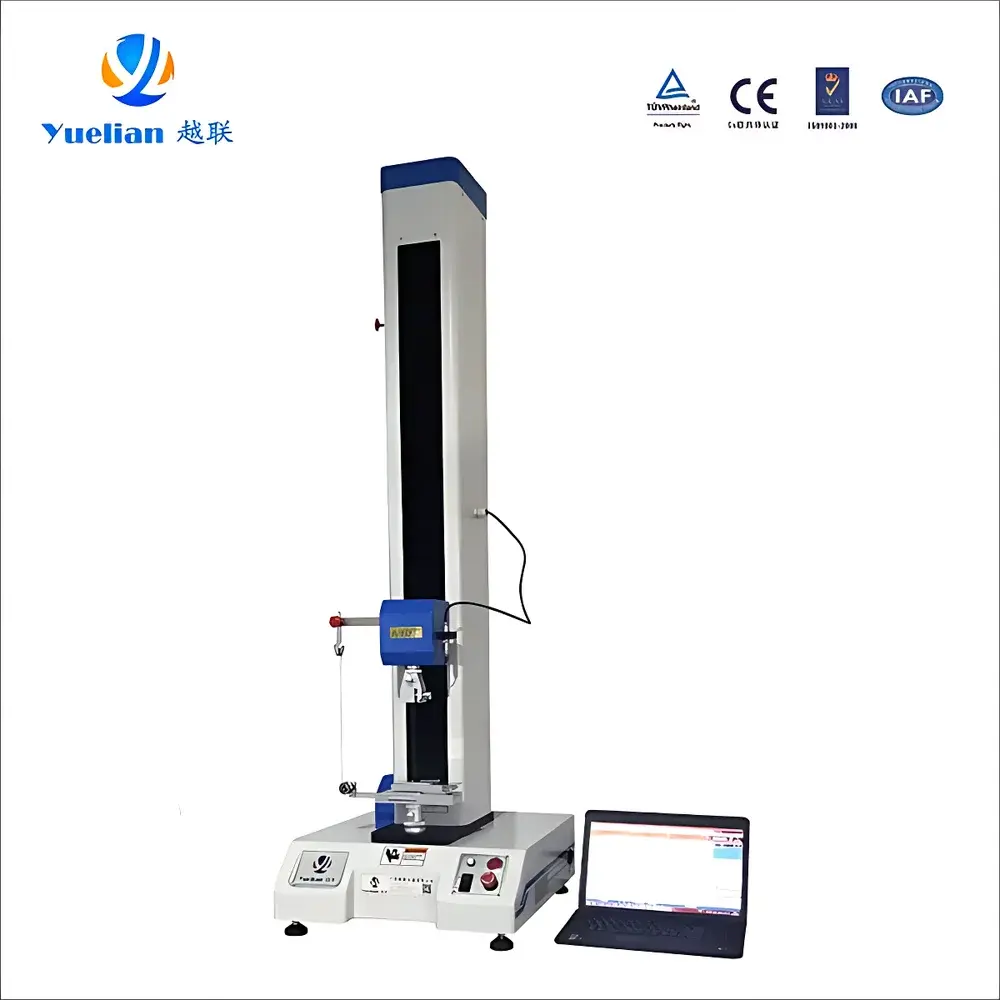
English Product Name
| Brand | Yuelian |
|---|---|
| Origin | Guangdong, China |
| Manufacturer Type | Authorized Distributor |
| Country of Origin | China |
| Model | YL-S72Q |
| Price Range | USD 7,000 – 14,000 (FOB) |
| Instrument Type | Electromechanical Universal Testing Machine |
| Load Capacity Options | 10 N to 5 kN (dual-range configuration available) |
| Force Resolution | 1 part in 500,000 |
| Force Accuracy | Better than Class 0.5 per ISO 7500-1 |
| Stroke Resolution | 1 part in 500,000 mm |
| Data Acquisition Rate | 50 Hz |
| Effective Stroke | 1000 mm |
| Speed Range | 0.001–30,000 mm/min (customizable) |
| Test Space Width | 140 mm |
| Power Supply | 220 V, 50–60 Hz |
| Motor Drive | AC Servo Motor |
| Transmission | Precision Ball Screw |
| Dimensions (W×D×H) | 520 × 590 × 1530 mm |
| Net Weight | 55 kg |
| Power Consumption | 400 W |
Overview
The Yuelian YL-S72Q High-Speed Peel Strength Tester is an electromechanical universal testing machine engineered for precision mechanical characterization of adhesive bonds, laminated structures, coated films, flexible packaging, and composite interfaces under controlled peel, tensile, compression, bending, shear, and puncture loading conditions. It operates on the principle of servo-controlled displacement actuation coupled with high-fidelity force transduction, enabling dynamic evaluation of interfacial adhesion strength at velocities up to 30,000 mm/min — a critical capability for simulating high-speed packaging line delamination, automotive tape debonding, or medical device label removal scenarios. Designed in accordance with ISO 7500-1 (static calibration), ISO 527 (tensile testing of plastics), ASTM D903 (peel resistance of adhesive bonds), and ASTM D3330 (pressure-sensitive tape peel adhesion), the system delivers traceable, repeatable, and audit-ready mechanical data suitable for R&D validation, QC release testing, and regulatory submissions under GLP/GMP frameworks.
Key Features
- AC servo motor drive with precision ground ball screw transmission, ensuring smooth motion control and minimal backlash across the full speed range (0.001–30,000 mm/min)
- Modular quick-connect fixture interface enabling tool-less interchange of peel jigs, tensile grips, compression platens, and puncture fixtures within seconds
- Integrated dual-limit microswitches for fine stroke adjustment and programmable upper/lower travel boundaries to prevent over-travel damage
- Comprehensive hardware safety architecture: overload cut-off, emergency stop button, automatic fracture detection, and software-enforced load/stroke limits
- Aluminum extrusion frame with sandblasted and anodized silver finish — corrosion-resistant, dimensionally stable, and compliant with ISO 14001 manufacturing standards
- Force sensor with bidirectional load capability and real-time polarity switching, supporting both tension and compression testing without manual reconfiguration
Sample Compatibility & Compliance
The YL-S72Q accommodates specimens ranging from thin polymer films (≥12 µm) and pressure-sensitive adhesives to rigid laminates, elastomeric foams, shoe soles, corrugated cardboard, and biomedical patches. Its 140 mm test width and 1000 mm effective stroke support standard ASTM D903 T-peel, 90° peel, and 180° peel configurations, as well as non-standard geometries via custom fixture design. All mechanical and software functions comply with ISO/IEC 17025 requirements for testing laboratories, and the system supports FDA 21 CFR Part 11-compliant user access control, electronic signatures, and audit trail generation when paired with validated software modules. Calibration certificates are traceable to NIM (National Institute of Metrology, China) and internationally recognized NMIs via DAkkS-accredited reference standards.
Software & Data Management
The embedded PC-based control software provides fully configurable test method templates aligned with ASTM, ISO, and GB/T standards. Real-time plotting supports simultaneous display of force-displacement, force-time, displacement-time, and stress-strain curves — with dynamic zoom, pan, crosshair cursor, and point extraction tools. Up to seven user-defined analysis intervals can be applied per test; manual point capture (40 points) and auto-sampling (120 points) enable granular event annotation (e.g., yield onset, plateau initiation, failure peak). Statistical reporting includes mean, median, min/max, trimmed mean (excluding top/bottom 5%), standard deviation, population SD, and process capability index (Cpk) — all exportable to CSV, Excel, or PDF with embedded metadata (operator ID, timestamp, calibration status, environmental logs). Data integrity is preserved via immutable file storage, version-controlled method libraries, and optional networked database archiving.
Applications
- Quantitative peel adhesion assessment of medical transdermal patches, surgical tapes, and wound dressings under accelerated aging conditions
- Quality control of flexible printed electronics substrates subjected to dynamic flexural fatigue and interlayer delamination
- Evaluation of automotive interior trim bonding integrity under thermal cycling and humidity exposure
- Validation of food packaging seal strength across varying peel angles and velocities to simulate filling and opening stresses
- Mechanical benchmarking of biodegradable films and compostable laminates per EN 13432 and ASTM D6400
- Structural testing of shoe upper-to-sole adhesion per ISO 20344 and SATRA TM144
FAQ
What peel test standards does the YL-S72Q support out-of-the-box?
Preloaded test methods include ASTM D903 (T-peel), ASTM D1876 (T-peel for metal foil), ASTM D3330 (180° peel for pressure-sensitive tapes), ISO 8510-2 (peel resistance of laminates), and GB/T 2790–1995 (peel strength of adhesives). Custom method creation is supported via scriptable control logic.
Can the system perform cyclic or multi-step tests?
Yes — the software enables nested multi-stage control sequences combining constant-rate, constant-load, constant-strain, and dwell phases, with conditional branching based on real-time force/displacement thresholds.
Is the force sensor calibrated and traceable?
Each unit ships with a factory calibration certificate traceable to national metrology institutes (NIM, China); annual recalibration services and on-site verification kits are available.
What third-party accessories are compatible?
Standardized M6 and 1/4″-20 threaded mounting interfaces support integration with extensometers (e.g., clip-on or video-based), environmental chambers (-40°C to +150°C), and pneumatic grip actuators.
Does the software meet regulatory requirements for pharmaceutical or medical device testing?
When deployed with validated installation qualification (IQ), operational qualification (OQ), and performance qualification (PQ) protocols, the system satisfies FDA 21 CFR Part 11, EU Annex 11, and ISO 13485 documentation requirements for electronic records and signatures.
Related Products



