
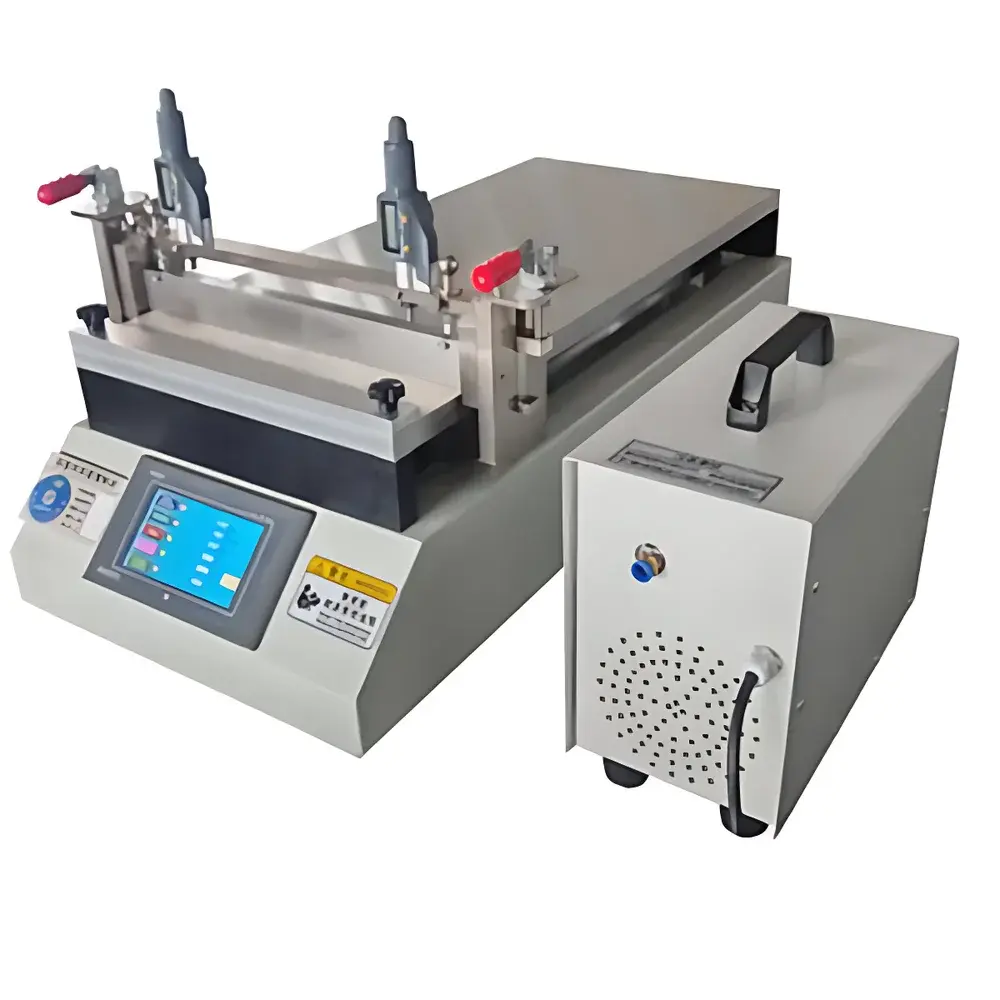
Yuelian PW-C02 Benchtop Vacuum Coating Machine
| Brand | Yuelian / PW |
|---|---|
| Origin | Guangdong, China |
| Manufacturer Type | Authorized Distributor |
| Country of Origin | China |
| Model | PW-C02 |
| Application | Laboratory-scale coating development and process simulation |
| Coating Method | Dual-mode — Doctor Blade & Wire Rod (independently operable) |
| Temperature Range | Ambient to 160 °C (PID-controlled constant-temperature heating) |
| Wet Film Thickness Range | 5 µm to 5 mm |
| Overall Dimensions (L×W×H) | 800 × 380 × 410 mm |
| Coating Speed | 1–5 m/min (digital display & adjustable) |
| Substrate Width Capacity | 300 mm |
| Maximum Coating Length | 10–450 mm (programmable) |
| Leveling System | Integrated mechanical leveling bar (pre-coating substrate flattening) |
| Vacuum Platform | Uniformly distributed vacuum suction (aluminum alloy + removable tempered glass surface) |
| Coating Uniformity | ±4% (dependent on substrate flatness and fluid rheology) |
| Wire Rod Specifications | Ø10 × 400 mm (standard), supplied with two adjustable counterweights |
| Blade Material | High-strength corrosion-resistant stainless steel (austenitic grade) |
| Power Supply | 110–220 V AC, 50/60 Hz |
| Power Consumption | 48 W (standby), 2000 W (max heating load) |
| Net Weight | 44 kg |
Overview
The Yuelian PW-C02 Benchtop Vacuum Coating Machine is an engineered solution for controlled, repeatable thin-film deposition in R&D laboratories and pilot-scale formulation development. Designed around a dual-mode coating architecture—supporting both precision wire rod and adjustable doctor blade methodologies—the system enables systematic evaluation of coating behavior across a broad viscosity spectrum (from low-viscosity UV-curable inks to high-viscosity polymer dispersions). Its integrated vacuum chuck platform ensures consistent substrate immobilization during coating, minimizing lateral drift and edge effects that compromise film homogeneity. The PID-regulated heated platen (ambient to 160 °C) permits real-time thermal modulation of coating rheology and solvent evaporation kinetics—critical for optimizing drying profiles, interfacial adhesion, and defect formation in functional layers. This instrument does not perform inline curing but serves as a foundational platform for generating representative coated samples prior to downstream characterization (e.g., SEM, profilometry, peel testing) or scale-up validation.
Key Features
- Dual independent coating modules: Wire rod applicator (with standardized Ø10 × 400 mm rods and dual counterweight system) and rear-hinged doctor blade assembly—each fully decoupled for method-specific calibration and cleaning.
- Vacuum-assisted substrate fixation: Aluminum alloy base plate with removable tempered glass surface and uniformly distributed suction ports (−80 kPa nominal), validated for paper, PET, PI, aluminum/copper foils, and nonwovens.
- Precision motion control: Digital speed setting (1–5 m/min) with encoder feedback; programmable coating length (10–450 mm) and automatic stop function.
- Thermal management: Heated platen with ±0.5 °C temperature stability over full range (ambient to 160 °C); thermocouple-based closed-loop regulation compliant with ASTM E220 standards for thermal sensor calibration traceability.
- Mechanical pre-leveling stage: Fixed-diameter leveling bar compresses substrate prior to coating head engagement—reducing air entrapment and improving wet film continuity on flexible or textured substrates.
- Modular construction: Tool-free disassembly of coating modules, vacuum manifold, and platen assembly supports routine maintenance, cross-contamination mitigation, and method transfer between labs.
Sample Compatibility & Compliance
The PW-C02 accommodates substrates up to 300 mm wide and 450 mm long—including release liners, metallized films, battery current collectors (Cu/Al foil), porous membranes, and fibrous webs. It supports aqueous, solvent-based, and UV-reactive formulations with viscosities spanning 10–50,000 mPa·s (measured per ISO 2555). Coating uniformity (±4%) meets internal QC thresholds for lab-scale feasibility studies and satisfies preliminary data requirements for ISO 9001-compliant documentation packages. While not certified to GLP or GMP, its programmable parameters, digital audit trail (via optional RS485 logging interface), and reproducible mechanical actuation support traceable method development aligned with ICH Q5E and USP guidance for functional coating qualification.
Software & Data Management
The PW-C02 operates via an embedded PLC controller with 7-inch resistive touchscreen HMI. All operational parameters—including speed, temperature setpoint, coating length, and dwell time—are stored in non-volatile memory with timestamped versioning (up to 99 user-defined protocols). Optional serial communication (RS485 Modbus RTU) enables integration with LIMS or SCADA systems for centralized parameter archiving and electronic batch record generation. No proprietary software installation is required; configuration files export as plain-text CSV for third-party analysis. Audit trail functionality complies with FDA 21 CFR Part 11 principles when paired with external identity-authenticated logging infrastructure.
Applications
- Battery electrode slurry screening: Optimization of solid loading, binder distribution, and calendering precursor thickness on Cu/Al foils.
- Functional barrier layer development: Evaluation of SiOx, AlOx, or polymer dispersion coatings on flexible packaging substrates.
- Optical film prototyping: Controlled deposition of anti-reflective, hard-coat, or conductive (ITO/PEDOT) formulations onto PET or PC.
- Medical device coating validation: Reproducible application of hydrophilic, antimicrobial, or drug-eluting layers on catheter shafts or wound dressings.
- Adhesive transfer testing: Quantitative assessment of tack, peel strength, and shear resistance across pressure-sensitive adhesive chemistries.
FAQ
What substrate materials are compatible with the vacuum platform?
Standard substrates include paper, PET, PEN, PI, BOPP, aluminum foil, copper foil, and nonwoven fabrics—provided surface roughness Ra ≤ 3 µm and tensile modulus ≥ 100 MPa.
Can the wire rod and doctor blade be used simultaneously?
No—coating modes are mutually exclusive; the system requires manual selection and physical reconfiguration to switch between wire rod and blade operation.
Is temperature calibration certificate included?
A factory calibration report (traceable to NIM China) is provided; NIST-traceable recalibration services are available upon request.
What safety certifications does the unit carry?
CE marking (EMC Directive 2014/30/EU and LVD Directive 2014/35/EU) and RoHS 2011/65/EU compliance are documented in the technical file.
How is coating thickness verified post-application?
Thickness must be measured ex-situ using calibrated contact profilometers (e.g., Dektak), optical interferometers, or gravimetric methods per ASTM D1210 or ISO 2808—no built-in thickness sensor is integrated.



