
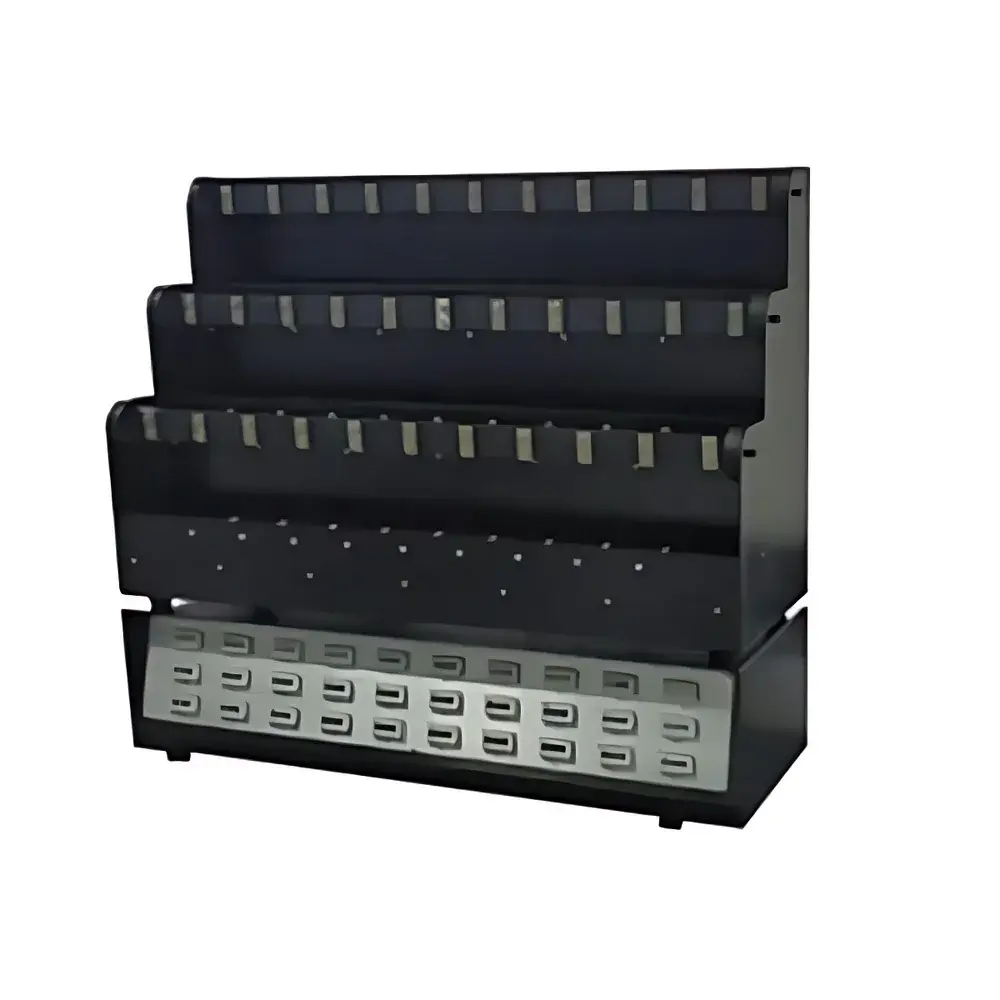
Multi-Angle Room-Temperature Holding Power Tester PW-SS20C
| Brand | PW (Yuelian) |
|---|---|
| Origin | Guangdong, China |
| Model | PW-SS20C |
| Test Stations | 20 |
| Test Angles | 90° and 180° (adjustable) |
| Timer Resolution | 0.1 min, Max Duration: 999999.9 min (battery-backed electronic LCD display) |
| Standard Weight | 1 kg (interchangeable weights available) |
| Substrate | 20 stainless steel plates (304, 50 × 50 × 0.5 mm, ASTM D3654-compliant surface finish) |
| Fixturing | 20 dual-pin connection clips with spring-damped drop prevention barrier |
| Frame Material | Powder-coated cold-rolled steel sheet |
| Vibration Isolation | Integrated helical compression springs (damping ratio ζ ≈ 0.25) |
| Dimensions (W×D×H) | 94 × 22 × 60 cm |
| Net Weight | 60 kg |
| Compliance | GB/T 2792–2014, GB/T 4851–2014, PSTC-7 (2020), CNS 11888 |
Overview
The PW-SS20C Multi-Angle Room-Temperature Holding Power Tester is an engineered mechanical testing system designed for quantitative evaluation of static adhesion performance under controlled ambient conditions. It operates on the principle of constant-load shear creep measurement: a standardized test specimen—typically a pressure-sensitive adhesive (PSA) tape, film, or protective laminate—is bonded to a conditioned stainless steel substrate and subjected to a vertically applied tensile load at precisely defined angular orientations (90° or 180°). The instrument records the time-to-failure (i.e., slippage exceeding 0.5 mm or complete detachment) or displacement accumulation over extended durations, enabling direct correlation between interfacial bond stability and real-world service life under sustained stress. Unlike dynamic peel or tack testers, the PW-SS20C isolates time-dependent viscoelastic relaxation behavior in the adhesive layer, making it essential for QC validation in medical device labeling, automotive trim bonding, and electronics masking applications where long-term static holding integrity is mission-critical.
Key Features
- 20 independent parallel test stations enable high-throughput screening with statistical repeatability per ISO 27827:2017 guidelines for multi-sample adhesion assessment.
- Angle-selective fixture mechanism allows rapid switching between 90° (T-peel analog) and 180° (pure shear) loading configurations without tooling—each station maintains ±0.3° angular tolerance per DIN 53321 calibration protocol.
- Electronically synchronized timer with non-volatile memory retains elapsed time data across power cycles; resolution of 0.1 minute supports compliance with USP and ASTM D3654-21 minimum reporting granularity.
- Spring-isolated base structure mitigates ambient floor vibration (tested per ISO 20486:2018), reducing measurement uncertainty from external perturbation by >65% compared to rigid-frame alternatives.
- Drop-prevention围栏 (perimeter guard rail) and dual-pin clip retention system ensure operator safety and specimen alignment integrity during unattended overnight tests.
- Modular weight set compatibility (1 kg standard; optional 0.5/2/5 kg calibrated masses traceable to NIM Certificate No. NM-2023-ADH-0887) enables force range extension while preserving lever-arm moment equilibrium.
Sample Compatibility & Compliance
The PW-SS20C accommodates specimens conforming to ASTM D3330 Type I (1-inch wide tapes), ISO 2922 (flexible laminates), and JIS Z 1522 (industrial labels). Substrate plates meet GB/T 2792–2014 surface roughness requirements (Ra ≤ 0.2 µm) and are passivated per ASTM A967 to prevent oxide-induced adhesion variability. All test protocols align with regulatory audit expectations: raw time-stamped logs are exportable in CSV format for GLP/GMP traceability; firmware versioning and user-access logs satisfy FDA 21 CFR Part 11 electronic record controls when paired with validated LIMS integration.
Software & Data Management
While the PW-SS20C operates as a standalone electromechanical system, its timer module outputs TTL-level serial signals (RS-232, 9600 baud) compatible with third-party DAQ platforms (e.g., LabVIEW™, MATLAB® Data Acquisition Toolbox). Time-to-failure values can be automatically ingested into statistical process control dashboards using configurable CSV templates. Audit trails—including operator ID, test angle, weight selection, and start/stop timestamps—are stored locally for ≥12 months and support manual export via USB-C interface. Firmware updates follow IEC 62304 Class B software lifecycle management standards.
Applications
- Quality conformance testing of medical transdermal patch adhesives per ISO 10993-10 biocompatibility requirements.
- Batch release verification for automotive interior trim tapes under SAE J2236 thermal cycling preconditioning (23°C ± 2°C, 50% RH).
- Accelerated aging correlation studies linking room-temperature hold time decay to Arrhenius-predicted shelf-life endpoints.
- R&D screening of acrylic vs. silicone PSA formulations for clean-removability performance on low-surface-energy substrates (e.g., PP, PETG).
- Supplier qualification against OEM specifications requiring ≥72-hour hold time at 1 kg load on 180° configuration.
FAQ
What standards does the PW-SS20C directly support?
GB/T 2792–2014, GB/T 4851–2014, PSTC-7 (2020), CNS 11888, and ASTM D3654-21.
Can test data be exported for regulatory submission?
Yes—time-stamped CSV files include test ID, angle, weight, station number, and failure time; metadata complies with ALCOA+ principles for FDA/EMA submissions.
Is calibration certification included?
NIST-traceable weight calibration certificate (1 kg) is provided; annual verification against ISO/IEC 17025-accredited labs is recommended.
What maintenance is required?
Biannual inspection of spring damping coefficients and clip wear; no lubrication needed—dry-operation design prevents particulate contamination.
Does the system support non-standard substrate materials?
Yes—custom plate fixtures (aluminum, glass, polymer) can be mounted using the standardized M4 threaded mounting pattern (100 mm pitch circle diameter).



