
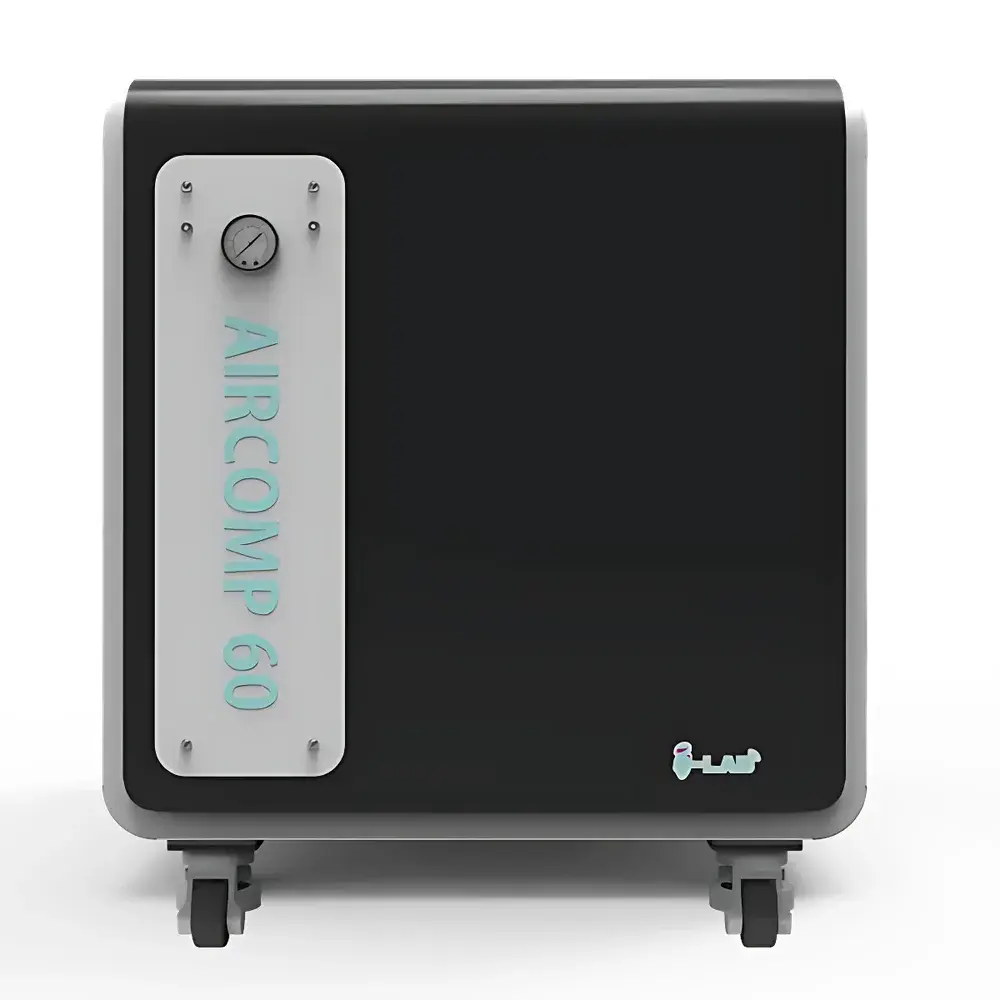
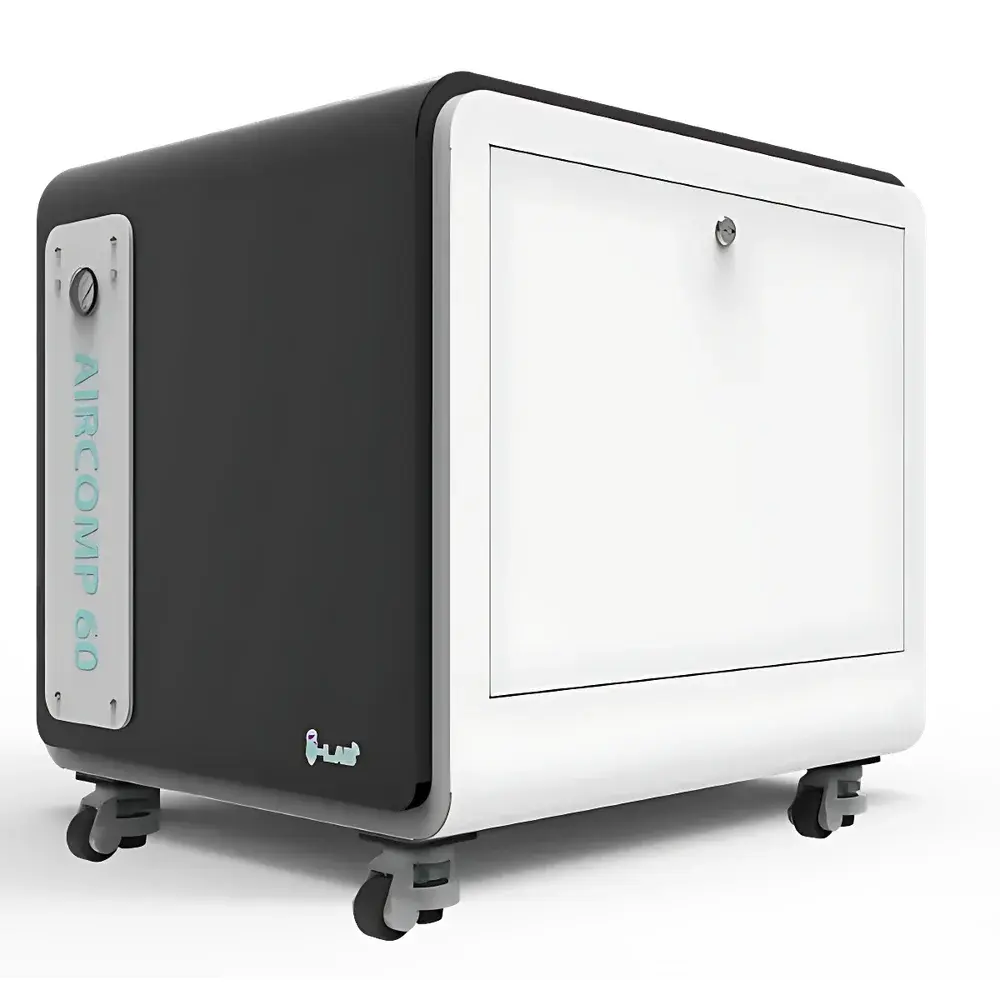
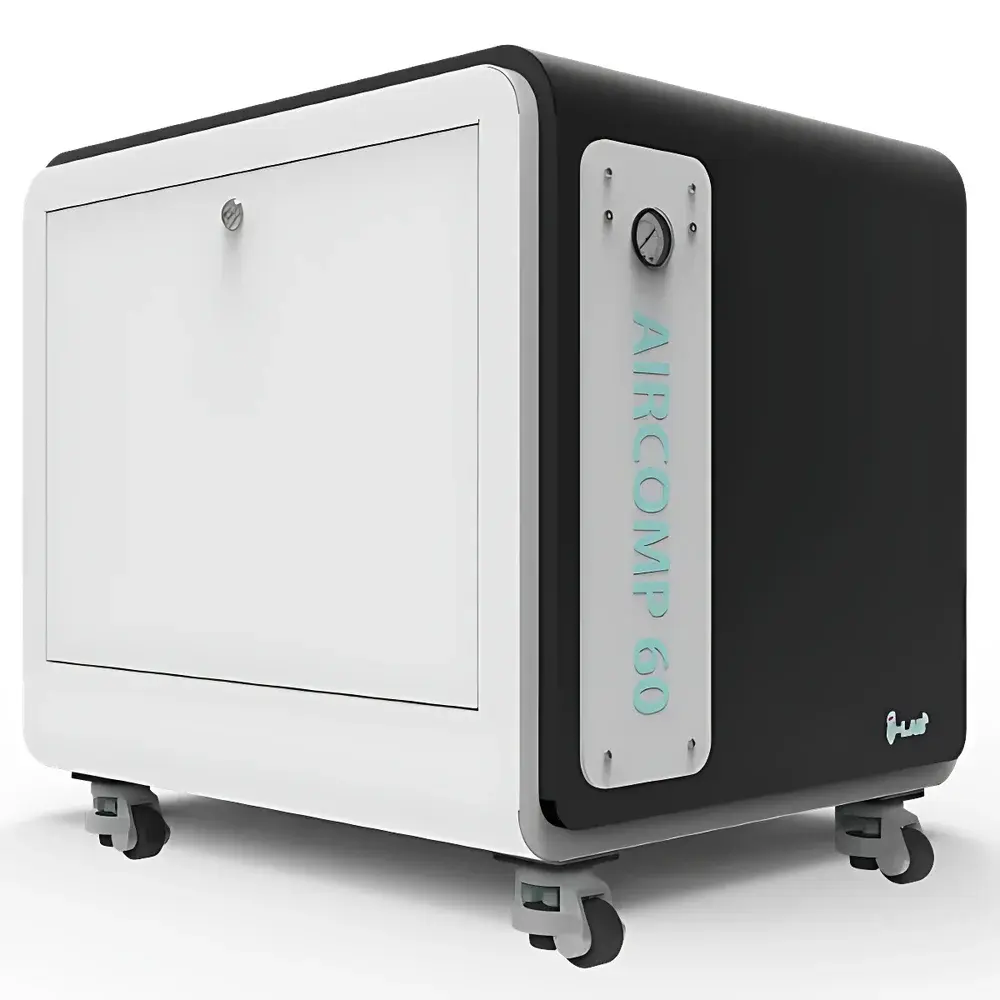
i-Lab AIRCOMP60 Air Generator
| Brand | i-Lab |
|---|---|
| Origin | Shanghai, China |
| Manufacturer Type | OEM Manufacturer |
| Region of Origin | Domestic (China) |
| Model | AIRCOMP60 |
| Pricing | Upon Request |
| Hydrocarbon Removal Principle | Pt-Pd Catalytic Cracking |
| Output Flow Rate | 60 L/min |
| Output Pressure Range | 0–7 bar |
| Total Hydrocarbon Content | < 0.1 ppm (as methane equivalent) |
| Dew Point | –20 °C |
Overview
The i-Lab AIRCOMP60 Air Generator is an integrated, oil-free laboratory-grade compressed air source engineered for high-sensitivity analytical instrumentation—including liquid chromatography–mass spectrometry (LC-MS), gas chromatography–time-of-flight mass spectrometry (GC-TOF), atomic absorption spectroscopy (AAS), and total organic carbon (TOC) analyzers. It employs a closed-loop purification architecture based on three sequential stages: coalescing filtration (particle removal), refrigerated/membrane-assisted drying (moisture control), and catalytic hydrocarbon abatement via Pt-Pd alloy catalysts operating at optimized thermal activation conditions. This multi-stage design ensures consistent delivery of ultra-pure compressed air meeting ISO 8573-1 Class 1.1.1 (solid particles ≤ 0.1 µm, dew point ≤ –20 °C, hydrocarbons < 0.1 ppm) — a specification aligned with the stringent inlet gas requirements of modern mass spectrometers and trace-level elemental analyzers.
Key Features
- Oil-free, brushless scroll-type air compressor with imported core components—ensuring silent operation (< 52 dB(A) at 1 m) and zero risk of oil contamination.
- Integrated triple-stage purification system: (1) pre-filter (3 µm particulate retention), (2) dual-mode dryer combining refrigerated cooling and selective permeation membrane technology, and (3) high-efficiency catalytic converter with Pt-Pd coated ceramic monolith for complete hydrocarbon decomposition into CO₂ and H₂O.
- Compact, benchtop-ready footprint (W × D × H ≈ 450 × 400 × 650 mm) designed for space-constrained labs and instrument cabinets.
- ECO-mode intelligent pressure regulation: automatic start-stop cycling triggered by downstream demand, reducing power consumption by up to 40% during intermittent usage patterns.
- Long-life consumables architecture—coalescing filter cartridges rated for ≥ 6,000 operating hours; catalytic bed service life ≥ 12 months under typical LC-MS duty cycles (24/7 operation at 40 L/min average flow).
- Modular service design enabling field-replaceable modules without system depressurization or calibration recalibration.
- Real-time status monitoring via front-panel LED indicators for pressure, dew point, filter saturation, and catalyst temperature.
Sample Compatibility & Compliance
The AIRCOMP60 delivers compressed air compatible with all major LC-MS platforms—including Thermo Fisher Scientific Orbitrap and Triple Quadrupole systems, Agilent 6400/6500 series, and Waters Xevo TQ-S micro—without requiring additional inline polishing filters. Its output meets ASTM D6304 (for moisture analysis in hydrocarbon streams), ISO 8573-1:2010 Class 1.1.1, and USP specifications for instrumental gas purity. The catalytic hydrocarbon removal stage complies with EN 14181 (ambient air quality monitoring standards) for residual VOC abatement validation. All internal wetted materials (stainless steel 316L, EPDM elastomers, alumina desiccant) are certified non-leaching and compatible with GLP/GMP environments subject to audit.
Software & Data Management
While the AIRCOMP60 operates as a standalone hardware unit, it supports optional RS-485 Modbus RTU interface for integration into centralized lab infrastructure management systems (LIMS or BMS). Event logs—including cumulative runtime, pressure transients, filter replacement timestamps, and catalyst thermal history—are stored in non-volatile memory and exportable via USB-C port in CSV format. Audit trail functionality satisfies FDA 21 CFR Part 11 requirements when deployed alongside validated electronic record systems, enabling full traceability of gas quality parameters across instrument qualification protocols (IQ/OQ/PQ).
Applications
- High-resolution mass spectrometry: Stable, low-hydrocarbon air supply for electrospray ionization (ESI) and atmospheric pressure chemical ionization (APCI) sources—minimizing background adduct formation and improving signal-to-noise ratios in trace quantitation.
- Multi-instrument central gas distribution: Parallel feeding of up to four LC-MS systems or hybrid GC/LC workstations via pressure-regulated manifolds with individual flow meters.
- Automated sample preparation: Reliable pneumatic actuation for nitrogen blow-down evaporators, solid-phase extraction (SPE) robotic platforms, and auto-samplers requiring precise, pulse-free airflow control.
- Industrial process support: On-site inerting and purging for pharmaceutical lyophilizers, food packaging lines (N₂-blanketed fillers), and reactor headspace displacement in fine chemical synthesis—all leveraging its adjustable 0–7 bar pressure range and stable 60 L/min capacity.
FAQ
Does the AIRCOMP60 require external cooling water or exhaust venting?
No. It is fully air-cooled and self-contained; no external utilities beyond standard 230 V AC / 50 Hz input are required.
Can it be used with ozone-sensitive instruments such as certain ICP-MS models?
Yes—the catalytic stage does not generate ozone; all oxidation reactions occur heterogeneously on the Pt-Pd surface below 200 °C, eliminating photochemical byproduct formation.
What is the recommended maintenance schedule for the catalytic module?
Under continuous LC-MS operation (≥ 50 L/min average), replace the catalyst cartridge every 12 months or after 8,760 operating hours—whichever occurs first—as verified by periodic hydrocarbon testing per ISO 8573-5 Annex B.
Is remote monitoring available via Ethernet or Wi-Fi?
Not natively; however, the RS-485 Modbus interface allows connection to third-party SCADA or building automation controllers for remote status polling and alarm relay outputs.
How does the dew point performance compare to traditional desiccant dryers?
Unlike regenerative desiccant systems that cycle between adsorption/desorption and exhibit dew point drift, the AIRCOMP60’s hybrid refrigerated-membrane design maintains a stable –20 °C dew point continuously, independent of ambient humidity fluctuations or load variations.



